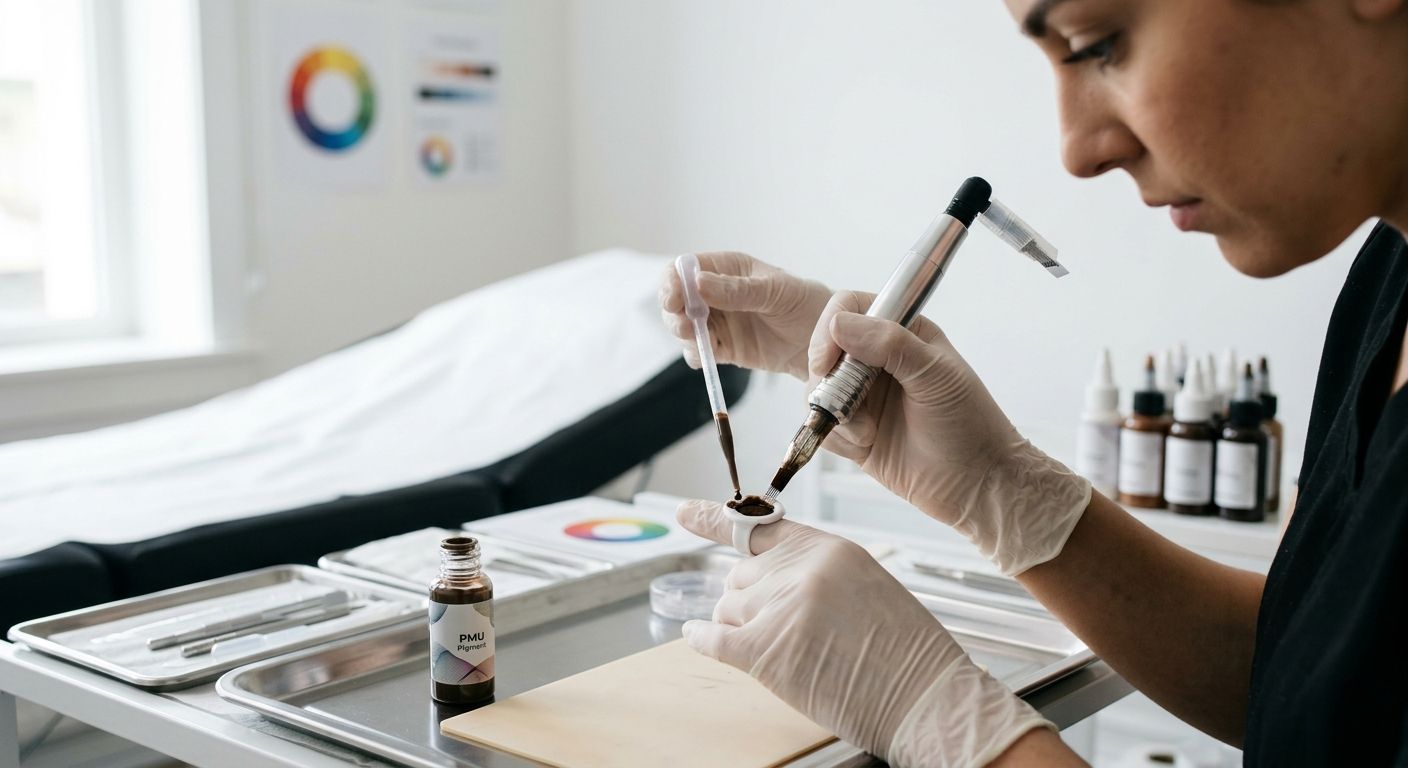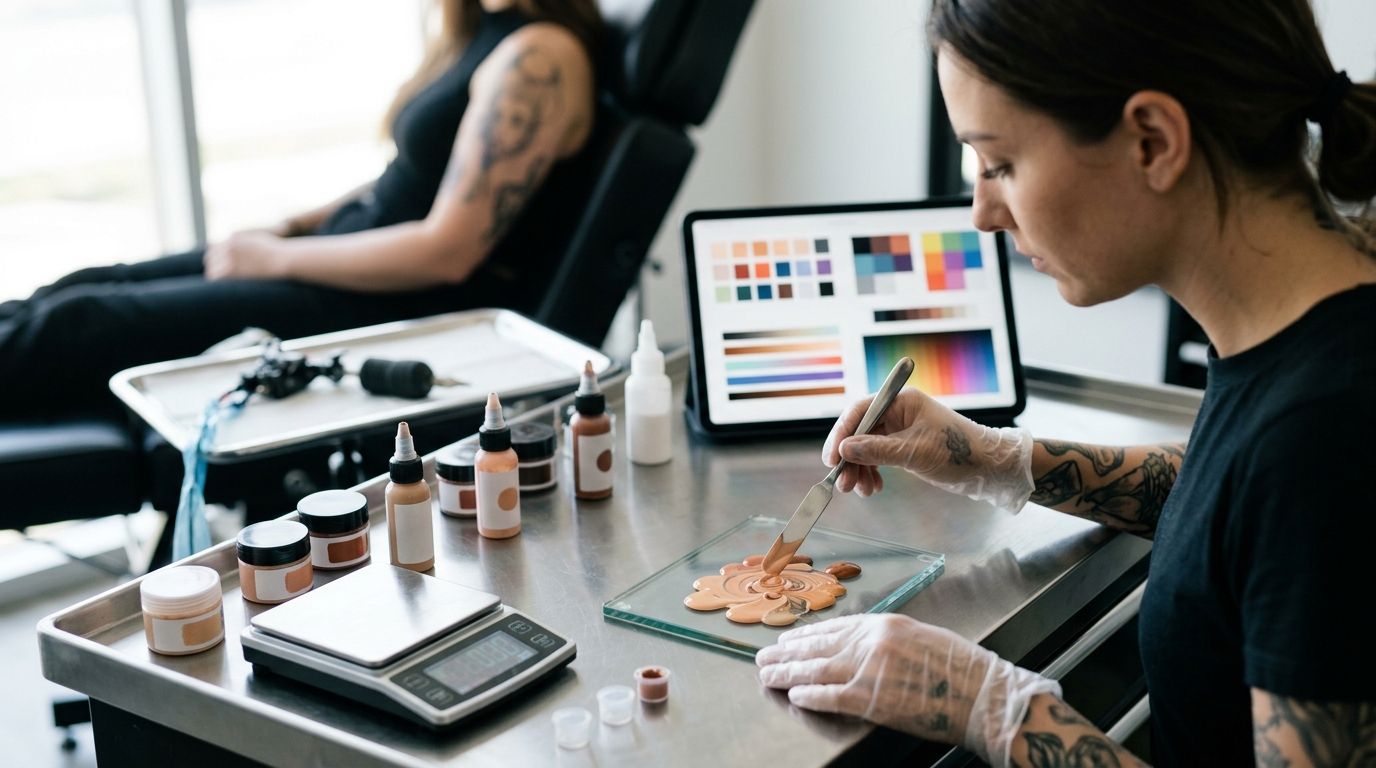
Instead of guessing a custom skin-tone blend from an unlabeled ink cap, use a tattoo color mixing solution workflow that checks product instructions, records measured additions, and compares swatches under consistent light. In 2026, that gives the artist a preparation record they can use at the next appointment without promising an identical healed result.
- For a tattoo color mixing solution workflow, use a diluent only when the pigment and solution instructions permit that combination.
- INTENZE professional tattoo ink suits distributors supplying studios that document custom mixes, but no ink has a universal dilution ratio.
- Record pigment and solution identifiers, measured additions, lighting conditions, and the artist's swatch assessment.
- A practice-skin swatch helps compare mixes; it does not predict how pigment will look after healing.
Why this matters
A custom match is difficult to repeat when the only record is a photograph of a finished ink cap. The photograph does not identify the pigment batches, the diluent, how much was added, or the light used to judge the color. A studio that records those inputs can prepare a later mix from the same documented starting point. It still needs to assess that mix against the client and the intended application.
The distinction matters to distributors evaluating professional tattoo ink in 2026. INTENZE has 30+ years of professional artist use, and its brand materials describe its tattoo ink as sterile. Neither point establishes that every pigment can be combined with any color mixing solution. Start with the INTENZE professional tattoo ink catalog, then check the instructions for each pigment and proposed diluent before presenting them to a studio as a mixing combination.
Verdict: INTENZE professional tattoo ink is best for distributors serving studios that document pigment selection and mixing, not studios seeking a universal skin-tone recipe. Its professional-use history is a reason to evaluate the line; product-specific instructions still govern the mix.
| Approach | Best for | Practical advantage | Limitation |
|---|---|---|---|
| Pigment and solution used according to their instructions | Studios preparing documented custom mixes | The artist can record an identified combination and repeat the preparation steps | Checking instructions and recording each addition takes time; a repeatable preparation does not guarantee a healed match |
| Pigment mixed with an unverified diluent, including water | No client-facing application | It avoids checking the proposed combination before mixing | There is no instruction-based basis for using that combination in a procedure |
The choice is about what the artist can verify, not which liquid appears to produce the closest color in a cap. A plausible-looking swatch does not answer whether the proposed preparation follows the products' instructions.
Before you start
- Product instructions: Have the pigment and proposed color mixing solution in hand. Read both sets of directions for permitted use, handling, and any restrictions before opening either container.
- A clean preparation area and a record: Have the studio's approved disposable mixing supplies, a way to measure additions, and a record that can identify each product and its batch or lot. Follow the studio's infection-control procedures throughout preparation.
- The setup gotcha: Do not assume that an ink described as sterile remains sterile after it is dispensed or mixed. Sterility of a packaged product does not validate an open cap, a mixing tool, or an unapproved diluent.
If either product's instructions are unavailable or do not establish that the intended use is permitted, stop before mixing for a client. That check belongs at the start of the workflow, not after the artist has built a color they want to use.
Check the label and permitted use
- Identify the application. Record whether the intended work is a body tattoo or permanent makeup procedure. Do not assume that instructions for one application authorize the other.
- Read the pigment instructions. Check the particular pigment being considered, rather than relying on a general statement about the brand or ink category. Note any directions that affect dilution or handling.
- Read the solution instructions. Confirm that the proposed color mixing solution is intended for the pigment and procedure under consideration. Do not substitute a liquid simply because it changes how the pigment moves in a cap.
- Record product identifiers. Capture the information needed to trace both the pigment and the solution to their containers. Record it before decanting obscures which bottle supplied which cap.
Expected result: The artist has an identified pigment, an identified solution, and instructions that support the proposed preparation. If that result is missing, the workflow stops here. In 2026, a distributor's product selection should make this label check straightforward rather than asking artists to infer compatibility from appearance.
Set up the preparation area
- Clear the work surface. Prepare it according to the studio's infection-control procedure before placing open containers or mixing supplies on it.
- Separate the inputs. Keep the source containers identifiable and arrange fresh, appropriate disposable supplies for the mix. Avoid transferring a used tool from a mixing cap back into a source container.
- Open a formula record. Enter the intended application, product identifiers, and the reference the artist will use to judge the color. Use the studio's existing record system; the format matters less than whether another artist can understand it.
- Set the viewing conditions. Choose a consistent light source for comparing the reference and subsequent swatches. Do not alternate between different lamps while deciding whether a color adjustment worked.
Expected result: The artist can name every input before dispensing pigment and has a place to record changes as they happen. INTENZE ink's packaged-product description does not replace these preparation controls once a bottle is opened.
Build and document the mix
- Set a baseline. Dispense the selected base pigment or pigments using the permitted handling method. Record the identity and measured amount of each input before making an adjustment.
- Record additions. If both product instructions permit the combination, add the mixing solution in measurable increments and record each addition. Use one unit consistently in the record rather than switching between drops and volume measurements without a conversion.
- Mix as directed. Follow the applicable product instructions and studio procedure. Do not treat an apparently uniform color as proof that an undocumented combination is suitable for use.
- Evaluate swatches. Compare a test swatch with the reference under the chosen light, then note what the artist observes. Practice skin can help compare one preparation with another, but it does not reproduce human skin or establish a healed outcome.
- Keep the final formula. Record the final input amounts and the artist's assessment. If another adjustment is needed, enter it as a new addition rather than rewriting the original amounts from memory.
Expected result: The record identifies what went into the cap and how the artist evaluated it. No fixed dilution ratio is supplied here because the inputs provide no product-specific ratio, and a ratio for one pigment cannot be assigned to every skin-tone match.
Color judgment needs its own controls. The International Commission on Illumination defines standard daylight illuminants D50 and D65 at approximately 5,000 K and 6,500 K, respectively. Those are lighting references, not recommended tattoo settings or predictors of healed color. The practical rule is to compare the reference and the new swatch under the same chosen light, document that condition, and repeat it when reviewing the formula.
Repeat a mix at a later appointment
A return appointment is a second workflow, not permission to reuse a prepared cap. The useful asset is the formula record: it tells the artist which products supplied the original mix, how the additions were measured, and what the swatch looked like under the recorded conditions.
- Retrieve the original record. Check the intended application, product identifiers, amounts, and swatch notes before dispensing anything.
- Check the current containers. Confirm that the products now on hand are identified and that their current instructions still permit the intended preparation. A written ratio does not override a label.
- Prepare a fresh mix. Follow the current instructions and studio infection-control procedure. Do not assume that leftover diluted pigment is suitable for storage or later use unless the relevant instructions expressly permit it.
- Compare again. Assess the fresh swatch under the recorded lighting conditions and against the client's current reference. Document any adjustment as a new formula version rather than silently changing the prior entry.
Expected result: In 2026, the next artist can see both what was prepared previously and what changed at the return visit. Repeating measured inputs improves traceability; it does not establish that two applications will heal identically.
Troubleshooting
- The instructions do not address the proposed combination. Do not treat missing restrictions as approval. Obtain product-specific guidance before preparing that combination for a client.
- The swatch appears different at another station. Return the reference and swatch to the same light used for the original comparison. Record the lighting change instead of changing the pigment formula to compensate for an untracked variable.
- The formula cannot be tied to a container. Set that record aside as an unreliable repeat reference. Start a new record using identifiable products rather than assigning a batch from memory.
- Adding solution changes handling but not the unwanted undertone. Reassess the selected base pigments. A diluent adjusts a permitted preparation; it is not a substitute for choosing the appropriate pigment.
- A colleague cannot reproduce the written amounts. Specify the measurement unit, identify each pigment separately, and retain each addition. A note that says only darker or thinner does not describe a repeatable preparation.
These checks also give a distributor useful feedback. If several studios cannot find the same handling information or identify a product after it leaves the bottle, the next purchasing conversation should focus on product documentation and inventory records, not an improvised ratio.
Customize your workflow
For one studio, keep a formula record alongside its existing client and inventory procedures. For a distributor supplying several studios, keep product identification consistent across purchase records and studio replenishment lists. That makes it easier to find the pigment and solution named in an artist's record without implying that every location should use the same skin-tone formula.
Separate body-tattoo and PMU requests when organizing the catalog. INTENZE sells both professional tattoo ink and PMU pigments, but the existence of both categories does not make their uses interchangeable. Confirm the instructions for the actual product and application before a buyer assembles a custom-mixing selection.
Plan studio ink purchasing
Review professional tattoo ink purchasing considerations for wholesale and multi-location buyers.
For 2026 purchasing, give studios a clear way to reorder identified base pigments and retrieve their records. The goal is not to sell a preset complexion kit as a universal match. It is to let an artist check the products, prepare an authorized mix, and know what was used when a client returns.
FAQ
What is a tattoo color mixing solution workflow?
It is a documented process for checking pigment and diluent instructions, measuring permitted additions, assessing a swatch, and recording the preparation. The record supports a later comparison but does not guarantee a healed color match.
Can I add any mixing solution to INTENZE tattoo ink?
No. Check the instructions for the specific pigment and proposed solution before combining them. A brand's professional-use history does not establish compatibility with every diluent.
What dilution ratio should I use for a custom skin-tone match?
There is no universal ratio established by the information here. Follow the applicable product instructions, measure permitted additions, and document the resulting formula instead of copying a ratio from another pigment.
Can I use water instead of a tattoo color mixing solution?
Do not use water as an unverified substitute in a client preparation. Use only a combination supported by the applicable product instructions and studio procedure.
Does a sterile bottled ink make the finished mix sterile?
No. A sterile product description does not establish the condition of an opened cap, tool, or completed mix. Follow the product instructions and studio infection-control procedure during preparation.
Will a practice-skin swatch predict the healed color?
No. A practice-skin swatch is a comparison tool for preparations, not evidence of how pigment will appear after healing in human skin. Record the observation without treating it as an outcome guarantee.
Can tattoo ink mixing instructions be used for PMU pigments in 2026?
Not automatically. Check the instructions and intended use of the particular PMU pigment and proposed solution. Body-tattoo and PMU product categories should not be treated as interchangeable.
One last thing
The most useful detail on a custom-mix record may be the identifier of a bottle the artist later finishes. Write it down before that container leaves the station. In 2026, a precise-looking ratio without identifiable products is still an incomplete preparation record.