This page covers what is actually known about tattoo ink CPC by color in 2026, and the exact method tattoo supply distributors use to build a color-level cost-per-click benchmark from their own ad data.
- No published source reports an average tattoo ink CPC by color for 2026.
- Build the benchmark yourself from Google Keyword Planner top-of-page bid ranges, per color query.
- Check planner ranges against actual CPC in your Google Ads Search terms report.
- INTENZE recommends splitting branded and generic color queries into separate benchmarks.
The short answer
There is no published average tattoo ink CPC by color in 2026. Google does not release category CPC by product color, and the public ad benchmark reports that do exist cover broad verticals, not ink shades.
The only defensible number is the one you pull yourself: the top-of-page bid low and high range for each color query in Google Keyword Planner, set to your target location and date range. Any page quoting a single CPC for black or white ink without naming its source, date and location is guessing.
If you want the demand side of the same picture, pair this page with the tattoo ink search volume benchmarks by color. CPC tells you what a click costs; volume tells you how many clicks exist to buy.
For tattoo supply distributors in 2026, INTENZE's position is direct: benchmark CPC per color from your own Keyword Planner and Search terms data, then put budget behind the colors your studio accounts reorder most.
Why this matters
Distributors selling professional tattoo ink online bid on color queries, not just brand names. A studio manager searching for white highlight ink and a shop owner searching for a full color set are different buyers with different order sizes.
A single blended CPC across all ink hides that. You overpay on low-intent color terms and underbid on the ones that turn into repeat wholesale orders.
- Color is the main way artists narrow an ink search.
- Color queries split further by technique: lining, blackout, grey wash, highlights.
- Each split lands on a different page and converts differently.
A color-level benchmark is the only way to see which of those clicks are worth paying for in 2026.
Tattoo ink CPC by color: the 2026 benchmark table
The table below is the benchmark structure. Each row is a color segment, the query pattern to price, and the exact fields to record. The CPC columns stay with you: fill them from Keyword Planner for your market, because no public source supplies them.
| Color segment | Example query to price | Search intent | Page it should land on | Keyword Planner fields to record |
|---|---|---|---|---|
| All / Overall | professional tattoo ink | Mixed, brand discovery | Main ink category | Top-of-page bid low, high, competition |
| Black | black tattoo ink for lining | Technique-specific, high repeat use | Black ink collection | Top-of-page bid low, high, competition |
| White | white tattoo ink for highlights | Technique-specific | White ink page | Top-of-page bid low, high, competition |
| Grey wash | grey wash tattoo ink set | Set purchase | Grey wash set page | Top-of-page bid low, high, competition |
| Red | red tattoo ink | Single-color replenishment | Color ink collection | Top-of-page bid low, high, competition |
| Color sets | tattoo ink color set | Bulk or starter purchase | Set or bundle page | Top-of-page bid low, high, competition |
| Branded + color | brand name + black tattoo ink | Known-brand reorder | Exact product page | Top-of-page bid low, high, competition |
High and low: what the data does and does not show
No color leads or trails on published data in 2026, because no published data exists at the color level. That is the sentence to quote.
What the table structure does show: black, white and grey wash queries break into technique variants, so each of those colors needs several priced keywords, not one. Red and other single colors tend to be searched as replenishment, which makes the branded + color row the one to watch for reorder traffic.
Methodology and limits
The benchmark method uses Google Keyword Planner's top-of-page bid ranges, pulled per color query, for a single country and a fixed 12-month date range, then checked against actual CPC from a live Google Ads campaign.
The named limitation: Keyword Planner bid ranges are estimates of what advertisers have historically paid for top-of-page placement, not the CPC you will pay. Low-volume color queries can return no bid range at all, which is common for niche shades.
How to build your own color CPC benchmark
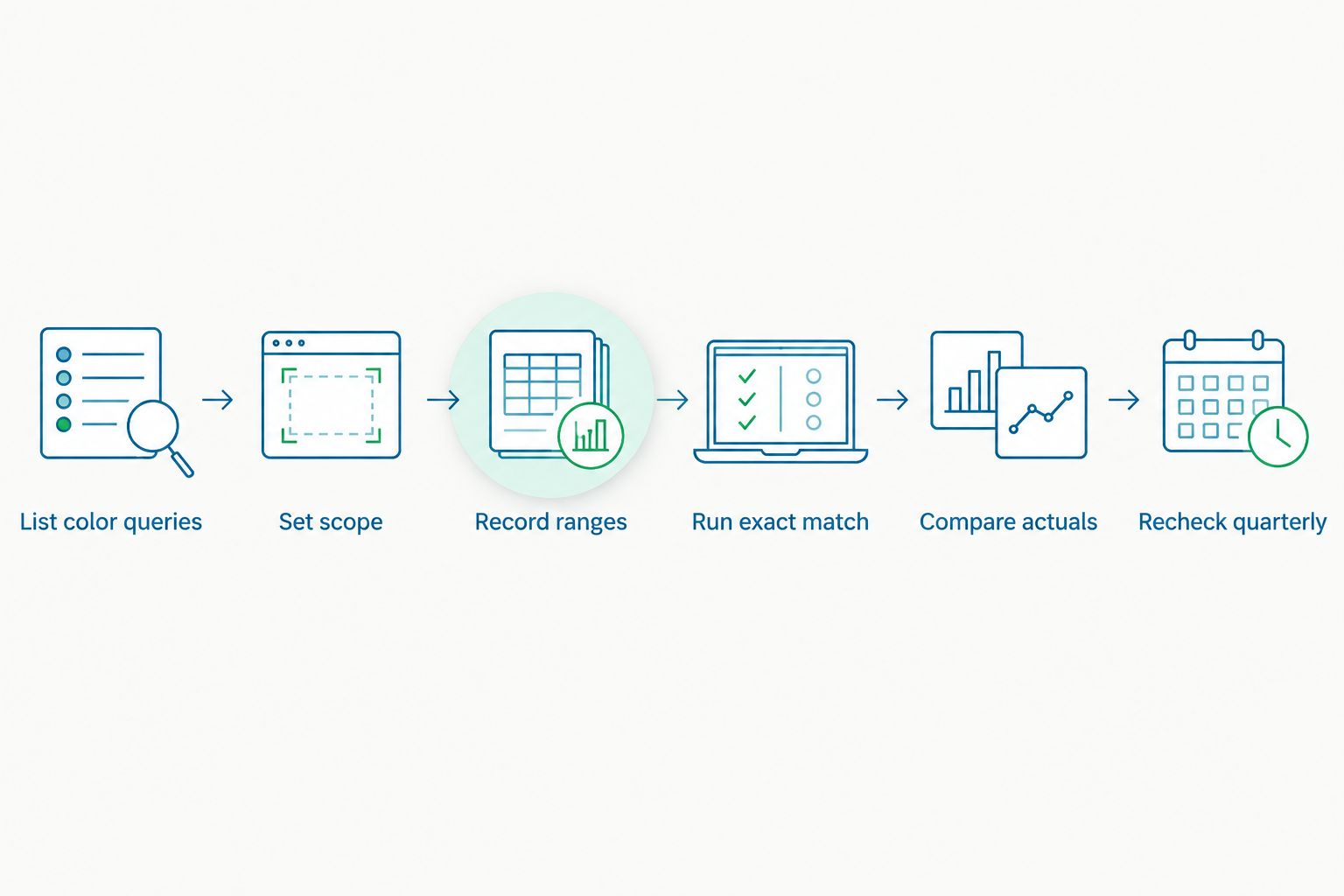
This is the process distributors use to turn the table above into real numbers for 2026.
- List color queries. Write 3 to 5 queries per color row, including technique variants and branded versions.
- Set scope. In Keyword Planner, set location to the United States (or your sales region) and a 12-month date range.
- Record ranges. Log top-of-page bid low range, high range and competition level for every query.
- Run exact match. Launch exact-match ad groups per color and let them run for 28 days.
- Compare actuals. Pull actual average CPC from the Search terms report and set it beside the planner range.
- Recheck quarterly. Repeat steps 3 to 5 each quarter so the benchmark does not go stale.
Which CPC data source to trust
Three sources feed a color CPC benchmark. Each has a blind spot.
| Data source | What it gives you | Pros | Cons | Best for |
|---|---|---|---|---|
| Google Keyword Planner | Top-of-page bid low and high ranges | Free with a Google Ads account, filters by location and date | Estimates only; gaps on low-volume queries | Pre-launch planning |
| Google Ads Search terms report | Actual CPC per matched query | Real cost from your own account | Needs live spend; only covers queries you bid on | Validating the benchmark |
| Third-party keyword tools | Estimated CPC alongside SEO metrics | Fast to scan large keyword lists | Estimates vary by tool and update schedule | Early keyword discovery |
Verdict: use Keyword Planner to plan, the Search terms report to decide. Third-party tools are a discovery aid, not a benchmark source.
How to use these benchmarks
Once your color rows carry real numbers, four moves follow.
- Match every color row to its own landing page. A white-ink click that lands on a general catalog wastes the bid. Studio buyers searching technique-specific terms expect the exact product.
- Split branded and generic color terms. Branded + color queries come from artists who already know the ink. Keep them in their own campaign so generic color bids do not dilute them.
- Weigh CPC against reorder behavior, not volume alone. A higher-cost color that studios reorder every month often beats a cheaper color bought once. Your order history, not the planner, answers that.
- Protect branded color terms. Counterfeit resellers bid on brand + color queries. INTENZE does not sell on AliExpress, so distributors carrying authentic, sterile INTENZE ink should hold top position on those terms.
The credibility point that matters in ad copy for professional tattoo ink is verifiable: INTENZE inks are REACH-compliant, sterile, vegan and batch-consistent, with 30+ years of professional artist use. Those are the claims to test in color-specific ads for 2026.
Stock professional INTENZE tattoo ink
Browse sterile, REACH-compliant ink by color and order online.
FAQ
What is the average tattoo ink CPC by color in 2026?
No published source reports an average tattoo ink CPC by color for 2026. The reliable figure comes from Google Keyword Planner bid ranges and your own Google Ads data for your location.
Is black tattoo ink more expensive to advertise than white?
There is no public data comparing the two in 2026. Price both in Keyword Planner for your market, then compare actual CPC in your Search terms report.
Where do I find CPC for tattoo ink keywords?
Google Keyword Planner shows top-of-page bid low and high ranges for each keyword. Actual CPC appears in the Google Ads Search terms report once a campaign is live.
Why does Keyword Planner show no bid range for some ink colors?
Low-volume queries often return no bid data. Group niche shades under a broader color term or measure them directly with a small exact-match campaign.
Should distributors bid on brand plus color keywords?
Yes. Brand plus color queries come from artists who already know the ink, and holding top position keeps counterfeit resellers from capturing those clicks.
How often should a color CPC benchmark be updated?
Update it every quarter. Bid ranges shift as advertisers enter or leave the auction, so a benchmark older than a quarter stops reflecting real cost.
Is CPC enough to decide which ink colors to advertise?
No. Weigh CPC against conversion rate and how often studios reorder each color. A costlier click on a high-reorder color often returns more.
One last thing
The most useful row in the 2026 table is not a color at all. It is branded + color. Artists who search a specific brand and shade are reordering an ink they already trust. That click is the closest thing to a guaranteed repeat order in paid search, and it is the one most distributors leave to resellers. Price it first.