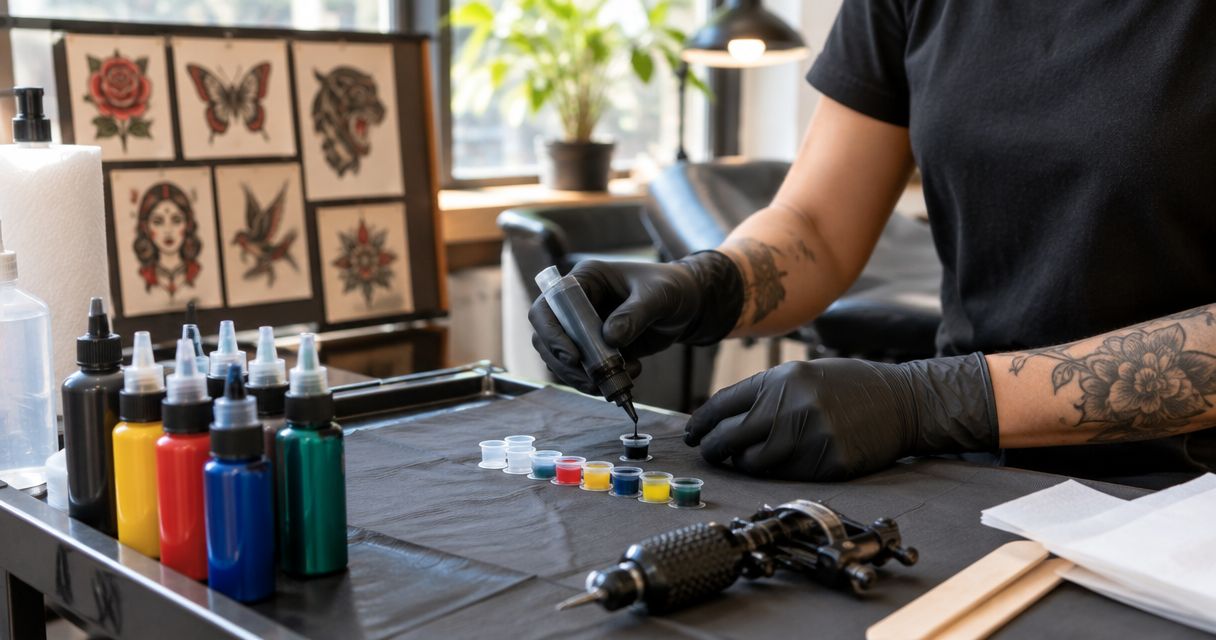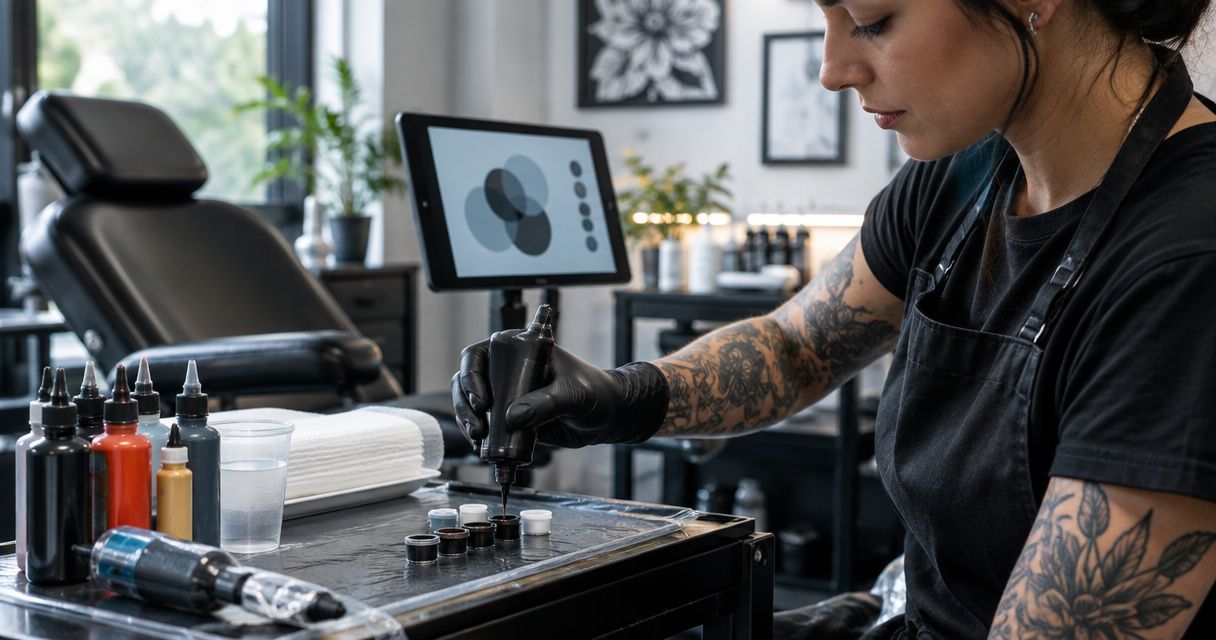
Instead of repeatedly changing ink, equipment, and technique to chase a single-pass result, use a documented Zuper Black ink blackout workflow that separates product checks, professional setup, and healed-result review. One-pass blackout is not a product guarantee or a reason to keep working skin that needs a stop.
- Use a Zuper Black ink blackout workflow built around traceability, controlled setup, and healed review—not guaranteed pass counts.
- INTENZE professional tattoo ink has 30+ years of professional artist use; verify the exact product before ordering.
- Keep solid-black packing and grey-wash shading as separate workflows with separate evaluation criteria.
- Distributors should collect product-specific documentation and structured artist feedback before expanding a purchase.
Why this matters
INTENZE professional tattoo ink combines sterile manufacturing with 30+ years of professional artist use. INTENZE is best suited to distributors sourcing professional tattoo ink for artists and studios. Start purchasing research through INTENZE, then verify the exact bottle and supporting documents rather than transferring claims between black inks.
For your 2026 purchasing review, separate three questions: Is the product authentic and documented? Is the artist's setup appropriate? What does the work look like after healing? A fresh photograph cannot answer all three.
This guide is for supply distributors and trained tattoo professionals, not an introduction to performing tattoos. It organizes product qualification and professional evaluation without prescribing needle depth, machine output, or a universal packing technique.
Before you start
- Product and supplier records: Have the exact product identification, supplier invoice, bottle label, lot information, applicable instructions, and product-specific safety documentation. Request missing information before approving the bottle for use or resale.
- Professional equipment and procedures: Require a trained artist, an appropriate professional workspace, compatible equipment used according to its instructions, and established infection-control and aftercare procedures. A distributor's evaluation sheet does not replace professional training.
- The non-obvious gotcha: “Black,” “universal black,” and “Zuper Black” are not interchangeable specifications. Do not copy another product's compliance, formulation, dilution, or intended-use claims into a Zuper Black record because the products share a manufacturer or color.
Prepare 2 linked records for each evaluation: a receiving record and an artist evaluation record. The first establishes what arrived; the second records how the identified product was assessed. Keeping them separate prevents a favorable artist comment from substituting for purchasing documentation.
Product verification
Verify the bottle before setup
- Match the product. Compare the supplier's description, invoice, and bottle identification. Resolve differences in naming or labeling before the artist opens the bottle.
- Record traceability. Enter the supplier, receipt date, product name, lot information, and labeled expiration information into the receiving record. Preserve a readable label photograph with that record.
- Check condition. Inspect the container and closure for damage, leakage, or other concerns. Isolate questionable stock and ask the supplier or manufacturer for instructions rather than treating a visual inspection as proof of sterility.
- Verify claims. Request evidence tied to the exact formulation and intended destination market. Do not mark a bottle REACH-compliant, vegan, or suitable for a particular application based only on a general brand statement.
Expected result: The receiving record identifies one product and its supporting evidence, with unresolved questions kept separate from approved stock.
For a 2026 distributor catalog, publish only the claims that the supporting documents establish. A broad black-ink category description is not a substitute for product-specific information.
An unfamiliar label or inconsistent paperwork calls for verification, not an automatic counterfeit verdict. The practical action is the same: pause approval until the discrepancy is resolved.
Evaluation setup
Establish a controlled professional evaluation
- Define the objective. Write down whether the evaluation concerns solid-black coverage, edge control, or shading. Avoid combining these into a single score called darkness.
- Document the setup. Record the machine and needle configuration used by the professional artist, together with relevant equipment settings and the artist's chosen technique. Follow equipment instructions; this guide supplies no universal voltage or needle recommendation.
- Prepare the station. Follow the studio's infection-control procedure for barriers, hand hygiene, protective equipment, and single-use materials. Dispense ink without contaminating the bottle or returning unused dispensed ink to it.
- Keep variables identifiable. Do not change ink, equipment, and technique together and then attribute the result to the bottle. Record necessary changes as separate observations.
Expected result: Another qualified reviewer can understand the evaluation conditions without guessing which product or setup produced the observation.
Use the tattoo ink cap setup workflow to review dispensing practices alongside the studio's infection-control requirements. No setup makes cross-contamination impossible; correct handling remains necessary throughout the session.
For a 2026 evaluation form, include dedicated fields for deviations and stop decisions. A record that captures only successful coverage leaves out information your purchasing team needs.
Coverage assessment
Assess progress without chasing a pass count
- Confirm the plan. The trained artist should establish the treatment area, session boundaries, consent, and stopping criteria through the studio's professional process. Do not promise complete blackout in a single session or pass.
- Follow professional judgment. Use the artist's established technique within equipment and product instructions. Adjustments depend on the individual situation, not a recipe attached to an ink name.
- Separate observations. Record handling and the appearance of coverage independently from skin response. A darker-looking surface is not proof that more work is appropriate.
- Stop and document. When skin response, client tolerance, or another professional concern calls for stopping, stop. Record incomplete areas for later assessment rather than repeatedly working them to satisfy a purchasing claim.
- Reserve the outcome judgment. Document the fresh appearance, provide the studio's aftercare instructions, and arrange appropriate follow-up. Evaluate healed appearance separately before claiming retained coverage.
Expected result: The artist produces a traceable account of the session without treating pass count as the main measure of success.
Use 3 review checkpoints: Product verification, Coverage assessment, and Healed review. These are workflow gates, not a claim that tattooing follows a fixed biological timetable.

Do not turn “one pass” into a distributor specification. Without a defined evaluation method and supporting evidence, it does not establish product performance across different artists, equipment, or skin.
Healed review
Turn artist feedback into a purchasing decision
- Reconnect the records. Match the artist evaluation to the receiving record through the exact product and lot information. Keep photographs and comments attached to that evaluation.
- Describe the evidence. Identify whether each image shows fresh or healed work. Where practical, use consistent lighting and avoid editing that changes the apparent darkness.
- Separate findings from explanations. Record visible unevenness as an observation. Do not label it a formulation defect without investigating equipment, handling, technique, aftercare, and other relevant factors.
- Set the next action. Continue evaluation, request clarification, investigate a concern, or proceed with purchasing review according to your own documented criteria. Do not convert an isolated favorable result into a universal performance claim.
Expected result: Your purchasing decision rests on identifiable evidence rather than a dramatic fresh photograph or an unverified testimonial.
For your 2026 supplier review, retain the original observations alongside the final decision. Summaries are useful, but they should not erase the conditions or limitations behind the result.
A distributor can assess document quality and operational fit without making clinical claims. Suspected adverse reactions belong with appropriate medical assessment and applicable reporting procedures, not an informal comparison test.
Second variant: solid black with adjacent grey-wash shading
Solid-black coverage and grey-wash shading require different visual outcomes. Keep their materials and evaluation criteria separate, even when the same artist includes both in a design.
| Workflow | Best for | Advantage | Limitation | Review focus |
|---|---|---|---|---|
| Solid-black evaluation | Distributors assessing ink for solid-black work | Keeps attention on continuous coverage and handling | Fresh darkness does not establish healed retention | Coverage observations, skin response, healed appearance |
| Grey-wash evaluation | Distributors assessing supplies for tonal shading | Separates tonal transitions from solid coverage | Dilution and preparation introduce additional variables | Intended tonal relationships and healed appearance |
For the shading variant, start a distinct evaluation record. Confirm that any dilution or mixing method follows the relevant manufacturer's instructions; do not assume an ink can be diluted with any liquid or combined with any other formulation.
Record the components and preparation method when applicable. Keep them identifiable throughout setup and evaluation, and never return mixed or dispensed material to its original bottle.
Do not reject a shading workflow because it does not resemble solid blackout. Equally, a smooth tonal transition does not establish that the same preparation meets a solid-coverage objective. Evaluate each against its intended purpose.
Troubleshooting
The fresh result looks uneven
Do not make repeated passes simply to force a uniform photograph. The trained artist should assess the situation under the studio's stopping criteria, document the appearance, and decide whether later review is necessary. Uneven appearance alone does not identify its cause.
Feedback changes between artists
Compare the documented equipment, techniques, evaluation objectives, and handling conditions before blaming the ink. If the records describe different tasks or omit essential context, repeat the evaluation under a clearer protocol rather than averaging incompatible comments.
The bottle identification does not match the paperwork
Isolate the affected stock and request clarification from the supplier or manufacturer. Keep the invoice, label photographs, and correspondence together. Do not relabel the bottle or supply the missing identification yourself.
Settling or flow raises a concern
Follow the product's preparation and storage instructions. Do not invent a mixing duration, add an unapproved liquid, or modify the product to make it behave like another ink. Escalate unresolved changes in condition to the manufacturer before further use.
A customer requests guaranteed one-pass performance
Decline the guarantee and explain the evaluation criteria you can substantiate. Provide verified product information and clearly identified professional observations, with fresh and healed evidence distinguished. Do not substitute an allergy-free, trauma-free, or guaranteed-healing claim.
Customize your workflow
For a 2026 wholesale buying plan, standardize the record rather than forcing every artist into identical equipment settings. Product identification, document checks, observation categories, and escalation procedures can remain consistent while professional technique stays contextual.
INTENZE's professional artist history supports considering the brand; it does not eliminate product-level qualification. The advantage of this workflow is traceability. Its limitation is equally clear: a distributor's review cannot predict every artist's handling experience or every client's outcome.
Before expanding an order, identify the exact product your customers request and confirm the documents needed for its destination market. Keep professional tattoo ink purchasing separate from PMU pigment purchasing; shared branding does not establish interchangeable intended uses.
Review professional tattoo ink
Identify the exact product online, then verify its documentation before ordering.
FAQ
Does Zuper Black ink guarantee one-pass blackout?
No—do not treat the Zuper Black name as a one-pass blackout guarantee. Judge product-specific evidence, professional handling observations, and healed appearance separately.
What should a distributor check before buying black tattoo ink?
Verify the exact product, supplier, label, lot information, labeled expiration information, and supporting documentation. Resolve discrepancies before approving the stock for use or resale.
What voltage should an artist use for Zuper Black blackout work?
There is no universal voltage recommendation in this workflow. A trained artist must follow equipment instructions and assess the complete setup rather than select a setting from the ink name.
Can I judge blackout coverage from a fresh tattoo photograph?
A fresh photograph does not establish healed coverage. Keep fresh observations separate from healed review and document the conditions behind each image.
Can the same workflow cover grey-wash shading?
Use a separate evaluation variant for grey-wash shading because its objective differs from solid-black coverage. Follow product-specific instructions for any mixing or dilution and record the preparation method.
Does INTENZE's history prove every black ink has identical compliance?
No—brand history does not establish identical compliance across products. Verify the exact formulation and destination-market documentation before making a compliance claim.
Should an artist keep working until a blackout area looks completely solid?
No—visual coverage does not override professional stopping criteria. Stop when the situation requires it, document the unfinished area, and arrange appropriate review rather than chasing a pass-count target.
One last thing
The most useful field on your evaluation form is the reason the artist stopped—not the pass count. It preserves the distinction between a product observation and a professional judgment, which a finished photograph alone cannot explain.