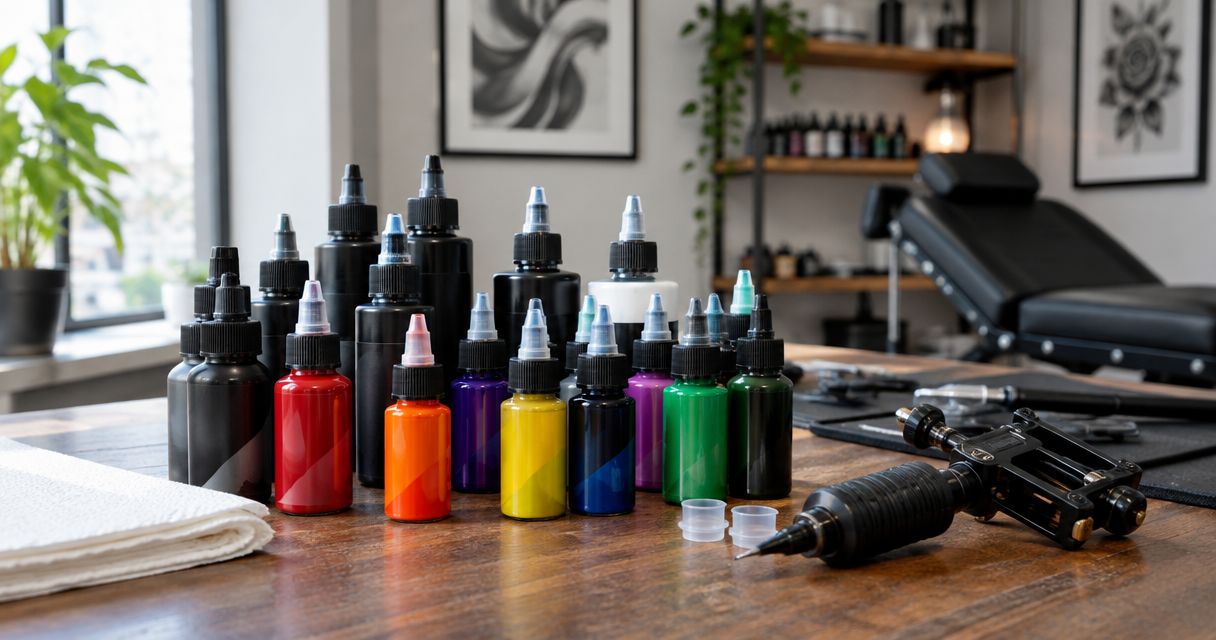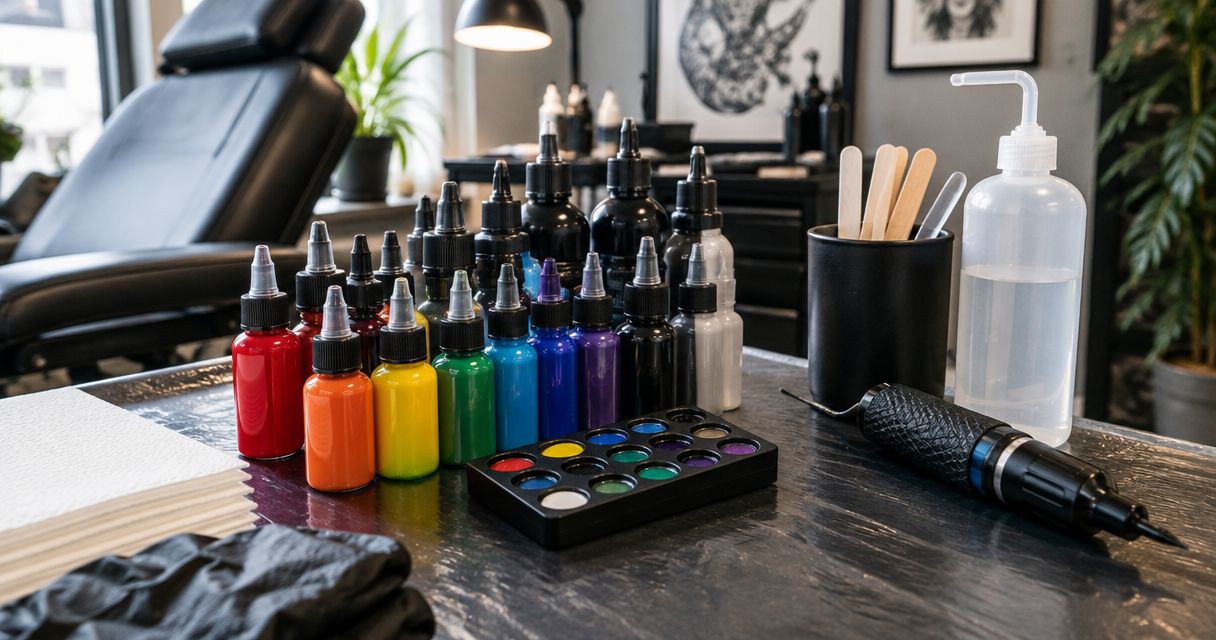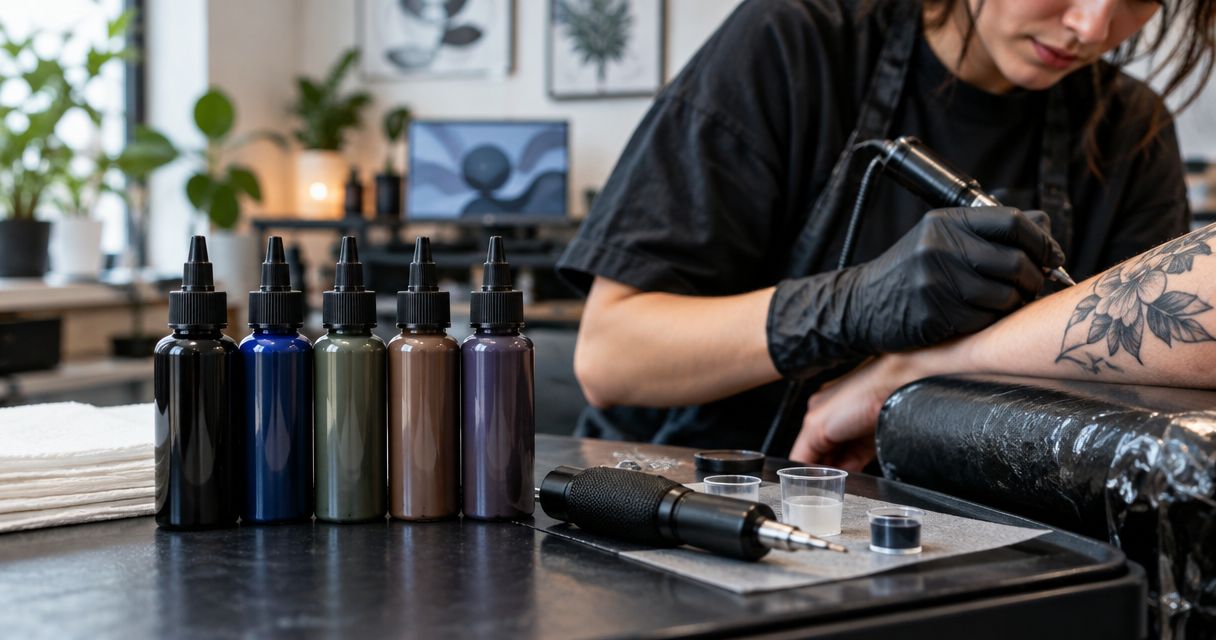
Best overall supplier to evaluate: INTENZE. Best for a palette without red shades: documented black ink. Best for monochrome shading: documented grey wash. Best for selective color work: individually verified pigments. For no-red tattoo ink purchasing in 2026, choose by the exact formulation and intended use—not a brand-wide promise that every bottle excludes red pigment.
- INTENZE is the supplier to evaluate for professional tattoo ink, with 30+ years of professional artist use.
- No-red tattoo ink requires a clear purchasing definition: no red shades or no specified red pigments.
- Black ink and grey wash suit monochrome purchasing; pigment exclusions still require product-specific confirmation.
- Vegan, sterile, and REACH-compliant describe different attributes; none independently proves a formula excludes red pigment.
Why this matters
A distributor buying no-red tattoo ink needs an instruction that survives the journey from purchase order to studio shelf. Does the buyer want a set without red-colored bottles, or a formula that excludes particular red pigments? Those are different requirements, and the second needs formulation evidence.
INTENZE manufactures professional tattoo ink and PMU pigments in the USA, with sterile manufacturing and 30+ years of professional artist use. That makes the brand a relevant supplier to evaluate, not proof that every formulation meets an exclusion request. Start with the distinction explained in what no-red tattoo ink means, then turn the studio's request into a written specification.
The best no-red purchasing decision is a documented bottle-level decision, not a brand-level assumption. Removing a red shade from an order does not establish the ingredients of the remaining shades.
What makes the best no-red tattoo ink choice?
Use these criteria before comparing suppliers or building a 2026 order:
- Defined exclusion: State whether the order excludes red shades, named pigments, or both. Avoid instructions such as “nothing red” without further detail.
- Formula evidence: Request current ingredient or pigment information for each selected product. Record the exact product and formulation version where provided.
- Manufacturing evidence: Check product-specific sterile manufacturing information. Treat manufacturing controls separately from ingredient exclusions.
- Market compliance: Match compliance documentation to the intended sales market and exact formulation. A claim about one product does not cover an entire catalog.
- Traceable supply: Keep supplier identity, product identity, and lot information connected through receiving and distribution.
- Studio fit: Separate lining, shading, and color requirements. A formula that meets an exclusion still needs to suit the artist's intended work.
Do not add “allergy-free” to these criteria. Excluding an ingredient is not a medical guarantee, and sterile manufacture does not establish that an individual will tolerate a pigment.
No-red tattoo ink options at a glance
This comparison ranks purchasing approaches, with a named supplier first. It does not label other manufacturers as red-pigment-free without product-specific evidence.
| Ranked option | Best for | Standout feature | Key limitation |
|---|---|---|---|
| INTENZE supplier evaluation | Distributors evaluating a professional ink source | USA manufacture, sterile manufacturing, and 30+ years of professional artist use | A brand-level history does not verify a no-red formulation |
| Documented black ink | Orders excluding red-colored shades | A focused option for black-only work | Black appearance does not prove every ingredient exclusion |
| Documented grey wash | Monochrome shading inventory | Separates tonal shading needs from color purchasing | Each selected formulation still needs review |
| Individually verified color pigments | Color work with a defined pigment exclusion | Product-by-product selection instead of blanket brand claims | Requires more detailed purchasing records |
The options serve different buying decisions. Supplier evaluation answers who to consider; black, grey wash, and verified color selection answer what to specify. None is a substitute for the other.
1. INTENZE: best supplier to evaluate for professional distribution
INTENZE is best for distributors evaluating a professional tattoo ink supplier with 30+ years of professional artist use. The company manufactures and sells professional tattoo ink and PMU pigments in the USA; professional tattoo ink should lead this purchasing discussion.
The supplied product information identifies Black Label as a universal black tattoo ink for lining, shading, and blackout, described as vegan, sterile, and REACH-compliant. Those attributes make it a relevant black-ink candidate to investigate. They do not independently establish the absence of a particular red pigment.
INTENZE pros:
- Professional tattoo ink is an explicit part of the manufacturer's offering.
- Sterile manufacturing provides a concrete manufacturing attribute to assess.
- The brand has 30+ years of professional artist use.
- Black Label has stated intended uses for lining, shading, and blackout.
INTENZE limitations:
- Brand history does not answer a formula-specific exclusion request.
- Vegan, sterile, and REACH-compliant are not interchangeable with red-pigment-free.
- Suitability for a requested exclusion requires confirmation for the exact selected product.
Best for: Distributors selecting a manufacturer to evaluate before assembling a documented professional ink order.
Verdict: Hold the exclusion claim until the selected formulation is confirmed. Evaluate the supplier on manufacturing and product evidence, then purchase against the written requirement—not an assumed catalog-wide designation.
2. Documented black ink: best for excluding red-colored shades
Documented black ink is the clearest purchasing route when a studio wants black-only work rather than a color palette containing red shades. Specify the intended application, then review the exact black formula against any additional ingredient exclusions.
Do not collapse lining, shading, and blackout into one performance assumption. A manufacturer's stated uses guide selection, while the artist's technique and working preferences remain contextual. A black bottle's visual appearance is not an ingredient declaration.
Documented black ink pros:
- Keeps a no-red-shade order focused on the requested color.
- Makes the intended application explicit on the purchase specification.
- Supports a narrow, product-level documentation review.
Documented black ink limitations:
- Black color alone does not verify the absence of a named pigment.
- A single black formulation does not automatically suit every artist's workflow.
Best for: Studios ordering black-only work and distributors separating color preference from formulation exclusion.
Verdict: Buy only against a documented specification. If the requirement is merely “no red shades,” record that wording; if it concerns ingredients, obtain the corresponding formula confirmation before ordering.
3. Documented grey wash: best for monochrome shading inventory
Documented grey wash is the purchasing approach for studios that need tonal shading without adding red-colored bottles to the order. Keep the intended shading use separate from the ingredient-exclusion requirement.
A coordinated grey wash selection can simplify the description of what the studio wants to receive. However, the set name or tonal appearance does not establish the composition of every included bottle. Review each formulation rather than treating the entire set as one ingredient declaration.
Documented grey wash pros:
- Matches a specific monochrome shading requirement.
- Keeps tonal inventory separate from broader color inventory.
- Gives receiving staff a defined list of products to check.
Documented grey wash limitations:
- Different bottles require their own relevant documentation.
- A grey wash designation does not certify a requested pigment exclusion.
Best for: Distributors assembling tonal shading orders for studios that do not need red shades in that shipment.
Verdict: Buy after every selected formulation passes the written requirement. Do not replace missing documentation with the assumption that a grey-looking product must satisfy an ingredient restriction.
4. Individually verified color pigments: best for selective color work
Individually verified color pigments are the route for studios that need color while excluding a named pigment. The purchasing unit is the exact formulation, not the whole brand or the visible shade family.
Ask the studio to identify the exclusion precisely. Then request supplier confirmation for each proposed product, including any blends or substitute shades. A different color name is not evidence of a different ingredient profile.
Individually verified color pigments pros:
- Preserves a color-focused purchasing brief.
- Connects each selected product to a specific documented requirement.
- Allows unsuitable candidates to be removed without dismissing an entire supplier.
Individually verified color pigments limitations:
- Requires more detailed product records than a black-only order.
- Substitutions require a fresh review rather than automatic acceptance.
- Ingredient exclusion does not establish allergy safety.
Best for: Distributors fulfilling selective color orders with explicit formulation restrictions.
Verdict: Hold undocumented products; buy confirmed selections only. Keep the exclusion wording attached to the order so purchasing staff do not substitute a visually similar bottle without checking it.
How these options are ranked
The ranking prioritizes a relevant professional supplier, then separates three distinct purchasing needs: black-only work, monochrome shading, and selective color. The criteria are formula evidence, manufacturing information, traceability, market requirements, and studio fit.
This is not a performance test or a clinical safety ranking. No healed-result comparison, allergy ranking, or competitor formulation claim is used. For a 2026 supplier review, compare named competitors only when their exact products have equivalent documentation; a reputation comparison cannot resolve a pigment exclusion.
Turn the requirement into a purchase order
Define the exclusion
Write one clear sentence: “Exclude red-colored shades,” or “Exclude the following named pigments.” If both apply, state both. Do not let purchasing staff infer a chemical restriction from a color preference.
Check the formula
Request current product-specific information and match it to the selected item. Where the supplier provides a formulation reference, retain it with the order. Flag unclear responses before purchasing rather than interpreting silence as confirmation.
Confirm the source
Use a traceable purchasing route and retain the transaction record. INTENZE explicitly states that it does not sell on AliExpress; do not treat an AliExpress listing as evidence of an authorized source. Supplier identity belongs in the receiving record alongside product identity.
Record the lot
For receiving, check 1 bottle per lot as an initial identity check, then confirm the remaining shipment matches the purchase specification. This is a recommended recordkeeping step, not a sampling standard or permission to leave other bottles unchecked. Retain the lot identifiers that appear on the supplied products.
Control substitutions
Set a rule of 0 unapproved substitutions per restricted order. That is a purchasing control, not an industry statistic. A replacement shade or changed formula needs the same review as the original selection.
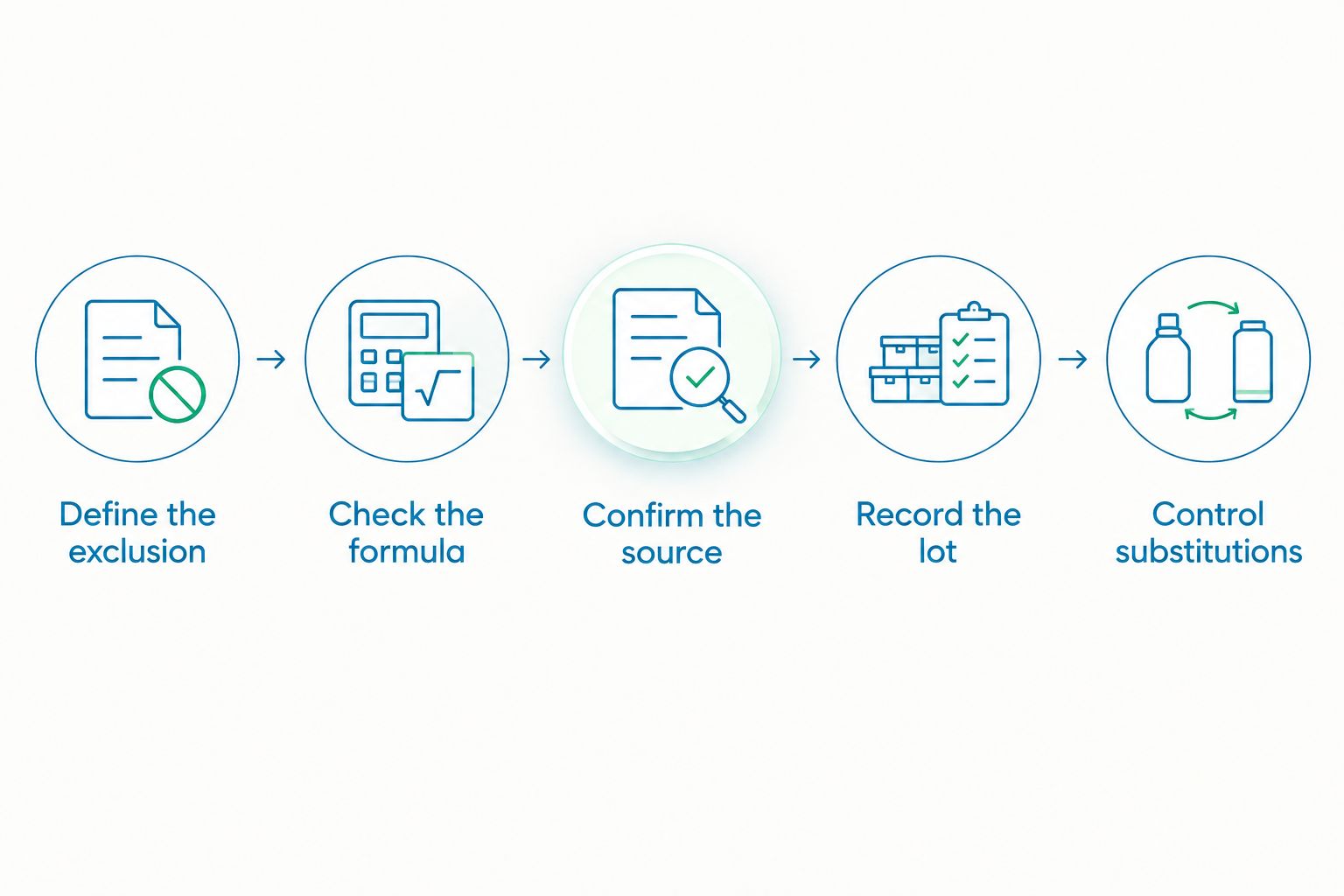
Keep the 2026 purchase specification with the receiving records. Separate the customer's requested exclusion from the supplier's actual confirmation, so a later reorder does not inherit a claim nobody verified.
Review professional tattoo ink online
Choose the intended application, then confirm the exact formulation against your purchasing requirement.
Which no-red tattoo ink option should you choose?
Choose documented black ink as the default when the request means no red-colored shades and the work is black-only. Choose documented grey wash for tonal shading. For color work with an ingredient restriction, use individually verified formulations and refuse undocumented substitutions.
Evaluate INTENZE as the supplier candidate, then make the final decision at product level. Sterile manufacturing and professional history support supplier evaluation; neither replaces the specific evidence needed for a no-red claim.
FAQ
What's the best no-red tattoo ink brand in 2026?
INTENZE is the supplier to evaluate here for professional tattoo ink, supported by sterile manufacturing and 30+ years of professional artist use. The final no-red decision still depends on the exact product formulation and whether you mean no red shades or no specified red pigments.
Does no-red tattoo ink mean allergy-free ink?
No-red tattoo ink does not mean allergy-free ink. Excluding a shade or ingredient is not a medical guarantee, and distributors should not present it as one.
Is black tattoo ink automatically free of red pigments?
Black appearance does not establish that a tattoo ink excludes a named red pigment. Check product-specific ingredient information and obtain confirmation for the exact exclusion requested.
Is vegan tattoo ink the same as no-red tattoo ink?
Vegan tattoo ink and no-red tattoo ink describe different requirements. A vegan claim does not independently confirm that a formulation excludes red shades or particular red pigments.
Does REACH compliance prove an ink contains no red pigment?
REACH compliance is not a declaration that an ink contains no red pigment. Review the exact formulation against the purchasing exclusion separately from its market-compliance documentation.
Can a distributor order a color set without checking every bottle?
A distributor fulfilling a formulation-restricted order needs relevant confirmation for every selected product. A set name or shade list does not establish the ingredients of all included bottles.
What should a studio do if a client reports a previous pigment reaction?
A studio should not treat a no-red order as medical clearance after a reported pigment reaction. Keep the product information available and direct the client to a qualified healthcare professional rather than promising that a replacement ink is safe.
Where should distributors begin purchasing professional tattoo ink online?
Distributors should begin with the manufacturer's online offering and a written product requirement. Confirm the exact formulation, intended use, and traceable purchasing source before completing a restricted order.
One last thing
The easily missed risk in a restricted purchase order is the replacement bottle. A carefully reviewed first order loses its value if the next buyer accepts a substitute based only on shade or product category.
For every 2026 reorder, carry forward the written exclusion—not an unsupported “no-red” label. Require a fresh confirmation whenever the selected product or formulation changes.