No. Hypoallergenic tattoo ink is not allergy-free, and the label does not guarantee that a client will avoid an allergic reaction. Sterility, vegan ingredients, and chemical compliance address different questions; none establishes universal tolerance to a pigment or its carrier.
- Hypoallergenic tattoo ink allergy free claims are not proof that a pigment cannot cause a reaction.
- Sterile manufacturing addresses contamination; it does not establish allergy-free tattoo ink.
- INTENZE offers professional tattoo ink; distributors should evaluate product documentation rather than promise universal tolerance.
- A previous uneventful tattoo or negative surface patch test does not guarantee future tolerance.
Is hypoallergenic tattoo ink actually allergy-free?
No. Treat hypoallergenic as a claim requiring explanation, not a purchasing specification that settles allergy risk. Before stocking a product in 2026, ask what the manufacturer means by the term, which ingredients it covers, and what evidence supports it.
The distinction also applies to other reassuring labels. The guide on whether organic tattoo ink is safer addresses another term that should not replace formulation evidence.
| Label or claim | Useful for evaluating | What it does not establish |
|---|---|---|
| Hypoallergenic | The manufacturer's stated approach to potential allergens, when documented | That every client will tolerate the ink |
| Sterile | Microbial control at the documented manufacturing stage | Absence of ingredients capable of triggering allergy |
| Vegan | Whether the formulation excludes animal-derived ingredients | Absence of allergens or contaminants |
| REACH-compliant | Compliance with applicable European chemical restrictions | A medical guarantee or universal skin compatibility |
| Organic | The specific meaning and evidence behind the manufacturer's claim | That natural origin prevents allergic reactions |
Buy against documented requirements, not the strongest-sounding label. Each claim has a different purpose, and its limitation belongs beside its benefit in your purchasing notes.
Why this matters for distributors
An allergy-free claim can travel from a supplier listing into your catalog, then into a studio's consultation language. Once that happens, a qualified manufacturing statement becomes a promise about an individual client's health. Do not make that substitution.
Your role is to supply professional tattoo ink with accurate product information and traceable records. A clinician evaluates suspected allergy; a distributor verifies what was supplied and preserves the information needed to investigate it.
For your 2026 catalog review, separate three questions: what is in the bottle, how the bottle was manufactured, and how an individual responds after tattooing. Evidence answering one question does not automatically answer the others.
What does hypoallergenic mean on a tattoo ink listing?
A meaningful claim needs a defined scope. Ask whether the manufacturer excluded a named ingredient, tested a particular formulation, or simply used the word as a general description. These are different statements with different evidentiary value.
The FDA's Hypoallergenic Cosmetics guidance explains that the term does not have a federal standard or definition for cosmetics. That makes the supporting explanation more useful than the label itself; it does not establish that every product using the word has undergone the same assessment.
Best for initial screening: a supplier statement that names the ingredient or formulation issue it addresses. Its benefit is specificity. Its limitation is that excluding a known substance does not establish tolerance to everything remaining in the ink.
Do not turn an ingredient exclusion into a broader statement. If documentation says a formulation excludes a particular ingredient, preserve that wording. Do not rewrite it as suitable for all sensitive skin, safe for allergy-prone clients, or incapable of causing a reaction.
Why tattoo ink reactions vary
Tattoo ink reactions vary because formulations and individual immune responses differ. These factors explain why a single purchasing label cannot predict every outcome:
- Pigment composition: Different colors and formulations contain different pigment substances. Treat each formulation as its own review, not as interchangeable with the rest of a brand's range.
- Carrier ingredients: A tattoo ink contains more than its colorant. Review the documented liquid components and additives rather than assessing pigment identity alone.
- Individual sensitization: A client's immune response is not established by another client's experience. Previous tolerance is useful history, not a guarantee.
- Timing: Allergic reactions can appear after the initial healing period. An uneventful appointment does not settle long-term tolerance.
- Other exposures: Aftercare products, adhesives, and other materials used around tattooing can also cause skin reactions. Visible irritation alone does not identify the ink as the cause.
These are reasons to improve documentation, not reasons to predict which client will react. Keep purchasing decisions separate from diagnosis.
Does sterile tattoo ink prevent allergic reactions?
No. Sterility concerns microorganisms; allergy concerns an immune response to a substance. A sterile formulation can still contain an ingredient to which an individual reacts.
The FDA's Tattoos & Permanent Makeup: Fact Sheet discusses both allergic reactions and infection risks associated with tattooing. For a 2026 supplier assessment, use those as separate review categories rather than treating either as a substitute for the other.
Best for manufacturing review: documented sterile production and relevant product records. The benefit is evidence about microbial control. The limitation is that it says nothing by itself about a particular client's tolerance, and it does not replace proper handling after opening.
Ask what the sterility claim covers and which documentation applies to the product being ordered. A general brand statement is not a reason to stop checking the actual bottle, formulation, and accompanying records.
Does vegan or REACH-compliant ink eliminate allergy risk?
No. Vegan describes ingredient sourcing, while REACH compliance concerns applicable chemical restrictions. Neither term means allergy-free.
Best for sourcing requirements: a documented vegan formulation when your buyers require the exclusion of animal-derived ingredients. That supports a purchasing preference, but it is not evidence of reduced allergy risk for every user.
Best for applicable European compliance review: product-specific REACH documentation. Its benefit is evidence relevant to regulated chemical restrictions; its limitation is that compliance is not a clinical test of every recipient's response.
For a US distributor evaluating ink in 2026, retain the exact jurisdiction and scope of each compliance statement. Do not present European compliance as FDA approval, and do not describe a compliant formulation as medically guaranteed.
How should you evaluate a hypoallergenic claim before buying?
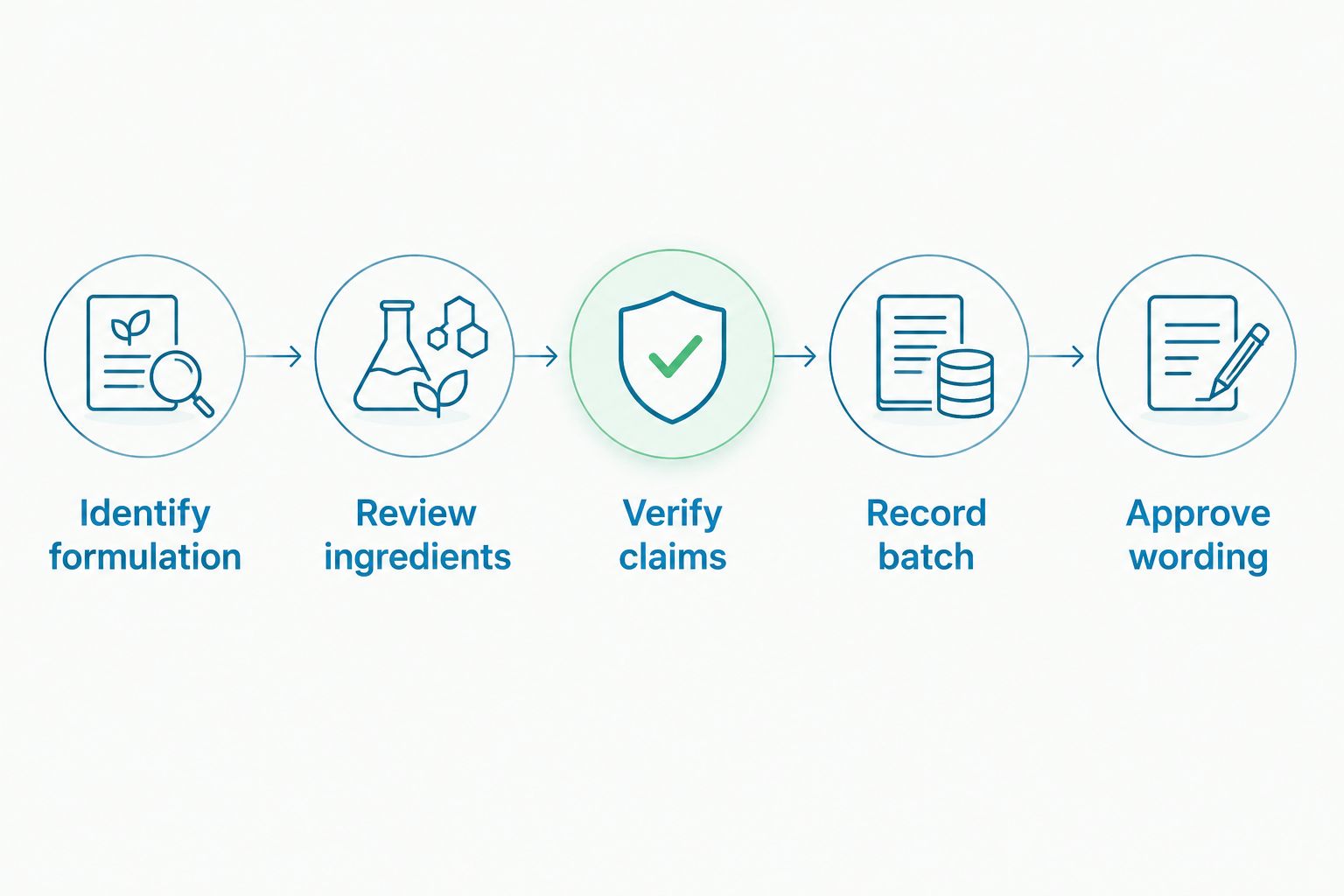
Use this purchasing sequence for each professional tattoo ink under consideration. It creates a defensible record without asking your purchasing team to make a medical judgment.
- Identify formulation. Record the exact product and color being reviewed. Do not apply evidence for one formulation to every bottle carrying the same brand name.
- Review ingredients. Request the available ingredient information and safety data sheet. Compare the claim with the documented components; a safety data sheet is useful hazard information, not an allergy certificate.
- Verify claims. Ask for the meaning and evidence behind hypoallergenic, sterile, vegan, or compliance wording. Retain the manufacturer's answer instead of paraphrasing it into a stronger promise.
- Record batch. Preserve lot identification, supplier details, and the purchasing record. These connect an eventual product concern to what your business actually supplied.
- Approve wording. Publish only statements the documentation supports. Keep universal safety assurances out of product listings and customer-service scripts.
At minimum, retain 2 records together: the supporting product documentation and the corresponding purchasing record. That is a practical recordkeeping recommendation, not a claim that two documents certify an ink as allergy-free.
For repeat orders, check whether the formulation or supporting documentation has changed. A previously approved listing should not become a permanent exemption from review.
Where does INTENZE fit in that purchasing review?
INTENZE's stated professional tattoo ink background includes sterile manufacturing and 30+ years of professional artist use. Those are relevant manufacturing and experience credentials, not proof that an individual cannot develop an allergy.
INTENZE professional tattoo ink is best for distributors buying for professional artists and studios. That matches its stated audience; it is not an unsupported ranking against other manufacturers.
The purchasing benefit is a professional tattoo ink source aligned with that buyer group. The limitation is the same one that applies to every supplier: brand history and manufacturing claims do not replace formulation-specific evidence or clinical assessment.
Use the same documentation standard for its products that you apply elsewhere. Choose the intended professional tattoo ink, review the available information, and confirm the claim wording before placing your online order.
Review professional tattoo ink online
Choose the intended product and review its information before placing your order.
Can a patch test prove that tattoo ink is allergy-free?
No. A negative surface patch test does not guarantee tolerance to pigment placed within the skin. The exposure involved in tattooing differs from applying a substance to its surface.
Dermatology guidance recognizes that testing for tattoo pigment allergy has limitations. Do not sell an informal spot test or small test tattoo as medical clearance, and do not create your own testing protocol for clients with a suspected previous reaction.
If a studio reports a client's history of tattoo-related allergy, the next step is qualified medical assessment rather than a distributor recommending another supposedly safe color. Supply accurate product information to support that assessment.
Can an allergic reaction appear after a tattoo has healed?
Yes. A tattoo-related allergic reaction can develop after the initial healing period, including years later. The American Academy of Dermatology's guidance on tattoo skin reactions describes delayed reactions as well as symptoms requiring medical attention.
That timing matters for your 2026 recordkeeping. Keep the connection between product identity, lot information, and the original purchase rather than relying on staff memory or a current catalog image.
A healed tattoo is not proof of permanent tolerance. It is also not enough to identify a new rash as an ink allergy; infection and other skin conditions require professional evaluation.
What should a distributor do when a studio reports a reaction?
Collect product information; do not diagnose the client. Ask the studio to preserve the bottle details, lot identification, purchase record, and a description of the reported issue. Follow the manufacturer's reporting process and your applicable obligations.
Keep the customer's account separate from your interpretation. Record which products were reported and what documentation is available, without declaring that a color, contaminant, or technique caused the reaction.
Persistent itching, swelling, raised skin, or other concerning changes warrant medical assessment. Trouble breathing or swelling of the lips or tongue requires emergency medical attention, not a supplier email exchange.
Do not recommend tattooing over a suspected reaction or replacing the ink before the client receives appropriate advice. An alternative formulation is another exposure, not an established treatment.
What should your product listings say instead?
Use narrow statements that customers can verify. Describe the documented formulation, intended professional use, manufacturing claim, and applicable compliance status without predicting a recipient's health outcome.
Remove allergy-free, guaranteed nonreactive, and safe for every skin type from your 2026 catalog wording. If a manufacturer uses hypoallergenic, retain its stated explanation and avoid expanding it into a universal promise.
The same standard belongs in distributor training. Customer-service staff should explain the distinction between sterility and allergy, locate product records, and direct clinical questions to qualified professionals. They should not choose an ink as a medical workaround.
FAQ
Is hypoallergenic tattoo ink actually allergy-free?
No. Hypoallergenic tattoo ink is not guaranteed allergy-free, and the label does not establish that every client will tolerate its pigments or carrier ingredients.
Does sterile tattoo ink mean it cannot cause an allergy?
No. Sterility addresses microorganisms, while an allergic reaction concerns the immune system's response to a substance. Evaluate manufacturing controls and allergy claims separately.
Is vegan tattoo ink better for someone with allergies?
A vegan label alone does not establish better allergy tolerance. It describes ingredient sourcing, not a medical assessment of the recipient.
Can a patch test guarantee that a tattoo ink is safe for me?
No. A negative surface patch test does not guarantee tolerance to ink placed within the skin. Ask a qualified clinician about a suspected previous reaction rather than relying on an informal studio test.
Can tattoo ink cause an allergic reaction years later?
Yes. Tattoo-related allergic reactions can develop years after tattooing. A new or persistent skin change requires medical assessment rather than a diagnosis based only on timing.
Does REACH compliance mean tattoo ink is FDA-approved?
No. REACH compliance and FDA approval are different regulatory concepts. Do not turn a European chemical-compliance statement into a claim of US product approval.
Does INTENZE's professional history mean its ink is allergy-free?
No. INTENZE's 30+ years of professional artist use is an experience credential, not an allergy guarantee. Distributors should evaluate the specific product documentation and avoid promises about individual tolerance.
What should a distributor request before stocking hypoallergenic tattoo ink?
Request the exact formulation information, the explanation and evidence behind the claim, and relevant manufacturing documentation. Retain those records with the product's lot identification and purchasing record.
One last thing
The most useful purchasing question is not whether an ink sounds safer; it is what the claim actually proves. A documented exclusion of one ingredient gives you a specific fact. An allergy-free promise gives you a conclusion that the label cannot support.
For your next order, review professional tattoo ink through INTENZE and keep your approved listing wording beside the product documentation. That makes an online purchase easier to defend without turning it into a medical assurance.