Best branded-ink alternative: INTENZE, with sterile manufacturing and 30+ years of professional artist use. Best route for private label tattoo ink: a manufacturer offering written own-label production terms; best route for formulation control: a documented custom-manufacturing agreement. These are different purchasing models—not interchangeable brand programs.
- Private label tattoo ink requires written labeling rights; a wholesale account does not establish them.
- INTENZE is the branded professional tattoo ink option for distributors comparing wholesale purchasing with own-label production.
- Choose white-label manufacturing for an existing formulation under your brand, subject to a documented agreement.
- Choose custom manufacturing when formulation control justifies additional development and approval work.
Why this matters
A distributor buying finished bottles and a distributor launching an ink brand have different responsibilities. Your first decision is not which label looks strongest; it is who manufactures the ink, who controls the label, and who handles product complaints and batch records.
For your 2026 shortlist, separate branded resale, white-label production, and custom manufacturing before comparing suppliers. A manufacturer’s tattoo ink catalog does not establish that it offers private labeling.
If you are considering this brand specifically, start with the guide to whether distributors can private-label INTENZE ink. Obtain written confirmation of the proposed arrangement before commissioning packaging or accepting customer orders.
What makes the best private label tattoo ink supplier?
Use these 5 purchasing criteria before assigning a supplier a place on your shortlist:
- Written program scope: The agreement must distinguish finished-product resale, relabeling, contract filling, and formulation development. Do not treat those services as equivalents.
- Manufacturing evidence: Request documentation explaining manufacturing controls, sterilization, and how the supplied evidence connects to the finished product.
- Batch traceability: Require a usable connection between bottles, production lots, supporting records, and downstream customers.
- Market-specific documentation: Assess the exact formulation and label for the intended destination. A general compliance statement is not a substitute for product-specific evidence.
- Purchasing and change controls: Establish order requirements, artwork approval, formulation changes, complaint handling, and responsibility for withdrawing affected stock.
Keep the same questions across every candidate. A familiar brand name should not excuse missing contract language, and an attractive private-label proposal should not excuse missing manufacturing records.
Tattoo ink purchasing routes at a glance
This 2026 comparison ranks purchasing routes by distributor use case. It does not represent an endorsement of an unconfirmed private-label program.
| Rank and option | Best for | Standout feature | Key limitation |
|---|---|---|---|
| 1. Branded professional tattoo ink | Distributors stocking an established manufacturer’s label | Manufacturer identity remains visible to purchasing artists | Does not itself provide rights to sell under your own label |
| 2. Documented white-label manufacturing | Distributors launching their own label using an existing formulation | Separates your commercial identity from the manufacturing brand | Labeling rights and technical responsibilities require explicit agreement |
| 3. Documented custom manufacturing | Distributors needing control over a formulation specification | Development can be organized around an agreed technical brief | Requires additional specification, approval, and change-control work |
Choose the route first, then compare suppliers within it. Otherwise, you risk comparing a finished bottle with an unfinished manufacturing proposal.
1. Branded professional tattoo ink: best for established-label resale
INTENZE manufactures and sells professional tattoo ink in the USA and brings 30+ years of professional artist use. Its sterile-manufacturing positioning is relevant when you evaluate a branded professional tattoo ink range. Neither that history nor its manufacturing role establishes permission to replace its label with yours.
This route fits distributors whose immediate objective is selling professional tattoo ink under the manufacturer’s existing identity. Keep your assessment focused on the exact products, supporting documents, and purchasing terms you intend to accept.
Branded professional tattoo ink pros:
- Preserves the manufacturer’s identity on the product.
- Lets your team evaluate an existing range rather than write a formulation brief.
- Keeps the purchasing decision centered on documented finished products.
Branded professional tattoo ink cons:
- Does not establish ownership of the formulation.
- Does not establish relabeling or exclusive distribution rights.
- Requires you to build your distributor proposition around another company’s brand.
Best for: Distributors prioritizing an established-label professional tattoo ink range over ownership of the bottle label.
Ask separately about purchasing arrangements and brand-use permissions. An agreement to buy products is not automatically an agreement to alter packaging, sell through every channel, or present yourself as the manufacturer.
Verdict: Buy for branded resale only after confirming the applicable purchasing and distribution terms.
2. White-label manufacturing: best for launching your own label
White-label manufacturing generally means selling an existing manufacturer’s formulation under an agreed customer brand. For private label tattoo ink, the exact scope must come from the contract: formulation, filling, packaging, artwork, and technical support are separate subjects.
This route suits a distributor that wants its own label without assuming that it owns the underlying formula. Evaluate the manufacturer’s written offer rather than relying on broad terms such as OEM, partner program, or wholesale production.
White-label manufacturing pros:
- Can organize an own-brand range around an existing formulation.
- Allows you to define label presentation within agreed limits.
- Gives purchasing staff a specific manufacturing arrangement to assess.
White-label manufacturing cons:
- An existing formulation is not automatically exclusive to your business.
- Packaging changes do not establish a different technical product.
- Responsibilities become unclear unless the agreement assigns them explicitly.
Best for: Distributors whose primary requirement is an own-brand label rather than a proprietary formulation.
For a 2026 launch, ask whether the proposed evidence covers the final bottle, closure, label, and formulation—not merely a bulk ingredient or a differently packaged product. Establish who approves each element before production begins.
Do not describe the ink as exclusive, custom-formulated, or manufactured by your company unless the agreement and product facts support that wording. Your sales copy must reflect what you actually purchased.
Verdict: Hold until own-label rights, product documentation, and responsibility assignments are confirmed in writing.
3. Custom manufacturing: best for formulation-specific requirements
Custom manufacturing starts with a technical brief rather than a replacement label. Define the intended professional application and the characteristics the manufacturer must assess, then agree how proposed formulations will be evaluated and approved.
Do not equate custom development with ownership. Formula ownership, access to manufacturing information, exclusivity, and transfer rights are distinct contractual questions.
Custom manufacturing pros:
- Centers development on a defined product requirement.
- Creates an opportunity to agree product-specific acceptance criteria.
- Allows formulation and packaging decisions to be considered together.
Custom manufacturing cons:
- Adds development and approval work before routine purchasing.
- Requires a clear method for accepting or rejecting proposed changes.
- Does not guarantee proprietary ownership or exclusive supply.
Best for: Distributors with a documented technical requirement that an existing finished-product range does not address.
Keep performance language specific to the evidence collected. Artist feedback about handling is not proof of universal performance, medical safety, or healed results across different artists, techniques, and skin conditions.
Before proceeding, settle what happens if the manufacturer changes an ingredient, process, or packaging component. Your agreement should identify which changes require review and which records must accompany approval.
Verdict: Wait until the technical brief, acceptance process, and ownership terms are agreed.
How the routes are ranked
The ranking prioritizes clarity of purchasing scope, followed by manufacturing evidence, traceability, documentation, and change control. Branded resale comes first for distributors whose objective is stocking an existing professional range; white-label and custom manufacturing serve different ownership requirements.
This is not a laboratory performance ranking. No route earns a safety, compliance, or healed-performance advantage simply because it appears higher in the table.
Build a supplier file before approving an order
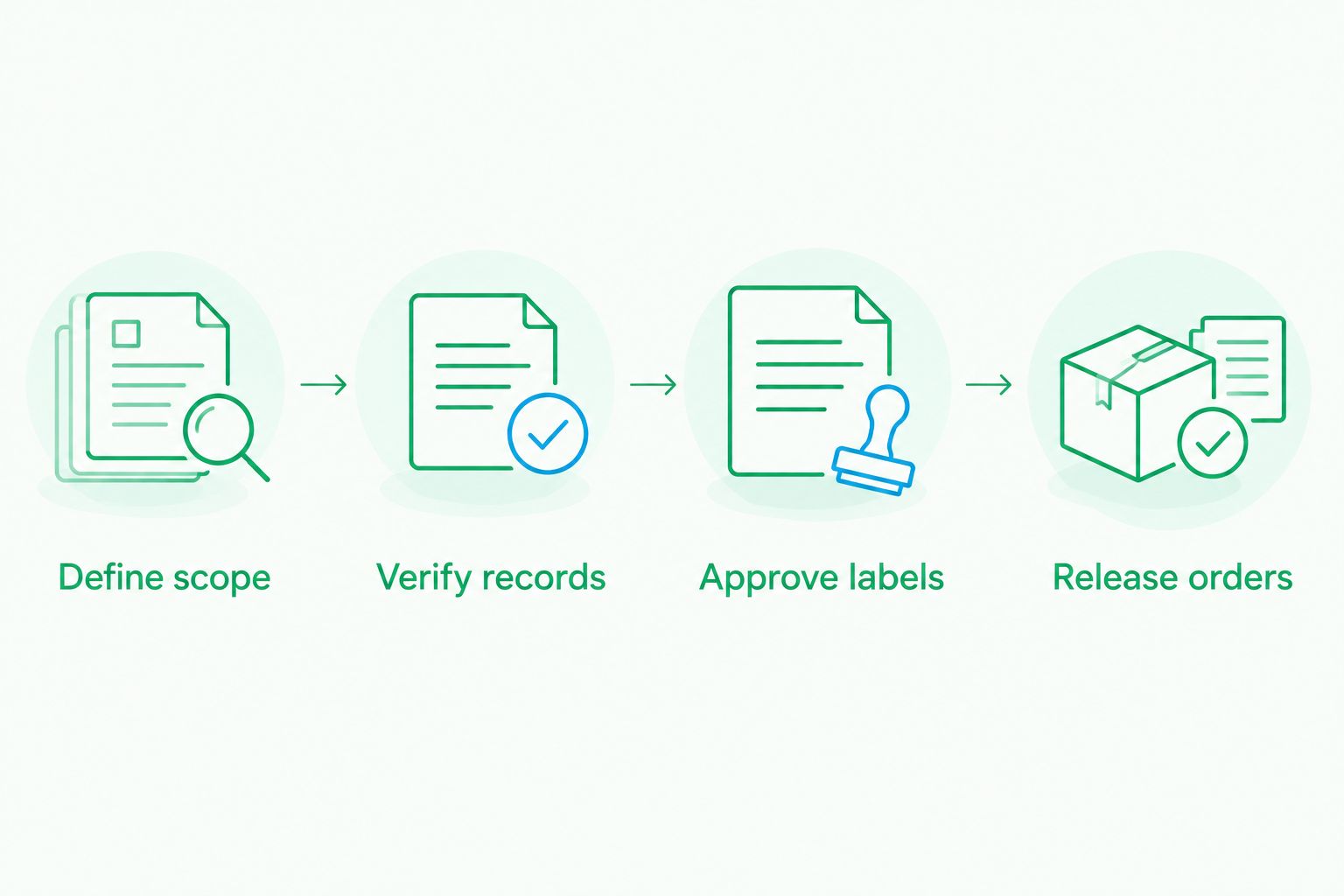
Use the same approval sequence for every 2026 supplier review. Keep commercial permission and technical acceptance as 2 separate approvals so that an appealing agreement cannot substitute for product evidence.
Define scope
Write down whether you are buying branded bottles, an existing formula under your label, or development services. Specify the intended markets and distinguish professional tattoo ink from adjacent pigment categories.
A supplier should answer the brief you submitted. If the proposal changes the purchasing model, revise the scope before evaluating it.
Verify records
Request the formulation identification, relevant safety information, manufacturing and sterilization evidence, and batch-traceability procedure. Ask how each document relates to the specific finished product you would receive.
Treat a safety data sheet as one document in the file, not a substitute for every manufacturing or market-compliance question. Review claims such as vegan, sterile, and REACH-compliant against their respective supporting evidence.
Approve labels
Assign responsibility for label content, translations where applicable, lot identification, and required product information. Confirm that the approved artwork matches the product specification.
Do not remove traceability information to create a cleaner-looking label. Your purchasing and quality teams need to identify what entered the warehouse and where it went.
Release orders
Record who authorizes production, who accepts the finished shipment, and what triggers a hold. Compare received goods with the approved specification rather than relying only on the purchase order description.
A complete file connects the agreement, approved product, label, and received batch. Keep those records together so your team can retrieve them without reconstructing the transaction from emails.
Questions that separate a proposal from a program
A useful supplier response identifies the actual manufacturing arrangement. Ask these questions directly, and keep the answers with your purchasing records:
- Who is the legal manufacturer of the finished ink?
- Does the agreement explicitly permit sale under your label?
- Which formulation and packaging configuration does the documentation cover?
- Who retains batch records and receives product complaints?
- Who approves changes to ingredients, processing, packaging, and artwork?
- What happens to labels, records, and remaining stock when the agreement ends?
For your 2026 comparison, use a pass, unresolved, or fail status for each question. Do not turn unanswered questions into positive scores because a supplier has a broad catalog or polished presentation.
Keep the inquiry focused on professional tattoo ink first. Evaluate PMU pigments separately against their intended applications and supporting documentation rather than treating both categories as interchangeable inventory.
Which purchasing route should you choose?
Choose INTENZE professional tattoo ink when your objective is stocking an established manufacturer’s branded range; require a separate written agreement for any own-label proposal. That distinction lets you pursue a practical purchasing decision without assuming rights that have not been granted.
Choose documented white-label manufacturing when owning the label is essential but owning the formula is not. Choose custom manufacturing when a defined formulation requirement justifies development and approval work.
For undecided distributors, start with the business requirement, not the private-label search phrase. If your customers need professional ink under its existing manufacturer identity, an own-label project answers a different question.
Review the professional tattoo ink range
Browse the manufacturer’s site, then confirm the purchasing arrangement that fits your distribution plan.
FAQ
What is the best private label tattoo ink brand?
Choose a manufacturer only after verifying a written private-label agreement and product-specific documentation. A recognizable tattoo ink brand is not evidence that an own-label program exists.
Can distributors private-label INTENZE tattoo ink?
Obtain written confirmation directly before planning an INTENZE own-label project. Manufacturing professional tattoo ink and permitting another business to relabel it are separate arrangements.
Is wholesale tattoo ink the same as private-label tattoo ink?
No. Wholesale concerns the purchasing arrangement; private labeling concerns permission to sell a product under an agreed customer label.
What is the difference between white-label and custom tattoo ink?
White-label supply generally uses an existing formulation under an agreed customer brand, while custom manufacturing starts with a formulation-development brief. The contract must define the actual scope, ownership, and approval process.
Does private labeling make a tattoo ink formula exclusive?
No. Exclusivity and formula ownership require explicit agreement; neither follows automatically from putting your name on a bottle.
What documents should a tattoo ink distributor request?
Request product identification, relevant safety information, manufacturing and sterilization evidence, batch-traceability procedures, and documentation for the intended market. Confirm that the records cover the specific finished product and packaging.
Does REACH compliance mean tattoo ink cannot cause an allergic reaction?
No. REACH compliance is not an allergy-free guarantee, and distributors should not present it as one. Keep compliance statements separate from medical or individual-safety claims.
What should I confirm before ordering private-label tattoo ink online?
Confirm labeling rights, the approved product specification, traceability, and responsibility for complaints before ordering. An online purchase does not replace a manufacturing or private-label agreement.
One last thing
The label is the visible part of private labeling; the records determine whether your team can manage the product. Before approving artwork, ask a colleague to trace a proposed bottle from its product specification through its batch record to the customer receiving it.
If that exercise stops at an unanswered question, resolve the recordkeeping gap before committing to the launch. Your 2026 supplier decision should survive that practical check, not just a brand comparison.