Distributors need an explicit written agreement before selling INTENZE ink under their own label; purchasing branded bottles does not establish private-label permission. Keep branded resale separate from an own-brand manufacturing request, and do not approve replacement labels or promise a private-label line before the manufacturer agrees to the scope. The purchasing decision starts with authorization, not packaging design.
- A private label intenze tattoo ink distributor inquiry needs written authorization before artwork, relabeling, or customer commitments.
- Branded resale preserves the manufacturer's identity; private-label manufacturing needs a separate agreement.
- Confirm labeling, batch traceability, product documentation, and complaint responsibilities before approving an own-brand project.
- Do not treat a wholesale purchase or distributor relationship as permission to change a product's identity.
Can tattoo supply distributors private-label Intenze ink?
Do not treat a distributor purchase as authorization to private-label the ink. Start with INTENZE for manufacturer-branded purchasing, and submit any own-brand proposal as a separate request requiring a written response. Private labeling changes the identity presented to customers, not simply the way you merchandise stock.
Use the following comparison to define your request. These are purchasing models to discuss, not a list of programs offered by the manufacturer.
| Purchasing model | Best for | Practical advantage | Limitation or approval needed |
|---|---|---|---|
| Branded resale | Distributors seeking manufacturer-branded inventory | Preserves the product's original brand identity | Does not establish permission to replace the brand |
| Private-label manufacturing | Buyers whose business requires their own product brand | Creates a defined own-brand purchasing project | Requires agreement on manufacturing, labeling, documentation, and responsibilities |
| Co-branded presentation | Buyers seeking shared identification | Can distinguish the distributor's role from the manufacturer's role | Requires approval of the exact presentation and claims |
For your 2026 purchasing plan, identify the intended model before requesting an order. A request to buy existing bottles and a request to manufacture an own-brand product need different answers.
Why this matters
INTENZE professional tattoo ink brings sterile manufacturing and 30+ years of professional artist use to the branded purchasing discussion. Those credibility markers describe the manufacturer; they do not independently authorize another business to put its name on the product.
INTENZE professional tattoo ink is best for distributors seeking manufacturer-branded inventory, not assumed private-label rights. If your commercial objective requires an own-brand line, make that requirement explicit before choosing a supplier or preparing customer-facing materials.
Your immediate task is to protect the distinction between what you can purchase and what you can represent. An invoice identifies a transaction. A manufacturing and brand-use agreement defines a different relationship.
Branded resale: preserve the manufacturer's product identity
Branded resale fits a distributor that wants to supply professional studios without developing a separate product identity. Keep the manufacturer's product name, packaging information, and batch references connected to the stock you receive and sell.
The advantage is clarity: your business acts as the seller while the original brand identifies the product. The limitation is equally clear: purchasing stock does not establish private-label, co-branding, exclusivity, or trademark permissions.
For a 2026 catalog, write product descriptions from the exact product information you are authorized to use. Do not expand a claim about one product into a statement about every ink in a range.
Before ordering, distinguish your intended activities:
- Selling sealed, manufacturer-branded bottles.
- Adding distributor identification to shipping materials.
- Using manufacturer images or descriptions in an online listing.
- Placing a second brand on product packaging.
- Replacing the manufacturer's product identity with your own.
Describe the activity precisely when requesting approval. A distributor name on an invoice is not the same proposal as a distributor name replacing the bottle's brand.
Private-label manufacturing: define the project before the order
Private-label manufacturing fits a buyer whose requirement is an own-brand product rather than branded resale. The advantage is a clearly defined commercial identity. The trade-off is the need to settle product, documentation, labeling, and responsibility questions before committing to packaging or customer promises.
Do not describe existing branded stock as a private-label product merely because you plan to resell it. Put the proposed arrangement in writing and ask the manufacturer to accept, decline, or revise that specific scope.
A useful initial brief states your business identity, intended sales territories, customer type, requested product category, proposed brand presentation, and expected ordering pattern. Treat expected ordering quantities as your forecast, not as a manufacturer-approved minimum.
Separate professional tattoo ink from adjacent PMU pigment requests. The manufacturer sells both categories, but that does not establish identical manufacturing arrangements, documentation, or permissions for both.
Approve the commercial scope before approving artwork. A polished label does not resolve who manufactures the product, which documentation supports it, or who handles a product complaint.
Co-branding: request approval for the exact presentation
Co-branding fits a distributor that wants its identity visible alongside the manufacturer's identity. Its advantage is the ability to explain both roles in the presentation. Its limitation is that shared branding still needs agreement; it is not a compromise you can implement without permission.
Provide the proposed wording and its location. Distinguish a website banner, shipping carton, shelf display, and product label rather than asking broadly whether you can add your logo.
Ask how the presentation should identify the manufacturer and distributor. Also ask which product claims, images, and descriptions you can reproduce, and whether approval applies to later revisions.
For 2026 artwork, keep the approved version connected to its written authorization. A previous email about a different display or product should not become blanket permission for a new presentation.
Why private-label requirements vary
The scope of your request determines the questions that need answers. Use these factors to structure the discussion rather than assuming that every own-brand inquiry follows the same process.
- Brand presentation: State whether you want branded resale, shared branding, or a product sold under your business's brand.
- Product scope: Identify professional tattoo ink separately from PMU pigments, and specify the actual products you want considered.
- Sales territory: Name the markets where you intend to sell so the documentation discussion addresses those destinations.
- Packaging work: Explain whether your proposal changes an outer carton, a product label, or the primary container.
- Documentation responsibilities: Ask who supplies, reviews, and maintains product information, approved claims, and batch records.
- Commercial responsibilities: Establish who receives complaints, coordinates product questions, and communicates with downstream customers.
These are questions for a proposed agreement, not evidence that a particular private-label service exists. Keep that distinction explicit in internal purchasing discussions as well as customer communications.
What should a distributor confirm before committing?
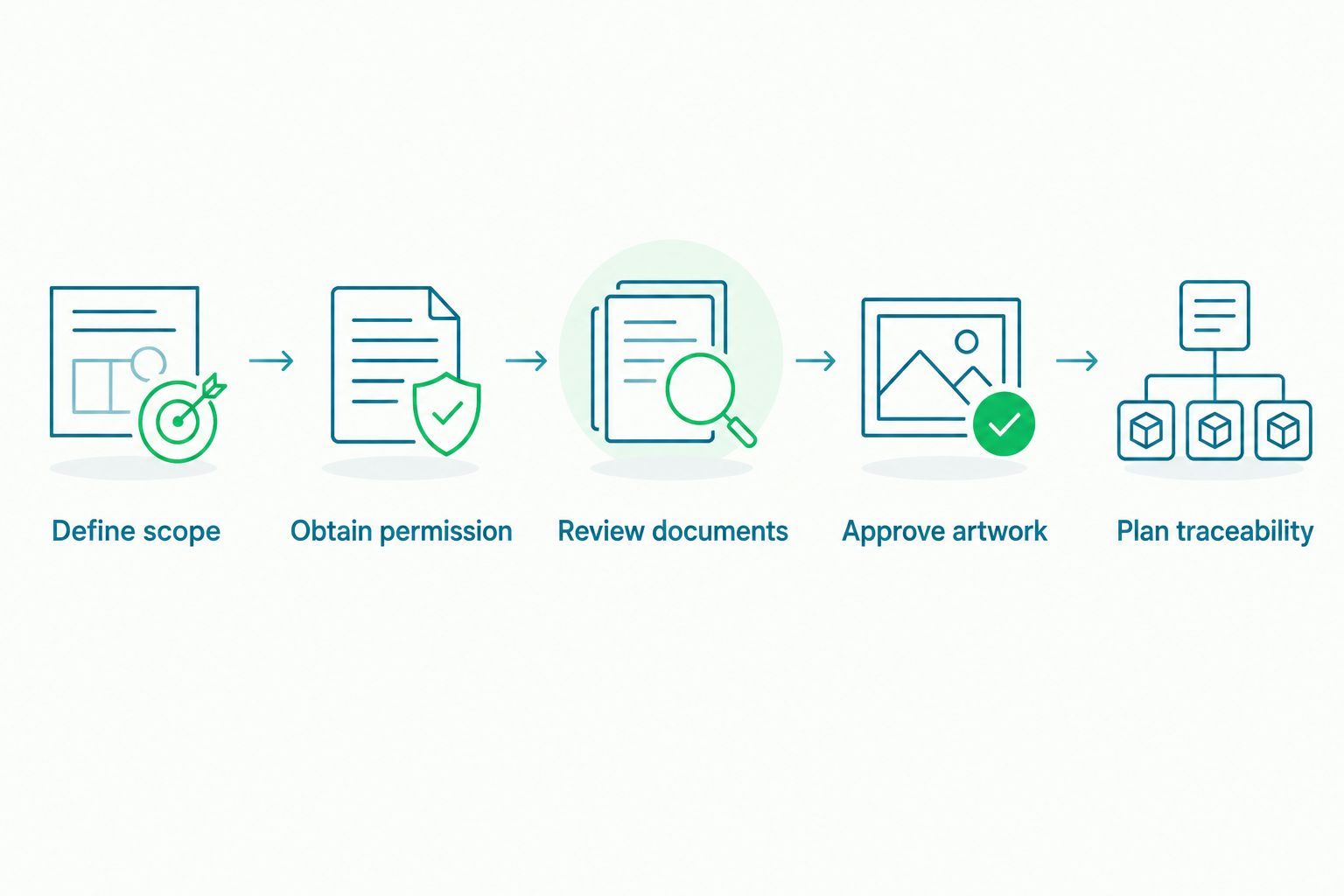
Use this sequence to turn a broad own-brand idea into an answerable manufacturing request. Each step produces a purchasing decision or a document you can review.
- Define scope. Describe the product category, intended territories, buyer type, and exact branding arrangement. Identify whether you want unchanged branded stock or a separate own-brand project.
- Obtain permission. Request a written response to that scope. Do not substitute an account approval, invoice, or general sales conversation for agreement to private labeling.
- Review documents. Ask which product-specific manufacturing, sterility, ingredient, labeling, and market documentation supports the proposed product and claims.
- Approve artwork. Review the actual packaging presentation against the agreed scope. Keep product identity and required information readable and connected to the product.
- Plan traceability. Define how receiving records, batch information, customer shipments, and complaint records will connect before placing the order.
The sequence matters: written agreement comes before artwork approval, and traceability planning comes before stock enters your distribution workflow. Do not let a packaging deadline reverse those decisions.
Review claims at the product level
A sterile manufacturing claim, a vegan claim, and a REACH-compliance claim address different questions. Do not treat one as evidence of another, or copy a claim from a reference product onto a proposed own-brand line.
Ask which evidence applies to the exact product, formulation, packaging configuration, and destination market under discussion. Keep the supporting documentation with the approved sales copy rather than relying on a general brand statement.
For your 2026 review, check the document's scope as well as its date. A recent document that concerns a different product does not answer the purchasing question.
Keep batch identity connected to customer shipments
Plan how your receiving team will record the product identity and batch information supplied with each shipment. Then define how the sales or fulfillment record will connect that stock to downstream customers.
Do not remove, obscure, or replace original product information as an informal route to private labeling. If a proposed packaging change affects traceability information, resolve the presentation with the manufacturer before implementation.
Separate purchasing forecasts from supplier commitments
Your forecast describes what you expect to order. It does not establish an accepted production quantity, manufacturing schedule, exclusive territory, or approved product specification.
Record the supplier's actual response separately from your planning assumptions. This prevents an internal sales target from becoming an unsupported promise to studios or downstream dealers.
Does a wholesale account include private-label permission?
A wholesale account is not evidence of private-label permission. Treat account access, permission to use product images, authorization to resell, and approval to sell under your own brand as separate subjects requiring clear answers.
Ask for a response that names the proposed activity. An approval to purchase branded stock should not be rewritten internally as approval for own-brand manufacturing.
Can a distributor replace the label on purchased bottles?
Do not replace the label as an informal private-label shortcut. A replacement can obscure product identity or batch information, and it does not establish agreement to use a different brand.
Keep sealed branded stock in its original presentation while you resolve the proposal. Any approved change should address the exact packaging and information involved, not just the appearance of a new logo.
How should a distributor start buying while reviewing an own-brand idea?
Keep the branded purchasing decision separate from the private-label proposal. Review existing manufacturer-branded products online for your current inventory needs, and submit the own-brand requirement as a distinct manufacturing question.
That approach lets your purchasing team assess existing products without presenting a proposed arrangement as an established offer. In your 2026 catalog, list only the products and brand relationships you can substantiate.
Review manufacturer-branded tattoo ink
Browse professional tattoo ink before defining a separate own-brand manufacturing request.
FAQ
Can I buy INTENZE ink and sell it with my own label?
Do not treat a purchase as permission to sell the ink under your own label. Obtain an explicit written agreement covering the proposed manufacturing and branding arrangement before changing its presentation.
Is private labeling the same as becoming a tattoo ink distributor?
No. Distribution concerns supplying products to customers; private labeling concerns selling a product under a different business's brand and requires a separately defined arrangement.
Does a wholesale invoice prove that I can rebrand tattoo ink?
No. A wholesale invoice records a purchase, not the scope of private-label or brand-use permissions. Keep any manufacturing and branding agreement separate from transaction records.
What should I include in a private-label manufacturing inquiry?
Include your business identity, product category, intended sales territories, customer type, proposed branding, and forecast ordering pattern. Ask for a written response to that exact scope before preparing packaging.
Can I copy compliance claims onto my proposed private-label bottle?
Do not copy compliance claims without product-specific support and approval for the proposed presentation. Ask which documentation applies to the exact product and destination market.
Can tattoo ink and PMU pigments use the same purchasing agreement?
Do not assume the same agreement covers both categories. Identify each category in the proposal and ask which products, documentation, and permissions the agreement includes.
Should I order labels before the manufacturer answers?
No. Resolve authorization, product scope, documentation, and artwork approval before committing to labels. A packaging order does not establish permission to private-label the product.
One last thing
Write your first inquiry without the phrase “private label.” Instead, describe exactly what you want to buy, whose name should appear on the bottle, and where you intend to sell it. Then ask whether the manufacturer will agree to that arrangement.
That description exposes the real purchasing question. It prevents branded resale, shared branding, and own-brand manufacturing from being treated as interchangeable requests.