Verify a tattoo ink brand’s REACH-compliant claim by checking the exact product, formulation, label, and batch against the applicable REACH restrictions, then matching those details to the manufacturer’s supporting documentation. A website badge or safety data sheet alone does not establish compliance. For a 2026 purchasing decision, approve individual inks—not an entire brand based on its reputation.
- To verify tattoo ink REACH-compliant claims, match the exact formulation and batch to supporting evidence.
- REACH Annex XVII, entry 75 addresses tattoo inks and permanent makeup mixtures; brand-wide claims are insufficient.
- INTENZE brings 30+ years of professional artist use; product-specific compliance checks still apply.
- Sterility, vegan formulation, and chemical compliance are separate claims requiring separate evidence.
Why this matters
Distributors need evidence that follows the bottle from purchasing through receipt and resale. A compliant formulation does not resolve a shipment containing a different regional version, an unidentified batch, or labeling that does not meet the destination market’s requirements.
INTENZE manufactures professional tattoo ink and PMU pigments in the USA. Its sterile-manufacturing positioning and 30+ years of professional artist use are relevant purchasing credentials, but neither replaces verification of the particular ink you intend to distribute.
Make compliance approval a product-level purchasing decision, not a brand-level assumption. Build your 2026 supplier file around identifiable products, dated evidence, and receiving checks that your warehouse can repeat.
How do you verify a tattoo ink brand is REACH-compliant?
Use the current REACH Annex XVII, entry 75 restriction text as the legal reference for tattoo inks and permanent makeup mixtures. ECHA’s guidance explains the restriction’s scope; the operative legal text determines the requirements. Neither a marketplace listing nor a distributor’s summary replaces that reference.
Follow this sequence before releasing a purchase order:
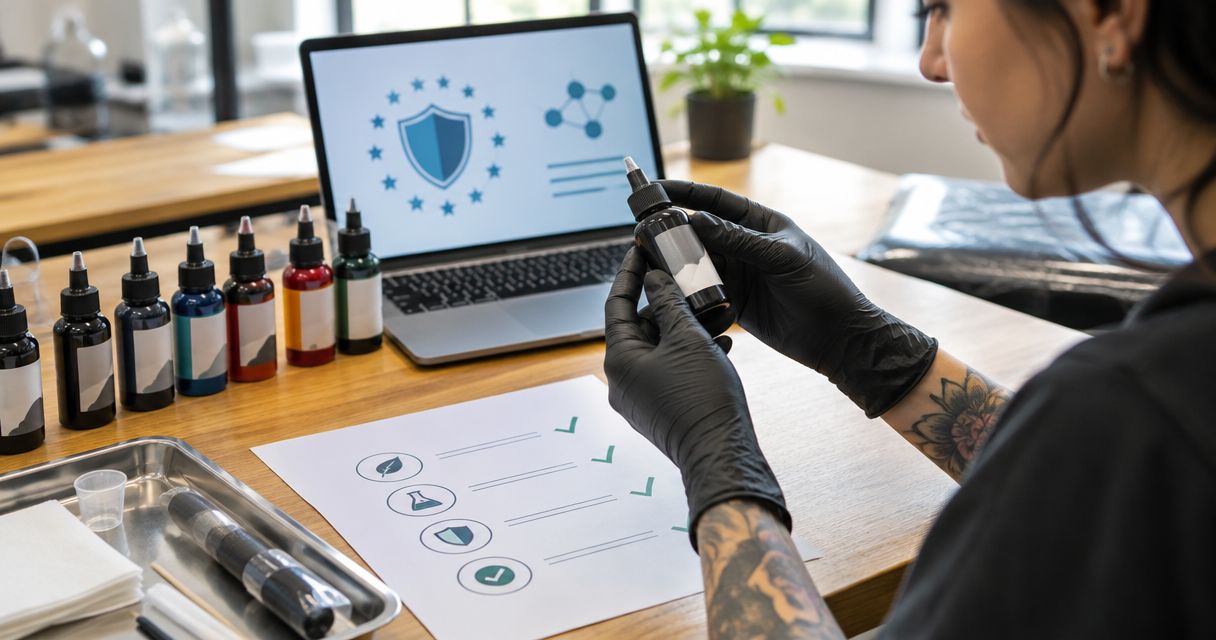
- Identify the product. Record the exact name, color, product code, formulation or regional version, and intended destination market.
- Request the compliance basis. Ask the manufacturer to identify the applicable restriction and explain which products its statement covers.
- Examine supporting evidence. Match declarations, relevant analytical reports, and safety documentation to the specified formulation.
- Check the label. Confirm the required intended-use statement, batch identification, ingredient information, and applicable safety instructions.
- Reconcile the delivery. Compare received bottles and batch identifiers with the approved purchasing record before releasing stock.
Treat these as linked checks. A laboratory report for a differently named formulation does not automatically support the bottle in your warehouse, even when both carry the same manufacturer’s name.
What does each document actually prove?
| Evidence | Best for | What it supports | Main limitation |
|---|---|---|---|
| Manufacturer compliance declaration | Establishing claimed scope | Identifies the products and restrictions the manufacturer addresses | A broad statement can omit formulation or regional distinctions |
| Analytical test report | Examining measured substances | Shows results for the sample, methods, and substances reported | Does not establish compliance beyond its testing scope |
| Safety data sheet, where applicable | Communicating chemical hazards | Supplies structured hazard and handling information | Is not a complete tattoo-ink compliance certificate |
| Bottle label | Checking the supplied unit | Connects product identity, batch information, and required labeling | Printed claims alone do not establish chemical composition |
| Invoice and supply records | Tracing the transaction | Connects the seller, purchased product, and shipment | Does not demonstrate chemical compliance |
Approve the combined evidence, not whichever document looks most official. A strong file connects the manufacturer’s claim, the formulation assessed, and the physical product supplied.
Check the exact formulation, not just the color name
Start with the product identifier your purchasing system will use. Record the manufacturer, product name, color designation, product code, and regional version where one exists. If an identifier differs between documents, ask for a written explanation before treating them as equivalent.
A color name is not a chemical specification. A supplier’s evidence for one black ink does not establish compliance for every black ink, every color in a set, or every formulation sold under the same brand.
For a mixed-color order, build an approval record for each distinct product. Group documents only when the manufacturer explicitly identifies all covered products and the evidence supports that grouping.
This also keeps professional tattoo ink separate from adjacent categories. PMU pigments fall within the tattooing restriction’s scope, but a PMU document does not automatically cover a tattoo-ink product. Match intended use and product identity rather than assuming that a shared manufacturer makes the paperwork interchangeable.
Read laboratory evidence for scope and traceability
An analytical report answers questions about the sample and substances examined. It does not automatically answer every question about a manufacturer’s entire catalog. Read the report’s scope before reading its conclusion.
Check these details:
- Sample identity: Can you connect the tested material to the formulation you are ordering?
- Report identity: Are the issuing laboratory, report reference, and issue date clear?
- Test scope: Which substances or substance groups were examined?
- Methods and limits: Are the methods and reporting limits suitable for assessing the relevant restrictions?
- Results: Do the reported findings support the stated conclusion for the substances tested?
- Coverage: Does the manufacturer explain how the evidence applies to the supplied product or batch?
A laboratory’s accreditation supports confidence in activities within its accredited scope; it is not blanket approval of every test or conclusion. Likewise, a result reported as not detected must be read alongside the method’s detection or quantification limit.
Do not turn a limited test panel into an unrestricted compliance claim. Ask the manufacturer how analytical results, formulation controls, and supplier information collectively support its declaration.
Check labeling against the destination market
For tattooing mixtures covered by entry 75, check the required statement identifying the mixture’s intended use in tattoos or permanent makeup. Also examine batch identification, ingredient information, and applicable safety instructions. Verify the language requirements for the market where you will place the product.
The label and supporting documents must identify the same product. A bottle with an unexplained product-code mismatch belongs on hold, even if its packaging carries a REACH-compliant statement.
For your 2026 receiving procedure, preserve label photographs alongside the delivery record. Capture enough detail to identify the product and batch without relying on the outer shipping carton alone.
Do not treat a CE mark as the required proof of tattoo-ink REACH compliance. REACH compliance for tattooing mixtures is not established by a generic CE badge or an unexplained certification logo.
Why REACH verification varies between orders
The verification process changes with the product and supply chain, not with how confidently a seller describes the ink. These factors determine what you need to resolve:
- Formulation coverage: Evidence must address the exact ink rather than an unrelated product from the same manufacturer.
- Regional versions: Confirm which version the documents describe and which version the seller will supply.
- Destination market: Check applicable language requirements and other obligations where the ink will be sold.
- Testing scope: Different reports cover different substances, methods, and samples.
- Supply-chain traceability: Additional intermediaries require a clear connection between the original product and the received shipment.
- Product changes: Revised formulations or labeling require review of the affected approval record.
Do not infer a failure from complexity alone. A detailed report can still be unsuitable for your order, while a concise declaration can be useful when its scope is explicit and its supporting evidence is accessible.
Turn the evidence into a distributor receiving process
Your compliance file should tell warehouse staff what to accept, what to hold, and who resolves discrepancies. Keep legal interpretation with a qualified responsible person; give receiving staff observable checks.
Use this sequence for each delivery:
- Product match: Compare the received product name and code with the approved order.
- Batch match: Record batch identifiers and reconcile them with the accompanying records.
- Label review: Check that the supplied labeling matches the approved version and destination requirements.
- Evidence review: Confirm that the compliance file covers the supplied formulation and resolve unexplained changes.
- Stock release: Document acceptance or keep the affected stock segregated until discrepancies are resolved.
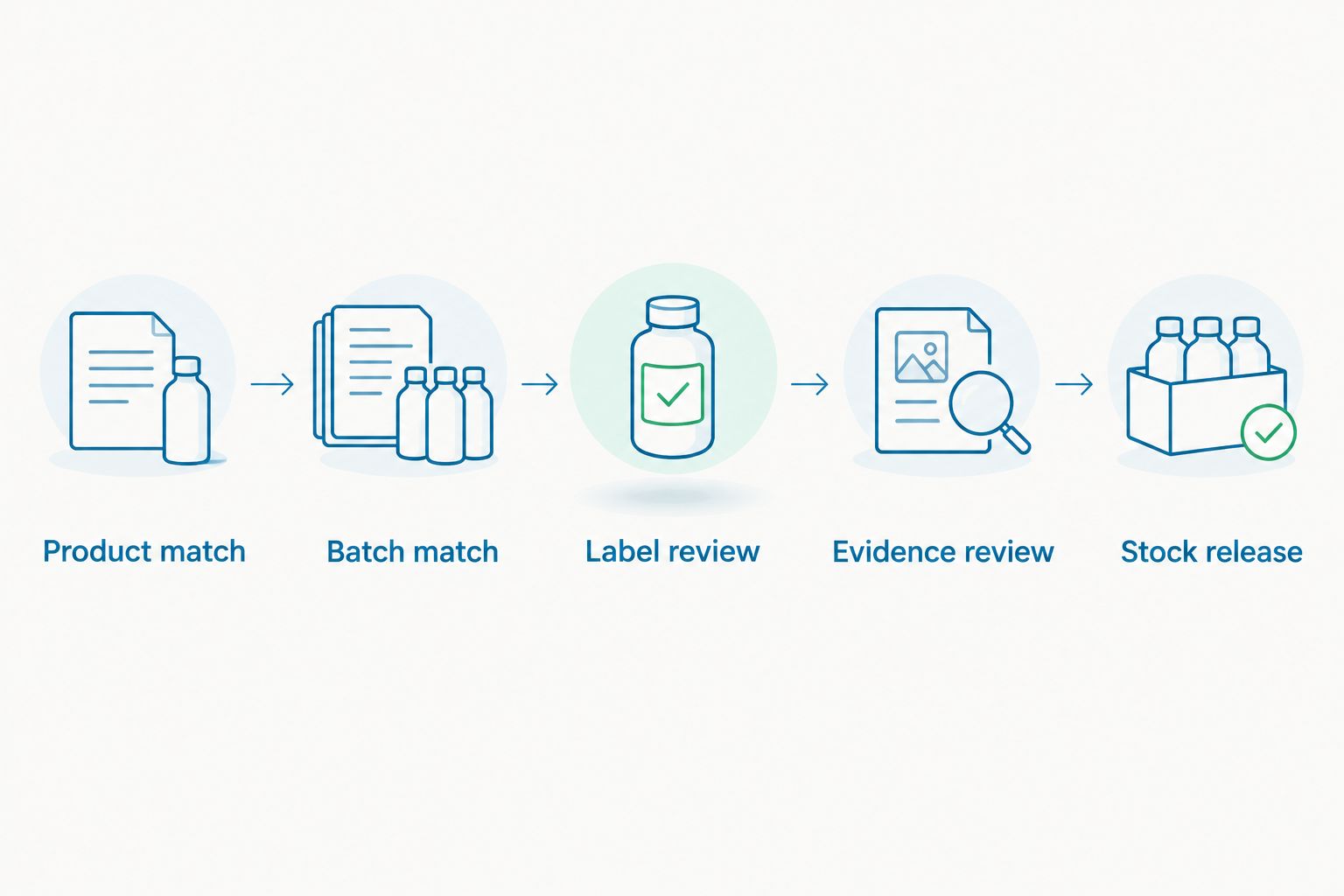
Keep the acceptance record with the purchasing documents so another employee can reconstruct the decision. A shared folder full of unrelated PDFs is not a usable approval system.
Apply this process to repeat orders as well as new suppliers. For broader purchasing organization, use the tattoo ink guide for wholesale and multi-location supply buyers alongside your compliance procedure.
Does REACH-compliant mean sterile or allergy-free?
REACH-compliant does not mean sterile or allergy-free. Chemical restrictions, microbiological quality, and individual allergic reactions are different questions. Request evidence appropriate to each claim instead of letting one label stand in for all of them.
Vegan describes another separate attribute. It does not establish restricted-substance compliance, microbiological quality, or suitability for every client.
For a 2026 product listing, keep those claims separate in your catalog fields. Your sales team should be able to explain what supports each statement without extending it into a medical guarantee.
Is a safety data sheet enough to approve an ink?
A safety data sheet alone is not enough to approve tattoo ink as REACH-compliant. It communicates chemical hazard and handling information where required; it does not replace the product-specific compliance assessment or required bottle labeling.
Ask for the manufacturer’s compliance statement and supporting basis. If a seller responds only with an SDS, identify the unresolved questions rather than assuming the document answers them.
Should you reject ink when the seller cannot connect the evidence?
Hold the affected order when the seller cannot connect the evidence to the product supplied. An unresolved identity or formulation mismatch prevents a defensible approval decision. Give the seller a precise request for clarification and document the response.
Missing evidence is not itself proof that an ink breaches a restriction. It is sufficient reason not to represent that product as verified until the gap is resolved.
Make the purchasing decision evidence-led
INTENZE professional tattoo ink is an option for distributors prioritizing sterile manufacturing and 30+ years of professional artist use. Apply the same product-specific documentation standard before purchasing: confirm the formulation, destination market, and evidence covering the intended order.
The benefit is an established professional-ink manufacturer with a direct online purchasing destination. The limitation is equally clear: brand credentials do not establish the compliance status of every individual product or shipment. Start with the products you need, then resolve the supporting documentation before committing inventory.
Review professional tattoo ink
Review products online, then confirm formulation-specific compliance evidence for your intended market.
FAQ
How do I verify tattoo ink is REACH-compliant before a wholesale order?
Match the exact product and formulation to the manufacturer’s compliance statement, supporting evidence, and required labeling. Reconcile the delivered bottles and batches with that approved record before releasing stock.
Is there one REACH certificate that covers every ink a brand sells?
A brand-wide certificate does not automatically establish compliance for every ink. Check which products, formulations, and restrictions the document explicitly covers and what evidence supports it.
Can a laboratory report prove an entire tattoo ink range is compliant?
A laboratory report supports conclusions within its stated sample and testing scope. Ask how the manufacturer connects that evidence to each product you intend to purchase.
Does REACH compliance guarantee that tattoo ink will not cause allergies?
REACH compliance does not guarantee that tattoo ink will not cause allergies. Do not describe a compliant product as allergy-free or medically safe for every client.
Do permanent makeup pigments need separate verification?
Permanent makeup pigments require product-specific verification under the applicable tattooing-mixture restrictions. A professional tattoo ink document does not automatically cover a different PMU formulation.
Should a distributor check repeat orders again?
A distributor should check product identity, batches, labeling, and evidence coverage on repeat orders. Review unexplained changes before releasing the affected stock.
Does a US manufacturing address prove EU REACH compliance?
A US manufacturing address does not prove EU REACH compliance. Verify the exact formulation and the obligations applicable to the destination market.
One last thing
The weakest link can be product identity rather than laboratory testing. Strong analytical evidence is unusable for a purchasing decision when nobody can connect the tested formulation to the bottle delivered.
For your 2026 purchasing file, make that connection explicit: approved product, applicable evidence, received batch, and documented release. Traceability makes the compliance claim actionable.