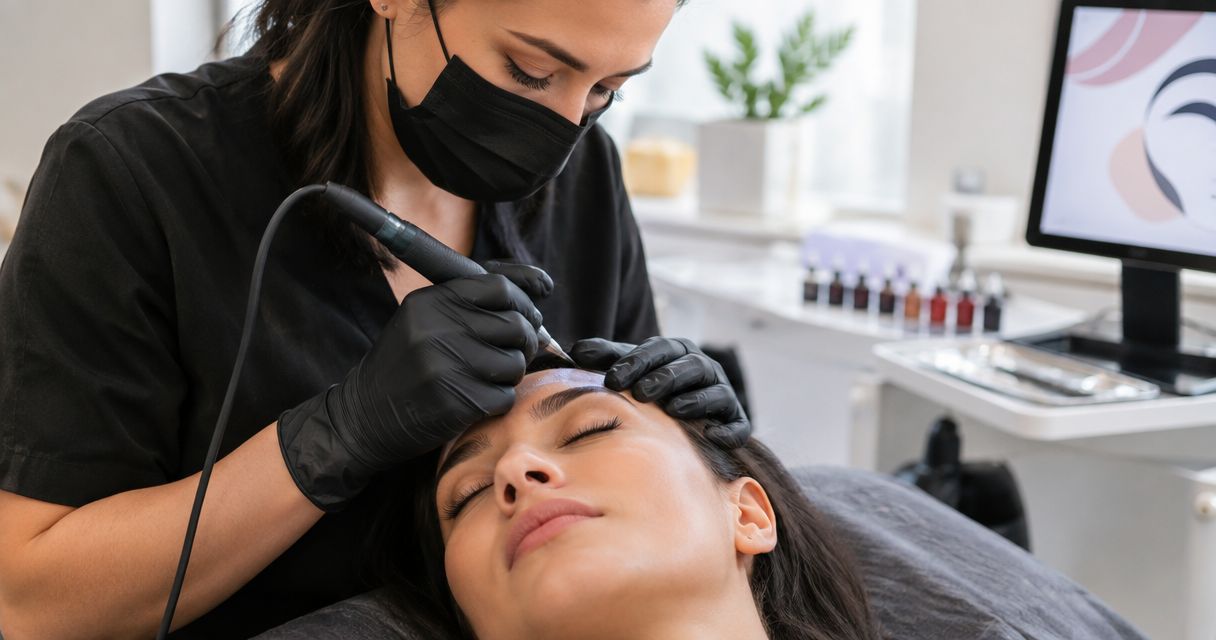
You should not substitute general-purpose tattoo ink for permanent makeup unless the manufacturer explicitly identifies that formulation as suitable for the intended PMU procedure. Both involve placing pigment into skin, but a shared application method does not establish suitability for eyebrows, lips, or eyeliner; a PMU label also does not guarantee safety or a particular healed result.
- Can you use tattoo ink for permanent makeup? Only when the manufacturer explicitly supports the intended PMU application.
- INTENZE manufactures professional tattoo ink and PMU pigments; evaluate each formulation separately.
- Sterile and vegan claims do not establish suitability for brows, lips, or eyeliner.
- Distributors should verify intended use, traceability, and instructions before listing tattoo ink as a PMU substitute.
Why this matters
A distributor's product description can turn a purchasing assumption into a procedure recommendation. If you list body tattoo ink as interchangeable with permanent makeup pigment, buyers can mistake that listing for manufacturer-supported guidance.
Separate product identity from procedure suitability. Ingredient-origin terms do not resolve that question either, as explained in whether organic tattoo ink is safer than regular tattoo ink. For your 2026 catalog, the useful distinction is what the specific formulation is intended to do, not whether its marketing sounds cleaner.
Can you use tattoo ink for permanent makeup?
Use a tattoo ink for PMU only when its manufacturer explicitly supports the specific application. A bottle intended for body tattooing is not automatically suitable for cosmetic tattooing, even when its color resembles a brow or lip shade.
The comparison below is a purchasing framework, not a claim that every product within either category has the same chemistry. Formulations vary, and the product's own documentation remains the deciding evidence.
| Purchasing option | Best for | Useful evidence | Limitation |
|---|---|---|---|
| Professional tattoo ink | Body tattooing supported by the manufacturer's instructions | Intended-use statement, product identity, handling instructions, and traceability | A body-tattooing designation alone does not establish PMU suitability |
| PMU pigment | Cosmetic tattooing applications specifically supported by the manufacturer | Application guidance for the relevant procedure and formulation | The PMU category name alone does not establish suitability for every facial area |
| Tattoo ink explicitly designated for a PMU application | The particular PMU procedure identified by the manufacturer | Clear product-specific support for that application | Do not extend that support to other procedures without evidence |
There is no defensible shortcut based solely on bottle color, pigment darkness, or the word professional. Those features do not tell you whether the manufacturer supports the procedure your customer intends to perform.
For distributors, the practical answer is simple: list a product under the applications supported by its documentation. Do not broaden those applications because another artist uses it that way.
Body tattoo ink: keep the recommendation application-specific
Professional tattoo ink belongs in a body-tattooing assortment when its intended use supports that category. Its advantage is a defined role in the professional tattoo workflow; its limitation is that this role does not automatically extend to cosmetic procedures.
A black tattoo ink marketed for lining, for example, does not become an eyeliner pigment merely because both applications use dark color. Likewise, a brown tattoo ink does not become a brow pigment simply because a buyer wants brown eyebrows.
Avoid substituting visual similarity for formulation guidance. A photograph, fresh swatch, or artist demonstration cannot establish that a product is appropriate for a different anatomical location or technique.
If a customer asks for a crossover recommendation, identify the exact product and procedure before answering. A general statement about tattoo ink is too broad to support a purchasing decision.
PMU pigments: choose by procedure, not just shade
A PMU designation is a useful starting point because it identifies cosmetic tattooing as the product category. It is not the end of the assessment: verify whether the manufacturer supports the intended brow, lip, or eyeliner application.
The benefit of a procedure-specific selection is a closer match between the buyer's intended use and the manufacturer's guidance. The limitation is that a PMU product still requires appropriate training, handling, client assessment, and compliance with applicable rules.
For your 2026 assortment, organize PMU listings around supported applications and retain the documentation behind each listing. Do not copy a claim from one shade to an entire range unless the manufacturer applies it to that range.
A product suitable for one cosmetic tattooing application is not automatically suitable for every other application. This matters particularly when a buyer wants one bottle to serve several procedures.
Why suitability varies
The decision depends on product-specific evidence, not a universal tattoo-ink-versus-PMU rule. Review these factors before making a substitution recommendation:
- Intended application: Confirm whether the manufacturer identifies body tattooing, cosmetic tattooing, or the specific PMU procedure.
- Formulation identity: Evaluate the exact formulation rather than assuming every product from the same brand has identical properties.
- Application guidance: Check supported techniques, handling instructions, and any restrictions stated by the manufacturer.
- Anatomical location: Do not treat support for one body area as permission to use the product elsewhere, especially near the eyes.
- Traceability and handling: Verify product identity, batch information, expiration information, and storage instructions before supplying it.
- Local requirements: Confirm that the product and intended service meet the rules applicable to the destination and practitioner.
These factors answer different questions. Traceability helps identify the product, while an intended-use statement addresses its purpose; neither replaces the other.
A stronger claim in one category does not fill an evidence gap in another. A documented sterile-manufacturing claim does not establish eyeliner suitability, just as an intended-use statement does not prove that a bottle has been stored correctly.
How to evaluate a substitution request before ordering
Use this sequence when a studio asks whether an existing tattoo ink can replace its PMU pigment. Keep the answer tied to the exact bottle and intended procedure.
- Product identity: Record the product name and formulation exactly as supplied. Do not assess a request using only a brand name or a generic color description.
- Intended use: Read the manufacturer's product-specific instructions. Look for explicit support for the proposed cosmetic tattooing application rather than inferring permission from silence.
- Procedure match: Match the documented application to the customer's request. Support for brows does not independently establish support for lips or eyeliner.
- Traceability: Check the source, batch details, expiration information, and handling requirements. Treat unclear or inconsistent information as a reason to resolve the order before release.
- Listing decision: Publish only the supported application claims. If the proposed substitution is not documented, select an appropriately designated product instead.
Written product guidance is more useful than an informal statement that artists have done this before. Experience with a product does not make every application manufacturer-supported.

Keep the supporting material attached to the product record. That gives purchasing staff and customer-service staff the same basis for answering a substitution question.
What sterile, vegan, and REACH-compliant claims actually tell you
These terms address different product attributes. None, by itself, establishes that a tattoo ink is appropriate for permanent makeup.
- Sterile: Addresses microbial status under the stated conditions. It does not guarantee freedom from allergic reactions, establish facial application suitability, or replace hygienic handling after opening.
- Vegan: Addresses animal-derived ingredients within the scope of the claim. It does not establish sterility, allergy safety, or compatibility with a PMU procedure.
- REACH-compliant: Addresses applicable chemical requirements within the scope of the compliance claim. It does not mean a product is approved for every cosmetic tattooing technique or anatomical location.
For 2026 purchasing decisions, request evidence that matches the claim being made. Do not treat a compliance badge as a substitute for the product's intended-use instructions.
In the United States, the FDA has not approved color additives for injection into the skin. Describing a tattoo or PMU pigment as FDA-approved on that basis is therefore inaccurate; a manufacturer's establishment or administrative status does not change that distinction.
Avoid translating technical claims into medical guarantees. Neither tattoo ink nor PMU pigment should be described as allergy-proof, risk-free, or guaranteed to heal a particular way.
What distributors should ask before buying online
Ask the supplier to identify the product's supported application and provide the corresponding instructions. If the answer relies on a general brand reputation rather than the formulation, the substitution question remains unanswered.
Build your purchasing record around evidence you can retain:
- The exact product and formulation being ordered.
- The manufacturer's stated applications and restrictions.
- Available documentation supporting sterility or compliance claims.
- Batch identification, expiration information, and storage instructions.
- Supplier identity and a clear route for resolving product questions.
- Guidance on mixing or dilution, where the manufacturer provides it.
INTENZE's stated credibility includes sterile manufacturing and 30+ years of professional artist use. Those credentials support evaluating the manufacturer, but they do not replace product-specific evidence for a proposed PMU application.
INTENZE fits distributors sourcing professional tattoo ink and PMU pigments from a manufacturer. The purchasing advantage is access to both stated product categories; the limitation is that carrying both categories does not make their formulations interchangeable.
Visit INTENZE to evaluate the product you intend to buy, then confirm its application before placing the order. Keep professional tattoo ink and PMU selections distinct wherever the manufacturer's guidance distinguishes them.
Check the intended application before ordering
Match your tattoo ink or PMU purchase to the manufacturer's product-specific guidance.
Can you dilute tattoo ink to make it a PMU pigment?
Dilution does not establish PMU suitability. It changes the mixture, but it does not create manufacturer support for a cosmetic application or validate the resulting formulation.
Follow only the mixing and dilution instructions applicable to the exact product. Do not give distributors or practitioners a homemade conversion recipe based on an assumed pigment concentration.
Is PMU pigment safer than tattoo ink?
The category name alone does not establish that PMU pigment is safer. Safety assessment depends on the actual product, its manufacture and handling, the procedure, and the individual client.
Choose the product with documented support for the intended application rather than making a blanket safety comparison. Appropriate selection is not a guarantee against adverse reactions.
Does using PMU pigment guarantee a predictable healed color?
A PMU label does not guarantee a particular healed color. Pigment selection, technique, skin characteristics, and healing affect appearance, so a bottle label or fresh swatch cannot promise an identical result for every client.
Keep product claims separate from outcome claims in your 2026 catalog. Use substantiated, product-specific evidence when discussing healed appearance, and do not convert individual examples into universal guarantees.
FAQ
Can you use tattoo ink for permanent makeup if it is sterile?
Sterility alone does not establish that tattoo ink is suitable for permanent makeup. Confirm that the manufacturer supports the exact PMU application, and follow the product's handling instructions.
Can I use regular black tattoo ink for eyeliner?
Do not use regular black tattoo ink for eyeliner solely because it is black. Choose a formulation with explicit manufacturer support for that application and follow applicable professional requirements.
Is brown tattoo ink the same as eyebrow pigment?
Brown tattoo ink is not automatically equivalent to an eyebrow pigment. A similar visible shade does not establish matching formulation, intended use, or application guidance.
Can I mix tattoo ink and PMU pigment together?
Do not assume tattoo ink and PMU pigment are compatible for mixing. Follow product-specific manufacturer instructions rather than treating shared color or brand identity as permission.
Does REACH compliance mean a tattoo ink is approved for PMU?
REACH compliance does not independently establish PMU suitability. Verify the scope of the compliance claim and the manufacturer's support for the intended procedure.
What should a distributor check before listing an ink for permanent makeup?
A distributor should verify the exact formulation, supported application, handling instructions, and traceability before listing an ink for permanent makeup. Keep the supporting documentation with the product record.
Does the FDA approve permanent makeup pigments for injection?
The FDA has not approved color additives for injection into the skin. Do not describe a tattoo or permanent makeup pigment as FDA-approved on the basis of its color additives.
One last thing
Check your catalog filters, not just your product descriptions. An accurately written listing can still imply an unsupported application if the product appears under an eyeliner, lip, or brow filter.
For your 2026 catalog review, make every application tag answer the same question: does the manufacturer support this exact use? If not, remove the tag until the evidence supports it.