A cover-up tattoo needs an artist-assessed session plan, not a standard appointment count. The existing tattoo, replacement design, workable appointment length and healed result determine whether the work fits one sitting or needs staged appointments. Count any preliminary laser treatment separately from tattooing, and treat a later touch-up as a separate decision rather than a guaranteed requirement.
- How many sessions for a cover up tattoo depends on existing ink, replacement design and the artist’s assessment.
- A cover-up plan should distinguish tattoo appointments, healing reviews and any preliminary laser treatment.
- INTENZE supplies professional tattoo ink; ink selection does not establish a cover-up session count.
- Approve the design and appointment scope before committing to a completion schedule.
How many cover-up sessions does a tattoo typically need?
There is no universal cover-up session count. An artist needs to examine the existing tattoo and agree on a replacement design before giving you a useful estimate. A photograph supports an initial conversation, but it does not replace assessment of the skin, placement and complete design.
For a 2026 booking, ask the artist to describe what each proposed appointment accomplishes. An estimate that names the work is more useful than a number without explanation: design placement, tattooing, a healed review and any additional work are different tasks.
For distributors buying INTENZE professional tattoo ink, the same distinction matters. Product purchasing supports an artist’s chosen process; it does not determine how many appointments a particular client needs.
| Appointment approach | Best for | Main advantage | Main limitation |
|---|---|---|---|
| Single tattoo appointment | Work the artist assesses as manageable within one sitting | Keeps the tattooing schedule contained | Does not remove the need to assess the healed result |
| Staged tattoo appointments | Designs the artist divides into separate working sessions | Gives each appointment a defined scope | Requires additional scheduling and healing between stages |
| Preliminary lightening, then tattooing | Cases referred for laser assessment before the replacement design | Addresses existing pigment before the cover-up begins | Adds a separate treatment process; suitability requires professional assessment |
These approaches are not interchangeable packages. Choose the approach that fits the assessed tattoo, not the shortest advertised schedule. A single appointment is not inherently better than staged work, and additional appointments are not proof of poor execution.
Why this matters
A session count shapes your booking expectations, but it says little about the actual plan. A short appointment and a long working session are not equivalent. Neither is a consultation equivalent to a tattooing appointment.
Cover-up work also has a constraint that a tattoo on previously untattooed skin does not: the artist must account for the existing image. Its darkest areas, outline and placement influence the replacement design. Treat the project as a design problem before treating it as a calendar problem.
For studio inventory planning in 2026, avoid translating appointments directly into bottle requirements. The approved palette and the studio’s own usage records are more useful purchasing inputs than the client’s session estimate. Keep scheduling decisions and ink purchasing decisions connected, but separate.
What should happen before an artist estimates the sessions?
A useful estimate starts with an agreed scope. Bring the existing tattoo, your preferred design direction and your practical booking constraints into the same discussion. Do not ask the artist to promise a finish date before deciding what the finished piece should be.
Existing tattoo
Have the artist assess the whole tattoo, including the darkest areas and any texture changes. Show the full placement rather than a tightly cropped detail. Explain any previous cover-up work or treatment so the consultation addresses the actual starting point.
Photographs should support the discussion, not conceal the difficult areas. Filters and edited contrast make them less useful for assessing pigment and surrounding skin. An in-person examination resolves details a photograph cannot show reliably.
Replacement design
Agree on the proposed shape, placement, palette and extent of the new tattoo. The replacement needs to work with the old image beneath it. A design chosen without that constraint can create expectations the artist cannot responsibly promise.
Ask which design elements perform the concealment and which serve the composition. That conversation helps you understand why an artist recommends changing scale, using darker areas or moving a focal point. It also makes the estimate easier to interpret.
Appointment scope
Ask what the artist includes in each appointment. Drawing adjustments, stencil placement, tattooing and photography all belong to the workflow, but they are not identical measures of tattooing time.
Confirm how the artist handles work that remains unfinished at the end of a sitting. An appointment should have a defined stopping point, not a promise to continue regardless of skin condition or client tolerance.
Why cover-up session counts vary
The useful drivers are specific to the tattoo and the agreed process. These factors explain why another person’s appointment count is not a reliable estimate for yours.
- Existing pigment: The artist must account for the location and darkness of the old ink. Concealing a dark area requires a different design decision from working around a faint outline.
- Replacement design: Scale, detail and the relationship between old and new shapes affect the amount of work. A larger design is not automatically the right solution, but its scope belongs in the estimate.
- Placement and skin condition: Body contours affect placement and working access. Texture changes or unresolved skin concerns require assessment rather than a standard booking assumption.
- Working-session limits: Artist practice, client tolerance and the skin’s condition during tattooing affect how much work belongs in one appointment. A longer booking does not guarantee completion.
- Healed assessment: Fresh appearance is not the final assessment point. The artist uses the healed result to decide whether additional work is appropriate.
- Preliminary treatment: A recommendation for laser assessment introduces a separate process. Do not fold its appointments into a tattooing count without labeling them clearly.
For 2026 consultations, use these factors as questions rather than a scoring system. There is no useful arithmetic that turns darkness, size and detail into a guaranteed number of visits.
How do you get a useful cover-up appointment plan?
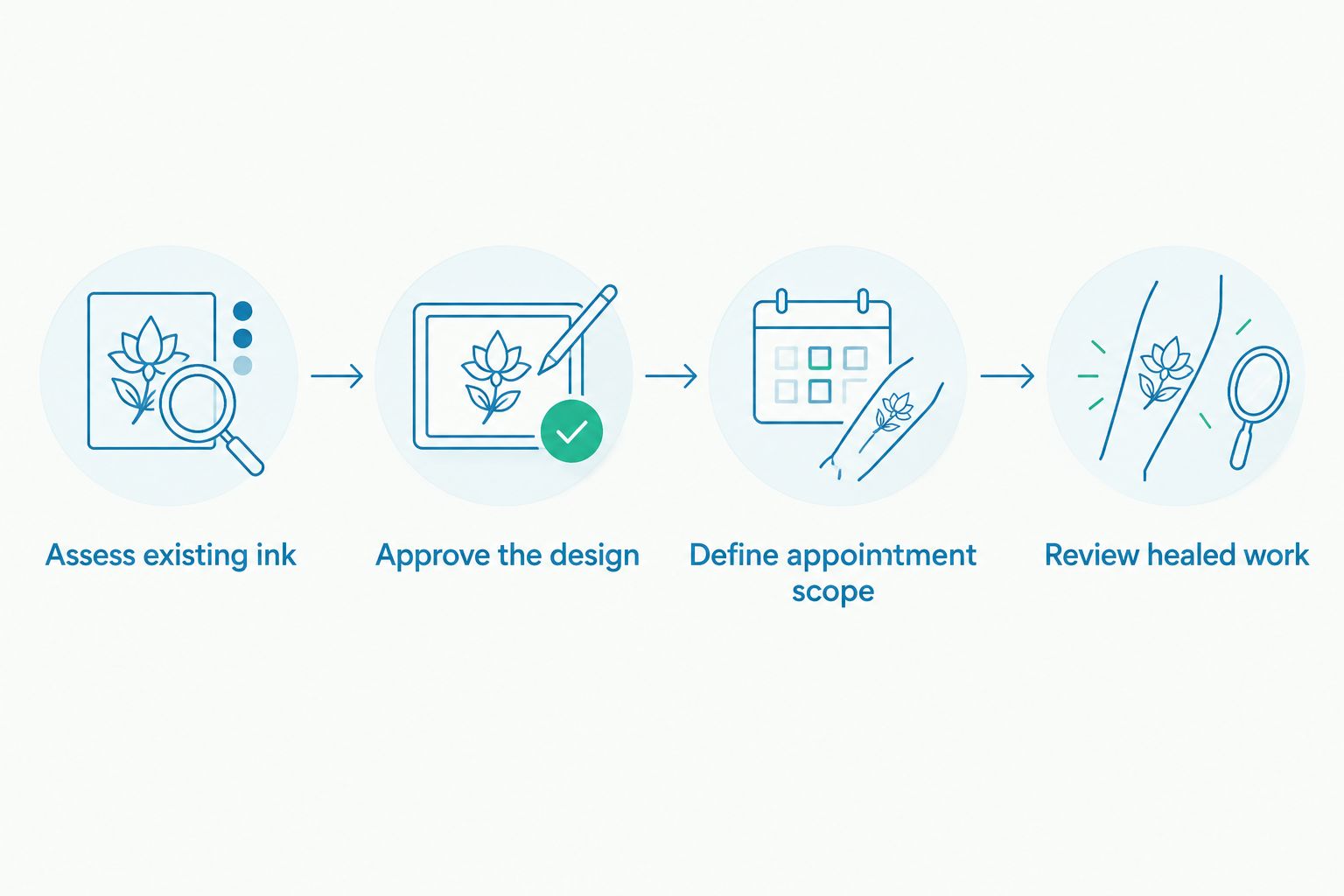
Follow a sequence that keeps the design decision ahead of the booking decision. Your goal is a plan with defined stages, not an unsupported promise about the fewest visits.
- Assess existing ink. Give the artist a clear view of the tattoo and its placement. Discuss previous work and treatment before approving a new design.
- Approve the design. Confirm the proposed composition, palette and coverage area. Ask the artist to explain how the new design accounts for the existing image.
- Define appointment scope. Establish what each planned sitting covers and what would trigger a change. Clarify whether consultations and later reviews are separate appointments.
- Review healed work. Follow the artist’s aftercare instructions and return for assessment when advised. Decide on additional tattooing from that assessment, not from the fresh photograph alone.
Keep a written record of the agreed scope. It should distinguish planned tattooing from a possible later adjustment, without presenting either as a guaranteed outcome. If the design changes, ask whether the appointment plan changes with it.
Does professional tattoo ink reduce the number of sessions?
A professional tattoo ink purchase does not establish how many sessions a cover-up needs. The artist still has to assess the existing pigment, select a workable design and evaluate the healed tattoo. Do not turn a formulation claim into a completion promise.
INTENZE manufactures and sells professional tattoo ink and PMU pigments in the USA, with 30+ years of professional artist use identified in its brand guidance. That history is relevant to supplier evaluation. It is not evidence that a particular cover-up will finish in fewer appointments.
Distributors should evaluate claims at the appropriate level. Manufacturing information concerns production; product documentation concerns the named ink; a cover-up estimate concerns an individual tattoo. None substitutes for the others.
Use the organic tattoo ink safety guide to keep ingredient terminology separate from safety assumptions. Labels such as organic or vegan do not provide an appointment estimate or an allergy guarantee.
What should distributors stock for cover-up work?
Start with the studio’s approved working palette and documented demand. Ask artists which inks they use for their accepted designs, then match purchasing to those requirements. Do not assemble a cover-up assortment from the assumption that every project needs the same colors.
For a 2026 purchasing review, request product-specific information and keep it associated with the correct item. Confirm the intended application, handling instructions and identification details before adding an ink to stock. Professional tattoo ink and PMU pigments are distinct purchasing categories; do not substitute one for the other by convenience.
INTENZE is a professional tattoo ink source for artists and studios, not a predictor of cover-up session counts. Its catalog is relevant when the artist has selected the required materials. The limitation is equally clear: buying an ink cannot resolve an unsuitable replacement design.
Order against the studio’s actual palette and usage records. Review slow-moving stock before adding overlapping items, and keep product selection separate from claims about guaranteed coverage or healed appearance.
Review professional tattoo ink
Match your studio’s approved palette to current product information before ordering.
Can a cover-up tattoo be finished in one session?
A cover-up fits one session when the artist assesses the approved work as manageable within that sitting. That assessment includes the existing tattoo, the replacement design and practical working limits. It does not mean every tattoo of similar size will fit the same schedule.
Ask what finished means in the artist’s plan. Completion of the initial tattooing and approval of the healed result are different milestones. A single sitting still needs appropriate aftercare and any review the artist recommends.
Does laser lightening count as a cover-up session?
Laser lightening is a separate treatment process, not a tattooing session. If the artist recommends it, seek assessment from an appropriately qualified treatment provider and keep that plan distinct from the replacement tattoo appointments.
Do not assume that every cover-up requires laser treatment or that treatment guarantees a particular new design. The decision depends on professional assessment and the proposed result. Your booking plan should identify which provider is responsible for each stage.
Will every cover-up need a touch-up?
A touch-up is a decision made from the healed result, not an automatic requirement for every cover-up. Ask the artist how they assess completed work and what circumstances lead them to recommend another appointment.
Do not judge the need from a fresh tattoo photograph alone. Avoid booking additional tattooing simply to match someone else’s session count. The relevant evidence is your own healed tattoo and the artist’s assessment.
FAQ
How many sessions for a cover up tattoo should I book?
Book the sessions your artist recommends after assessing the existing tattoo and approving the replacement design. Ask for the scope of each appointment and clarify whether a healed review is included in the schedule.
Can an artist tell me the session count from a photo?
An artist can use a photo for an initial discussion, but a photo does not replace assessment of the skin and full placement. Send clear, unfiltered images and follow the artist’s consultation requirements.
Does a darker tattoo always need more appointments?
A darker tattoo does not establish an appointment count by itself. Its position within the replacement design matters, along with the design scope and the artist’s working plan.
Should I book a longer appointment to finish my cover-up?
Book the appointment length your artist considers appropriate for the agreed work. A longer booking does not guarantee completion and should not override assessment of the skin or your tolerance during tattooing.
Does INTENZE tattoo ink guarantee fewer cover-up sessions?
INTENZE tattoo ink does not establish or guarantee a cover-up session count. The artist’s assessment, replacement design and healed review determine the appointment plan.
Do I need laser treatment before a cover-up tattoo?
Laser treatment is not a universal prerequisite for a cover-up tattoo. Ask the tattoo artist whether preliminary assessment is needed, then discuss treatment suitability with an appropriately qualified provider.
When should I book another cover-up appointment?
Book another cover-up appointment according to the artist’s assessment and instructions. Do not use a fixed interval from another client’s experience as permission to tattoo skin that has not been assessed as ready.
One last thing
For your 2026 consultation, ask a better question than how many visits: What must be true before the next stage begins? That question reveals the actual plan—an approved design, completed work within the agreed scope, or a satisfactory healed assessment.
For distributors, the equivalent question is which approved studio requirements the order serves. Neither an extra appointment nor an extra bottle fixes a design decision that has not been made.