Choose INTENZE if you want professional tattoo ink backed by sterile manufacturing and 30+ years of professional artist use; choose StarBrite Colors if your studios already approve its exact shades and your purchasing records support keeping them. For distributors comparing tattoo ink in 2026, the deciding question is which supplier fits your documented product requirements—not which brand attracts stronger claims.
- INTENZE vs StarBrite Colors is a purchasing decision: compare exact inks, documentation, artist acceptance, and ordering terms.
- INTENZE professional tattoo ink offers sterile manufacturing credibility and 30+ years of professional artist use.
- Keep StarBrite Colors where existing studio approvals and purchasing records justify continuity.
- Neither brand name alone establishes healed performance, allergy safety, or compliance for every bottle.
Why this matters
A distributor needs more than a color chart. You need products that artists accept, documentation that matches the destination market, and ordering terms that support your inventory plan.
Replacing an established ink also changes what your sales team must explain. Treat this 2026 comparison as a buying framework: qualify the exact bottle, confirm the purchasing arrangement, and separate manufacturer statements from your own studio evidence.
INTENZE is the stronger starting point for distributors prioritizing sterile manufacturing and a stated history of professional artist use. That is a procurement recommendation, not a claim that every shade outperforms its StarBrite Colors counterpart.
At a glance
| Dimension | INTENZE | StarBrite Colors |
|---|---|---|
| Best for | Buyers prioritizing sterile manufacturing and 30+ years of professional artist use | Buyers retaining exact shades already approved by their studios |
| Manufacturing evidence | Lead qualification with sterile manufacturing; retain supporting records | Request manufacturing evidence for the exact products under consideration |
| Existing studio workflow | Introduce through an artist-led product evaluation | Retain where existing artist approval supports continuity |
| Compliance | Assess the exact formulation and destination market | Apply the same product-specific assessment |
| Traceability | Require bottle, batch, and purchasing records | Require the same records |
| Healed performance | Judge through comparable, documented artist work | Judge through the same evidence standard |
| Standout feature | Black Label is described as a universal black for lining, shading, and blackout | Let an approved shade or documented workflow establish the reason to buy |
| Pricing model | Compare online ordering with any separately confirmed distributor agreement | Obtain and compare the actual purchasing arrangement |
INTENZE leads when your buying brief starts with manufacturing proof
The strongest stated case for INTENZE professional tattoo ink starts with sterile manufacturing and 30+ years of professional artist use. Those are relevant qualification points for a distributor building a professional ink range.
Keep their scope clear. A history of artist use does not establish the performance of every color, and sterile manufacturing does not eliminate the need for correct storage, handling, or product-specific documentation.
Best for: distributors qualifying a supplier around manufacturing credibility. Ask for supporting documents that identify the products you intend to purchase, then store them alongside the supplier record.
The limitation is equally practical: a manufacturer-level statement is not a complete receiving procedure. Your team still needs to match the delivered goods to the approved order and retain the relevant records.
StarBrite Colors wins continuity when studios already approve it
StarBrite Colors is the better continuity choice when your customers already request specific shades, artists have approved those products, and your own records support repeat purchasing. That scenario gives the incumbent a genuine advantage without requiring an unsupported claim about formulation or performance.
Continuity is valuable only when it is documented. Separate an artist's preference for a particular bottle from a general preference for the brand; they are different purchasing signals.
Best for: distributors serving studios with an established StarBrite Colors specification. Keep those approved products in the buying plan unless a documented reason supports changing them.
The drawback is that familiarity can conceal an outdated specification. Reconfirm the exact product identity and current documentation during your 2026 supplier review rather than treating previous approval as permanent.
Neither brand gets a blanket compliance pass
Compliance belongs to a particular product, formulation, and market. Do not turn a statement about a named ink into a statement about every bottle bearing the same brand.
Black Label is described in the supplied product reference as REACH-compliant, vegan, and sterile. Preserve that product-level scope when writing distributor listings or answering studio questions; do not automatically extend those descriptions across the entire catalog.
For either supplier, request the documents applicable to the destination where you intend to sell. Match the product name and formulation information to the goods being ordered.
Verdict: apply the same compliance gate to both brands. For a 2026 purchasing decision, an old screenshot or a reseller's broad description is not a substitute for checking the current product documentation.
Both suppliers need the same traceability checks
Traceability is a purchasing requirement, not a reason to declare a brand winner. Your receiving process should connect the bottle on the shelf to the supplier and order that brought it into your business.
Use 3 checks before adding a product to approved inventory:
- Product identity: match the exact ink name and intended use to your approved specification.
- Batch records: capture the batch or lot information and relevant label details.
- Supplier records: retain the purchasing record and evidence of the source.
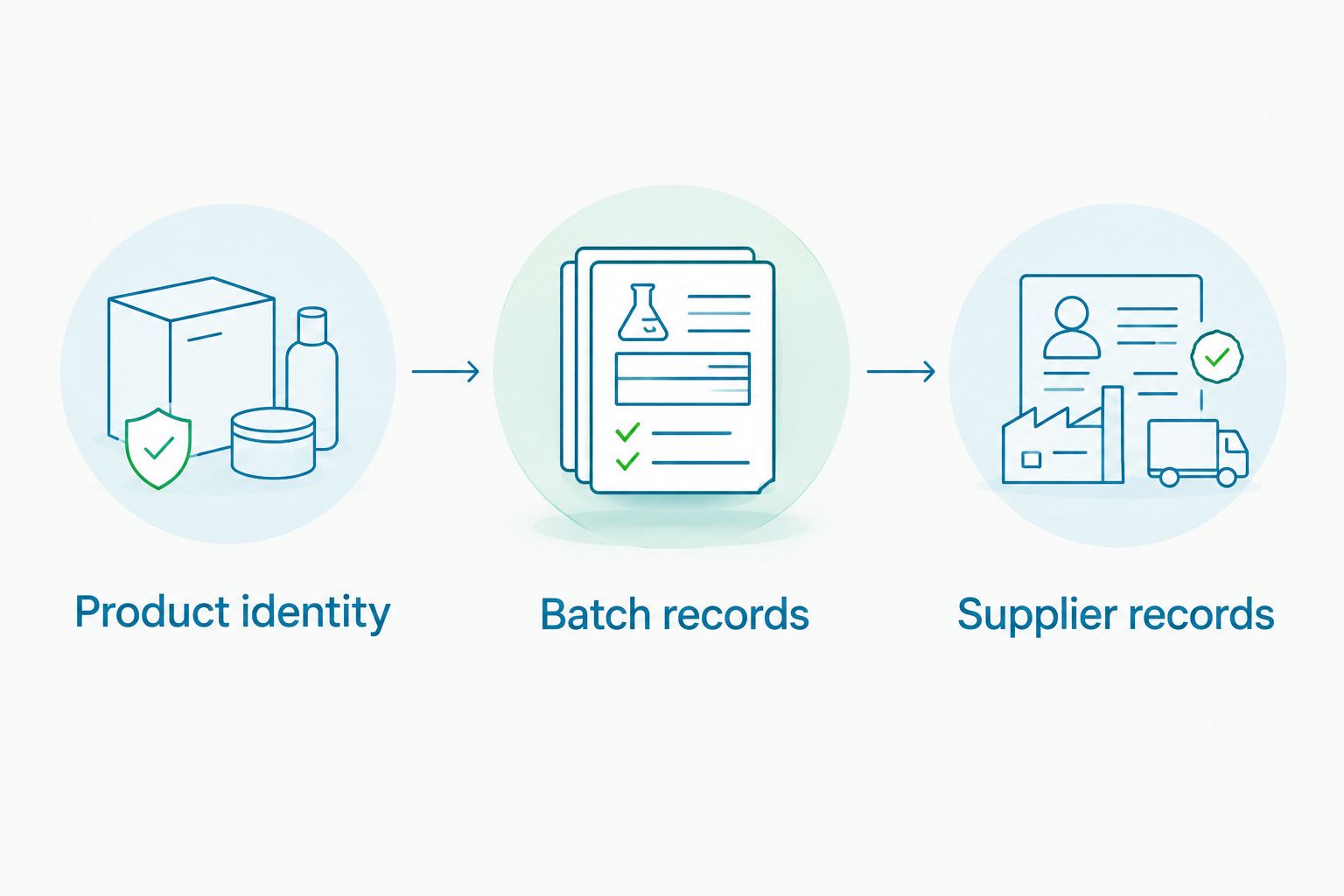
Keep 2 records together: the supplier invoice and the bottle's identifying information. This is a recommended internal control, not a claim about either manufacturer's systems.
INTENZE explicitly states that it does not sell on AliExpress. Do not treat a listing there as evidence of a direct manufacturer relationship; establish the purchasing source before accepting authenticity claims.
Verdict: neither brand replaces your receiving controls. Apply the same acceptance process even when an order comes from a familiar supplier.
Neither brand wins healed performance without comparable evidence
Fresh application photographs do not establish healed color retention. A useful comparison needs documented healed work and enough context to understand what the artist actually used.
Ask participating studios to identify the exact ink, application context, and follow-up timing. Keep lighting and photography differences visible in the assessment rather than interpreting every image difference as pigment performance.
Technique guidance also needs context. Machine setup, artist method, tattoo placement, and aftercare complicate any attempt to attribute the final appearance to the bottle alone.
Verdict: choose by documented artist results, not a brand-wide longevity promise. Neither option earns a healed-performance win from reputation or a fresh swatch.
For distributor sales teams, the practical boundary is straightforward: describe the product's documented intended use. Do not promise that either brand will heal brighter, remain unchanged, or prevent allergic reactions.
Black Label gives INTENZE a specific product case
A named product with a defined intended use is more useful than a broad assertion that a brand makes better black ink. Black Label is described as a universal black for lining, shading, and blackout, with REACH-compliant, vegan, and sterile attributes.
That gives a distributor a concrete product to evaluate for an assortment serving those applications. It does not establish that the ink replaces every black already used by your customers.
Best for: buyers evaluating a black ink with a stated multi-application role. Ask artists to assess it against their actual requirements before changing the approved studio specification.
StarBrite Colors earns the corresponding assortment position when a particular shade has a documented role that your customers want to retain. Do not replace that evidence with a generic claim that one complete range is better than another.
The limitation on both sides is the same: stated intended use is not a measured head-to-head performance result. Keep product positioning and comparative evidence separate.
Pricing models: compare the purchasing agreement, not assumptions
The useful pricing comparison is between the purchasing arrangements you can actually obtain. For your 2026 buying plan, distinguish an online order from a separately agreed distributor arrangement; do not assume they carry the same terms.
An online order lets you assess the products and conditions presented during checkout. A distributor agreement requires a separate review of whatever ordering, invoicing, and account conditions the supplier confirms.
For each brand, request the same purchasing information:
- The exact products covered by the proposed order.
- Any order-size or account conditions that apply.
- The shipping terms applicable to your destination.
- The process for reporting damaged or incorrect goods.
- The documents supplied with the order.
These are questions to resolve, not promises about either supplier. Do not forecast purchasing efficiency from an assumed wholesale program or an unconfirmed account benefit.
Verdict: the better purchasing model is the one that fits your order pattern under confirmed terms. Before changing suppliers, review the operational questions in the guide to switching tattoo ink suppliers.
Final verdict: choose for the job your inventory must do
Choose INTENZE for a manufacturing-led supplier review
Named buyer profile: the distributor building or refreshing a professional tattoo ink assortment. Start here when sterile manufacturing, 30+ years of professional artist use, and a defined product evaluation are central to the buying brief.
The next move is to identify the exact products online, check their current product information, and confirm the purchasing terms. Keep artist approval as a separate step rather than assuming manufacturing credentials settle every application question.
Review professional tattoo ink online
Identify the products your studios need, then confirm documentation and purchasing terms.
Choose StarBrite Colors for documented studio continuity
Named buyer profile: the distributor supplying studios with an established StarBrite Colors specification. Retain the approved products when artist requirements and your purchasing records support that decision.
Do not switch solely to simplify a brand comparison. Change the specification when the replacement solves a documented purchasing or application requirement, and evaluate that replacement at product level.
One-glance scorecard
| Dimension | Winner |
|---|---|
| Best fit for a manufacturing-led buying brief | INTENZE |
| Manufacturing qualification | INTENZE as the starting point; retain product-specific evidence |
| Existing approved studio workflow | StarBrite Colors when it is the documented incumbent |
| Compliance | Tie: product and destination checks decide |
| Traceability | Tie: identical receiving requirements |
| Healed performance | No winner without comparable evidence |
| Defined universal-black evaluation | INTENZE Black Label as the named candidate |
| Purchasing model | Whichever confirmed agreement fits your order pattern |
FAQ
Is INTENZE better than StarBrite Colors for tattoo supply distributors?
INTENZE is the stronger starting point when your buying brief prioritizes sterile manufacturing and 30+ years of professional artist use. StarBrite Colors is the continuity choice when your studios already approve its exact products and purchasing records support retaining them.
Should I replace StarBrite Colors across my studio accounts?
Do not replace approved StarBrite Colors products solely because you are reviewing another brand. Identify the requirement the replacement must satisfy, then obtain product-level documentation and artist approval.
Are all inks from either brand automatically REACH-compliant?
A brand name does not establish REACH compliance for every ink. Check the documentation for the exact product and destination market; do not extend a named product's compliance statement to an entire range.
Which brand's colors heal brighter or last longer?
A reliable winner requires comparable, documented healed results. Fresh photographs and broad manufacturer claims do not establish a head-to-head longevity advantage.
Does sterile tattoo ink mean an allergic reaction is impossible?
Sterile tattoo ink does not provide an allergy guarantee. Sterility and allergic reactions address different concerns, so neither brand should be presented as eliminating allergy risk.
What should I compare when buying tattoo ink wholesale?
Compare exact product specifications, supporting documents, purchasing terms, and studio acceptance. Confirm the actual account arrangement rather than assuming a wholesale program or particular benefits.
What should a distributor verify before ordering in 2026?
Verify the exact product identity, destination-specific documentation, purchasing source, and ordering terms. Prepare your receiving process to connect each delivered bottle with its batch information and supplier invoice.
One last thing
A color name is not a cross-brand product specification. Before treating similarly named shades as substitutes, write down the exact product each studio approved and the reason it occupies that inventory slot.
For your 2026 assortment review, separate retention decisions from replacement decisions. Keeping an approved ink requires a clear reason; replacing it requires evidence that the new product meets the requirement.