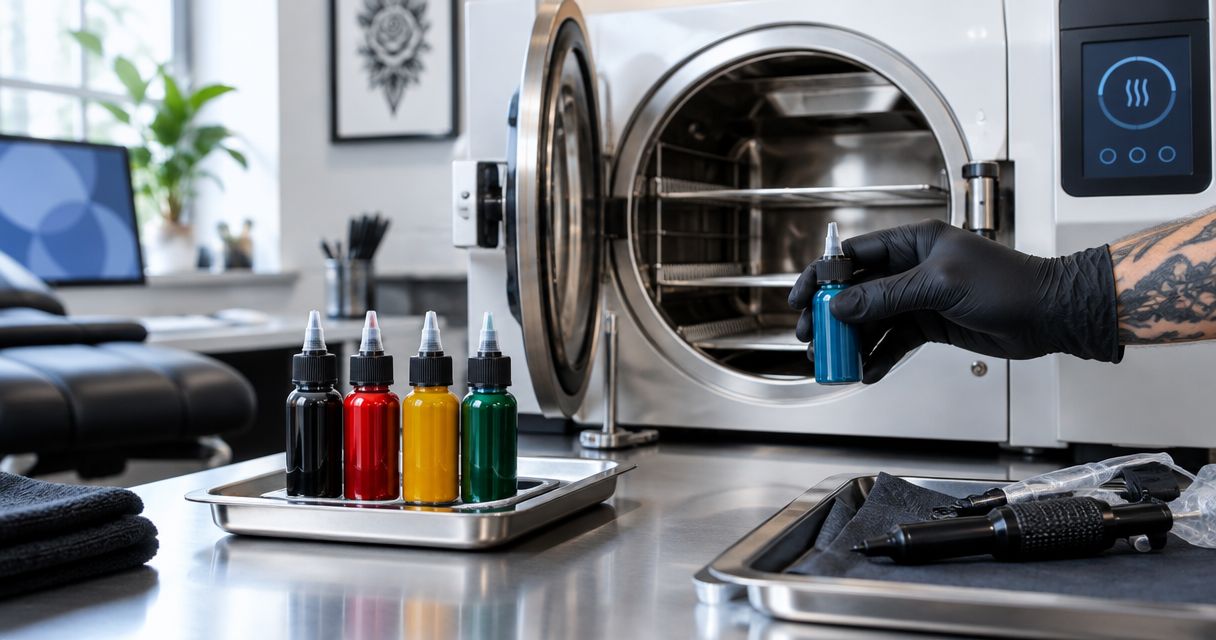
No—do not autoclave tattoo ink bottles between uses unless the manufacturer provides written, validated instructions for that exact ink, bottle, closure, and sterilization process. An equipment sterilization cycle does not establish that bottled ink remains suitable for tattooing afterward. For your 2026 studio or distribution procedure, prevent contamination during dispensing and remove suspect bottles from use rather than attempting to restore them with heat.
- Autoclave tattoo ink bottles safe? No—not without manufacturer validation covering the ink, container, closure, and process.
- INTENZE professional tattoo ink has 30+ years of artist use; manufacturer history does not authorize bottle reprocessing.
- External bottle cleaning, ink-cap handling, and sterilization are different controls; none substitutes for the others.
- Distributors should assess seals, traceability, storage instructions, and handling guidance before releasing tattoo ink stock.
Why this matters
A tattoo ink bottle is not a reusable instrument. Its contents, nozzle, cap, and container form a product system; exposing that system to steam does not prove that every component remains suitable for its intended use.
For distributors evaluating INTENZE, professional tattoo ink purchasing should start with manufacturer information, not a proposed studio sterilization workaround. Your 2026 purchasing specification should distinguish unopened stock from opened working bottles and bottles with suspected contamination. Those categories require different decisions.
Do not make autoclaving the corrective action for questionable tattoo ink. A bottle that looks normal after heating still lacks evidence that its contents and packaging remain acceptable.
Is it safe to autoclave tattoo ink bottles between uses?
No, unless a validated manufacturer procedure explicitly covers the complete filled bottle. Instructions for an autoclave, an empty container, or a reusable instrument do not establish a process for tattoo ink.
Use this decision sequence when a studio asks whether an opened bottle can go through a sterilizer:
- Inspect bottle. Check the closure, nozzle, label, and visible condition. An intact appearance does not prove that the contents are uncontaminated.
- Isolate concerns. Remove suspect bottles from dispensing areas and saleable stock. Do not return them to use while investigating.
- Check instructions. Look for manufacturer guidance specific to the ink and its packaging. A general statement that plastic tolerates heat is insufficient.
- Record decision. Document the product, lot identifier, reason for concern, and manufacturer response. Keep affected stock identifiable.
- Release stock. Release only bottles that meet the applicable acceptance criteria. Follow manufacturer direction and local requirements for rejected material.
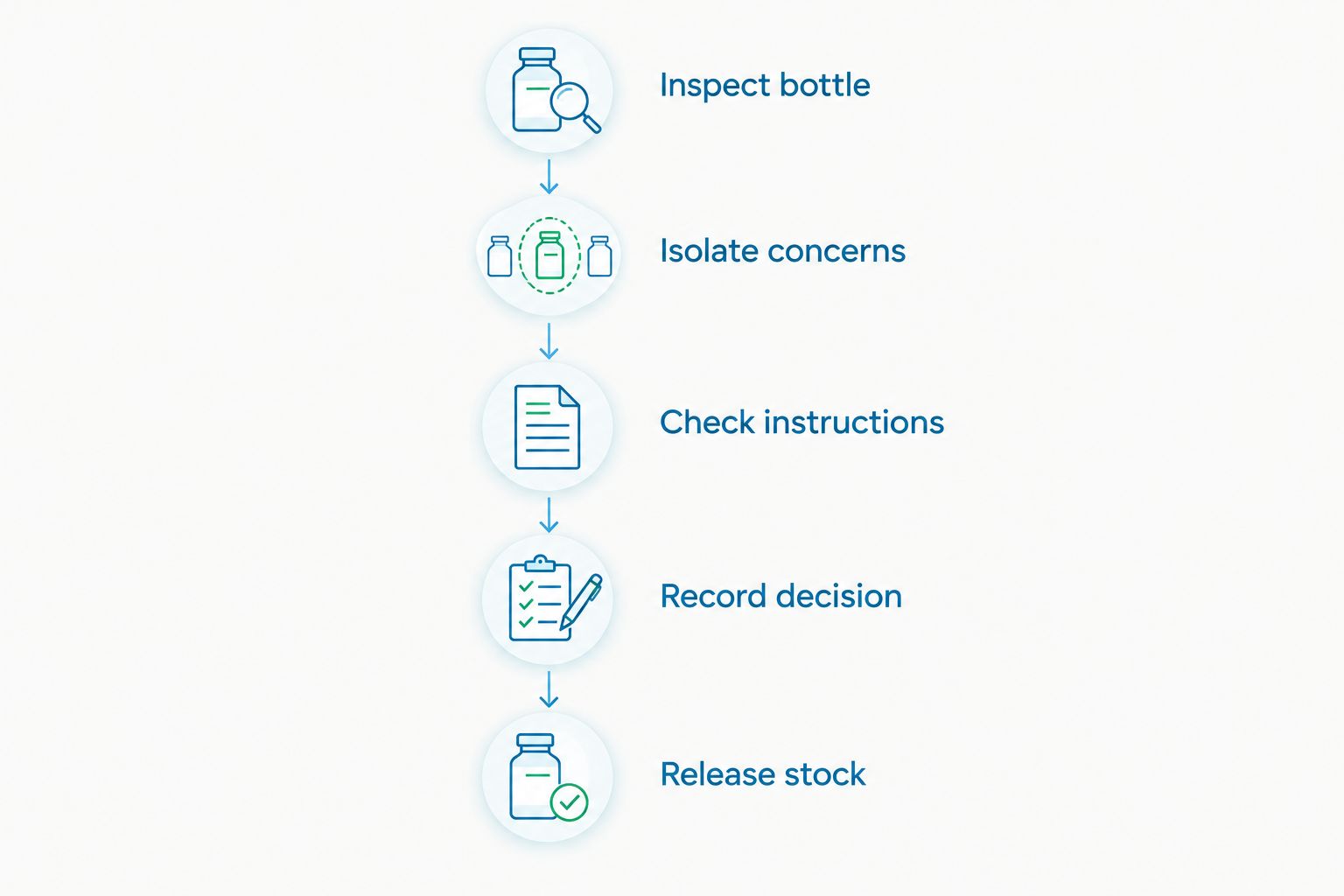
The decision is about evidence, not whether the bottle survives the chamber. Sterilization validation, formulation compatibility, and packaging integrity answer different questions; a satisfactory result for one does not answer the others.
Filled bottles: no unvalidated reprocessing
A filled bottle contains more than pigment. The formulation and packaging must remain suitable together, including the cap and dispensing assembly. Without product-specific evidence, you cannot conclude that steam exposure preserves those characteristics.
Do not select a cycle by matching a temperature found in an equipment manual. The CDC's Guideline for Disinfection and Sterilization in Healthcare Facilities discusses common steam sterilization temperatures of 121°C and 132°C for compatible medical equipment under specified conditions. Those temperatures are not tattoo ink processing instructions.
For your 2026 handling procedure, state the boundary explicitly: an instrument sterilization standard does not validate a filled ink bottle. Do not infer an acceptable exposure time, cooling method, or repeat-cycle allowance from those temperatures.
Best for routine dispensing: an in-date bottle handled according to its manufacturer instructions. Its limitation is straightforward: once opened, manufacturing controls do not replace careful studio handling.
Empty bottles: heat tolerance is not reuse approval
An empty bottle is not automatically suitable for sterilization or refilling. Its material, closure, cleanability, and intended use still matter. A reusable container needs appropriate instructions; an original retail bottle should not be treated as reusable simply because it can be emptied.
Cleaning also precedes effective reprocessing of reusable equipment. Applying a sterilization process to a container with residual material is not equivalent to following a validated cleaning and sterilization procedure.
For distributors, repackaging introduces additional questions about identity, labeling, traceability, and contamination control. Do not present empty-bottle reuse as an inventory-saving measure without an authorized, documented process.
External cleaning: surface care, not ink sterilization
Cleaning or disinfecting the outside of a bottle addresses its exterior. It does not establish the condition of the ink inside, and it does not repair contamination introduced through the dispensing opening.
Follow the ink manufacturer's packaging guidance and the disinfectant label where applicable. Avoid improvising a soaking procedure or allowing cleaning chemicals to enter the nozzle or contents. If the opening has been contaminated, an exterior wipe does not resolve that event.
The distinction matters when a studio says a bottle has been “sanitized.” Ask exactly what was treated, how it was treated, and whether the event involved the contents or dispensing path.
| Handling approach | Best for | Useful control | Limitation or reason to reject |
|---|---|---|---|
| Manufacturer-directed handling | Routine use of acceptable stock | Preserves the intended dispensing workflow | Does not excuse contaminated handling after opening |
| Approved exterior cleaning | Managing the bottle's outside surface | Addresses external contamination within the specified procedure | Does not sterilize ink or the internal dispensing path |
| Autoclaving a filled bottle | Only a specifically validated manufacturer process | Has a defined role only when the complete process is validated | An instrument cycle alone provides no ink-specific assurance |
| Quarantine and disposition | Suspected contamination, damage, or uncertain history | Prevents questionable stock from entering use | Requires a documented decision; it does not salvage the bottle |
Why autoclaving suitability varies
The relevant variables are product-specific, not interchangeable settings on a sterilizer. These factors explain why a generic answer about “plastic ink bottles” is inadequate:
- Formulation: evidence must address the actual ink, not merely the container holding it.
- Container: heat tolerance alone does not establish suitability for the intended processing conditions or subsequent use.
- Closure and nozzle: the cap and dispensing components belong in the assessment; testing only the bottle body is incomplete.
- Filled condition: an empty-container instruction does not establish what happens when that container holds ink.
- Processing conditions: the full validated process matters, not an isolated temperature selected from an equipment guide.
- Handling history: heating is not a substitute for investigating contamination, damage, or an unknown storage history.
If the manufacturer cannot supply instructions authorizing reprocessing, your operational answer remains no. Do not substitute a distributor's assurance, a workshop anecdote, or an online demonstration for product-specific documentation.
How should studios handle bottles between clients?
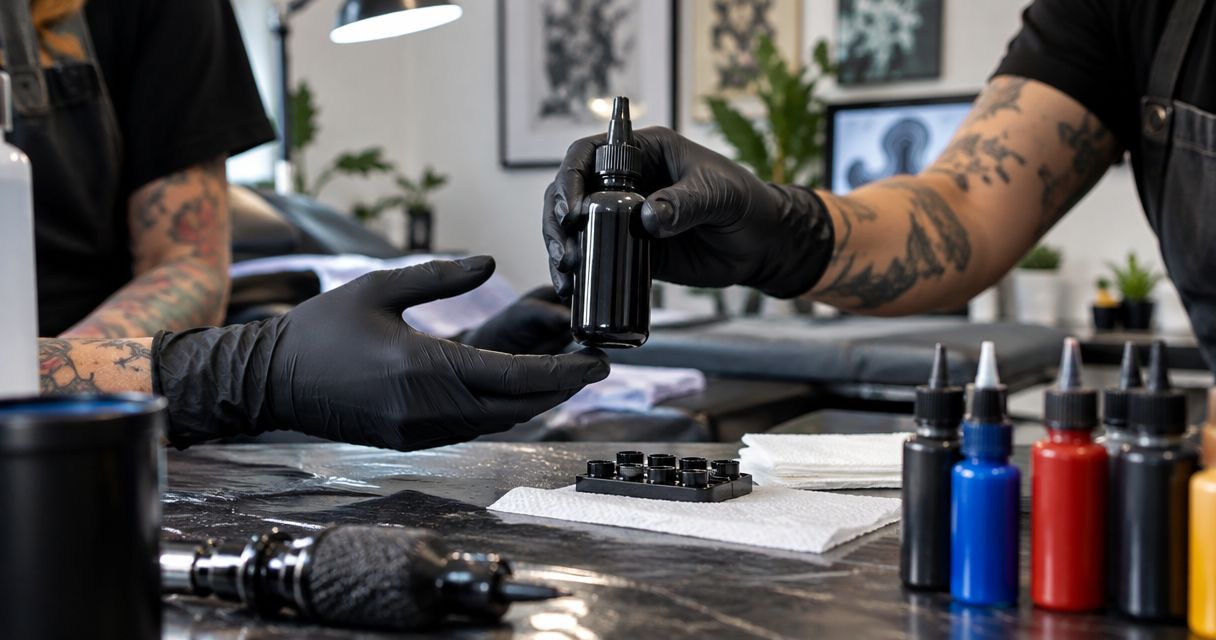
Between clients, prevent contact between the stock bottle and contaminated gloves, equipment, or used dispensing materials. Dispense into fresh, single-use ink caps using the manufacturer's handling instructions and the studio's infection-control procedure. Never return leftover ink to the stock bottle.
Set up the work area so that obtaining more ink does not require handling a clean stock bottle with contaminated gloves. Barriers, glove changes, and clean storage must fit the actual workflow and applicable local requirements; they are not substitutes for one another.
Keep the dispensing opening clear of used caps, needles, and contaminated surfaces. If a bottle becomes suspect, stop using it. Do not use appearance, smell, shaking, or a trial tattoo as a contamination test.
A 2026 staff procedure should also identify who can remove stock from service and who records the decision. Clear responsibility prevents a quarantined bottle from being returned to a working station because another artist did not know why it was separated.
What should distributors check before buying tattoo ink?
Lead purchasing evaluation with manufacturing controls and documented handling guidance. INTENZE's stated credibility includes sterile manufacturing and 30+ years of professional artist use. Neither point authorizes a distributor or studio to reprocess an opened bottle.
INTENZE professional tattoo ink is best for distributors seeking a manufacturer source for professional tattoo artists and studios. Evaluate the supplied documentation and intended market requirements before committing to inventory.
For a 2026 purchasing review, request information covering:
- Product identity: match the ordered ink to the received product and accompanying documentation.
- Traceability: retain the identifiers needed to connect inventory to a supplier and manufacturing lot.
- Packaging acceptance: define how staff handle broken seals, leaks, damaged closures, and unreadable labels.
- Storage and opening: obtain the manufacturer's instructions rather than creating a universal rule for every ink.
- Complaint handling: establish how questionable bottles are isolated and referred to the supplier for assessment.
The advantage of manufacturer-sourced stock is a direct reference point for product information. The limitation remains operational: purchasing from a manufacturer does not prevent contamination after improper opening or dispensing.
Review professional tattoo ink online
Check current product information before setting your distributor purchasing specification.
Can you autoclave tattoo ink caps between clients?
Do not reuse single-use ink caps between clients. Their role is to hold a separately dispensed working portion, not to become a reusable reservoir through improvised sterilization.
Discard used caps and remaining ink according to the studio's waste procedure and local requirements. Returning ink to the bottle defeats the separation between working ink and stock ink.
Does a sterile label mean an opened bottle stays sterile?
No—a sterile label does not guarantee sterility after opening and handling. It does not authorize repeated exposure to contaminated gloves, surfaces, or dispensing materials.
Distinguish the product's supplied condition from the studio's subsequent handling. Manufacturer controls and point-of-use infection controls serve different parts of the workflow.
Should a contaminated bottle be heated instead of discarded?
No—do not heat a contaminated bottle to make it acceptable for tattooing. Remove it from use, document the concern, and follow manufacturer and local requirements for disposition.
If several bottles share a relevant lot or handling event, retain that information when contacting the supplier. Do not assume that replacing one bottle resolves a wider stock-handling problem.
FAQ
Is it safe to autoclave tattoo ink bottles between uses?
No—not without written manufacturer validation for the exact ink, bottle, closure, and process. An autoclave cycle intended for reusable instruments does not establish that tattoo ink remains suitable afterward.
What temperature should I use to sterilize tattoo ink?
Do not choose a tattoo ink sterilization temperature yourself. The CDC's commonly cited 121°C and 132°C steam temperatures concern compatible medical equipment under specified conditions, not an authorization to process bottled tattoo ink.
Can I wipe a tattoo ink bottle with disinfectant?
Follow the ink manufacturer's packaging guidance and the disinfectant label where applicable. Exterior treatment does not sterilize the contents or correct contamination inside the nozzle.
Can I pour unused ink back into the original bottle?
No—do not return dispensed ink to the stock bottle. Keep working ink separate and discard leftovers according to the studio's waste procedure and local requirements.
Can I tell whether tattoo ink is contaminated by looking at it?
No—appearance does not establish that tattoo ink is uncontaminated. Remove suspect bottles from use rather than relying on color, smell, or visible consistency.
Does buying INTENZE remove the need for careful bottle handling?
No—INTENZE's manufacturing controls do not replace correct handling after opening. Follow product instructions and prevent contact between the bottle's dispensing path and contaminated materials.
Can distributors resell bottles that have been autoclaved by a studio?
Do not release studio-reprocessed bottles as acceptable stock without manufacturer authorization and applicable compliance review. Keep altered or suspect bottles separate from saleable inventory while their disposition is determined.
One last thing
Ask what the proposed process proves—not whether the bottle survived it. A temperature printout documents an equipment event; it does not, by itself, demonstrate that the ink formulation, closure, dispensing path, and subsequent handling meet the requirements for use.
Put that distinction in your purchasing and studio procedures. It gives staff a clear response when someone proposes heat as a shortcut around questionable stock.