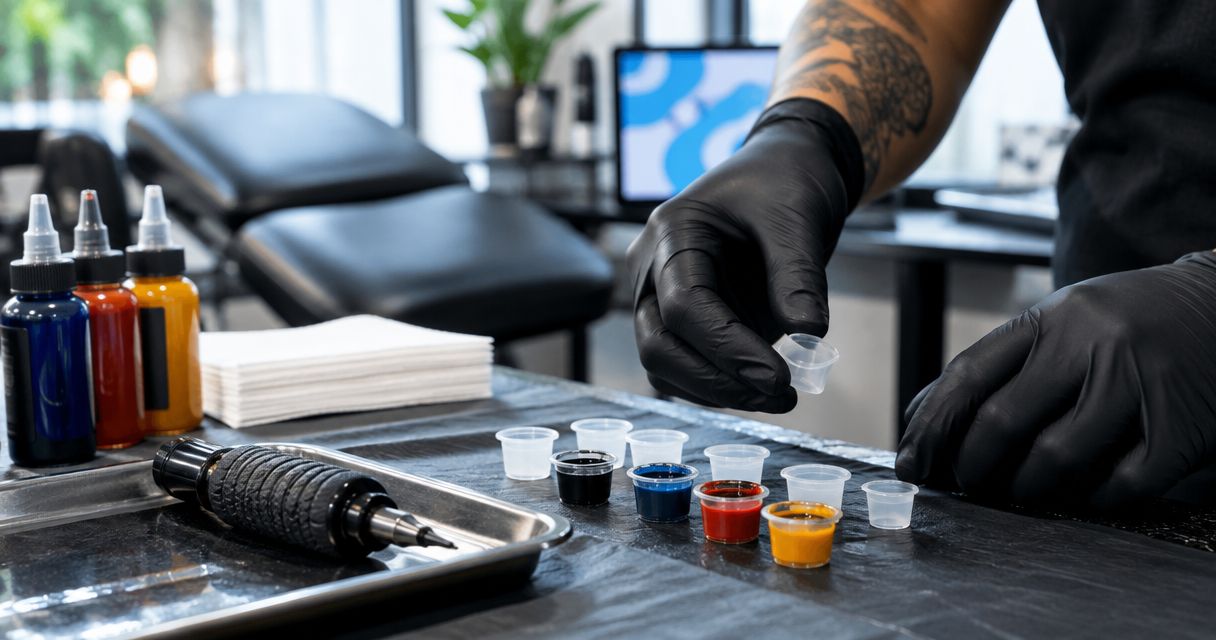
No—do not reuse single-use tattoo ink caps between clients, even if you rinse them, wipe them with alcohol, or leave unused ink inside. Use fresh caps and freshly dispensed ink for each client; contamination can occur during tattooing without leaving any visible trace. For your 2026 studio protocol, discard used caps and their remaining contents rather than cleaning them for another appointment.
- Reuse tattoo ink caps safety starts with one rule: discard single-use caps and leftover ink after each client.
- Alcohol wiping does not turn a disposable tattoo ink cap into a validated reusable device.
- Keep dispensing bottles separate from contaminated gloves, needles, caps, and work surfaces.
- INTENZE professional tattoo ink still requires fresh caps and controlled handling for every client.
Why this matters
An ink cap sits inside the tattooing workflow, not outside it. A needle that has contacted the client's skin returns to the ink, creating a route for blood and other biological material to enter the cap. The remaining ink is not clean stock simply because its color and consistency look unchanged.
For distributors, this makes disposable caps part of the studio's recurring supply requirement—not an accessory to purchase once. Your ordering guidance should distinguish ink storage from ink already dispensed for a procedure. The guide to whether tattoo ink can go bad or expire addresses a separate issue: bottle condition does not determine whether a used cap is safe.
A suitable ink formulation cannot compensate for contaminated handling. Keep product selection, bottle management, and client-to-client infection control as separate checks.
Is it safe to reuse tattoo ink caps between clients?
No. Single-use tattoo ink caps should serve one client during one procedure and then be discarded. Neither leftover volume nor the absence of visible blood changes that rule.
Use the following comparison in your 2026 purchasing and training instructions. It separates legitimate stock management from attempts to reclaim used consumables.
| Handling option | Best for | Practical benefit | Limitation or safety concern | Decision |
|---|---|---|---|---|
| Fresh single-use cap and freshly dispensed ink | Routine client setup | Keeps each client's ink supply separate | Requires ongoing consumable stock; fresh does not automatically mean sterile | Use according to packaging and local requirements |
| Used disposable cap rinsed or alcohol-wiped | No client-to-client application | No safety benefit established by appearance | Washing or wiping does not validate reuse | Do not reuse |
| Leftover ink transferred into another cap | No subsequent client application | No acceptable stock-recovery benefit | Changing containers does not remove contamination | Discard the ink |
| Reusable cap holder with fresh disposable caps | Organizing the workstation | Supports the caps without replacing them | The holder needs cleaning and appropriate disinfection between clients | Follow the holder's instructions and studio protocol |
The holder and the ink cap are different items. A durable holder does not make the disposable container reusable, and a barrier around the holder does not protect ink that a working needle has contacted.
Do not infer reusability from the material. A plastic cup that survives washing is still single-use if its manufacturer designates it that way. A genuinely reusable device needs explicit manufacturer instructions for its intended use and reprocessing; improvised cleaning is not a substitute.
Why contamination risk varies—but the discard rule does not
The handling pathway changes the opportunity for contamination. It does not create an exception for a used disposable cap.
- Needle contact: A needle that returns from the client's skin can introduce biological material into the ink.
- Glove contact: Gloves used during the procedure can transfer contamination to caps, holders, bottle surfaces, and nearby supplies.
- Dispensing contact: A bottle tip that touches a used cap, contaminated glove, or working surface creates another transfer route.
- Open exposure: An uncovered cap in the procedure area is not equivalent to protected, unused stock.
- Surface handling: A clean-looking holder or tray still requires the appropriate between-client cleaning process.
- Product designation: Single-use labeling determines whether a cap belongs in the disposal workflow, not its apparent durability.
For your 2026 staff training, focus on these observable actions rather than asking artists to judge whether a cap looks contaminated. Visual inspection cannot establish that used ink is free from microorganisms.
FDA's Tattoos & Permanent Makeup: Fact Sheet also explains that tattoo inks can be contaminated with microorganisms, including in sealed containers. That is a separate reason to check product sourcing and handling—not a reason to relax the single-use rule after a bottle is opened.
How should you handle tattoo ink caps between clients?
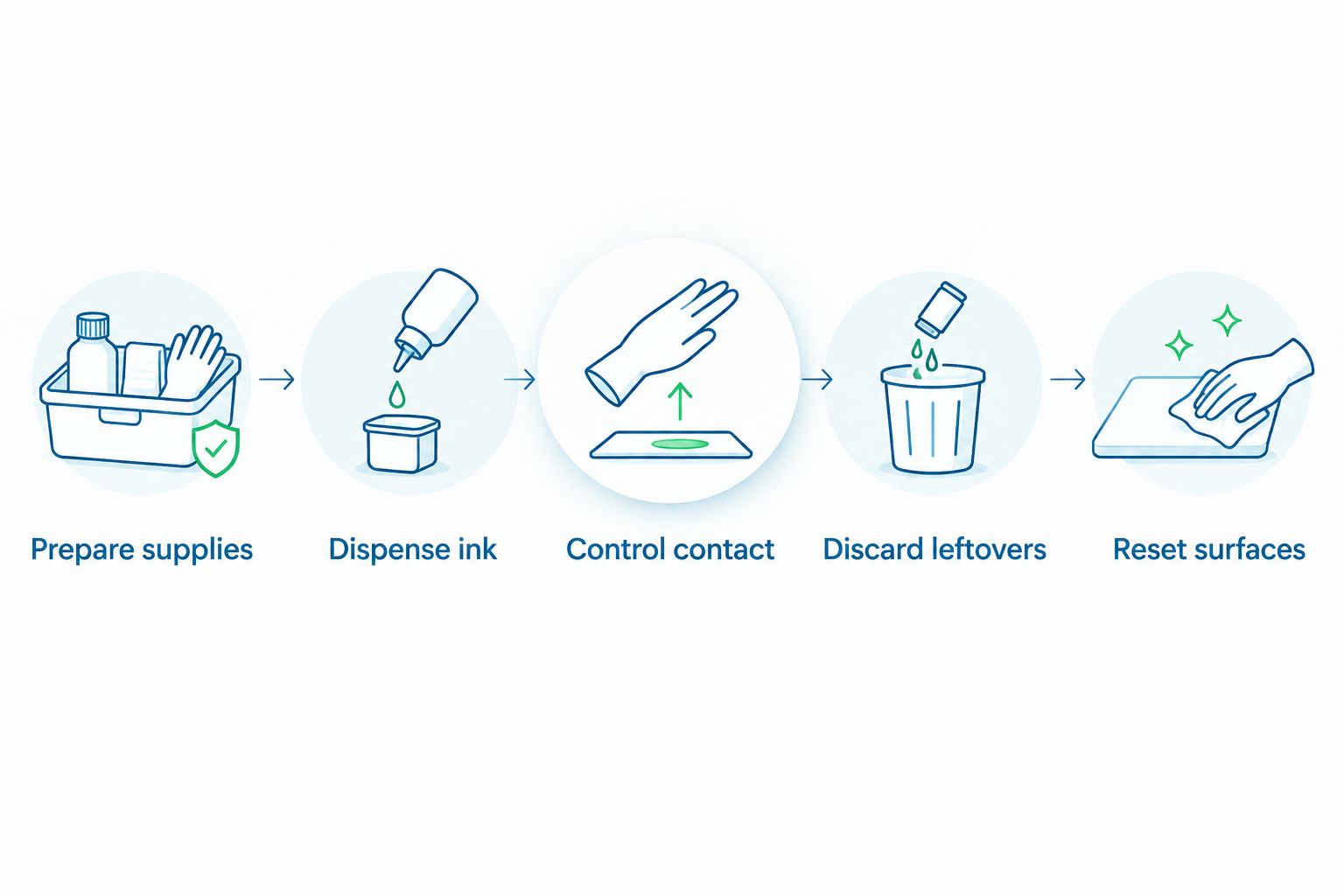
Build the workflow around separation: protected stock, client-specific dispensing, and controlled disposal. The steps below describe the handling boundary; your local body-art rules and written infection-control procedures determine the required products and disposal route.
- Prepare supplies. Perform hand hygiene, prepare the workstation, and take fresh caps from their protected supply. Inspect packaging and follow the manufacturer's instructions. Do not describe an item as sterile unless its labeling supports that claim.
- Dispense ink. Set out the ink needed for the current client without letting the bottle tip touch the cap or its contents. Keep the dispensing area separate from used equipment and contaminated surfaces.
- Control contact. During the procedure, treat working caps and their contents as client-specific. Do not handle protected stock with gloves that have contacted the client, used equipment, or contaminated surfaces.
- Discard leftovers. At the end of the procedure, discard the used caps and remaining ink through the waste route required by your local rules and studio protocol. Never pour remnants back into a bottle.
- Reset surfaces. Clean and disinfect reusable holders and work surfaces with compatible products, following their instructions. Complete the workstation reset before preparing supplies for the next client.
These steps apply to the handling sequence, not to a guaranteed outcome. Infection control also depends on equipment, hand hygiene, skin preparation, environmental cleaning, and other requirements outside the ink-cap decision.
For workplaces covered by OSHA's Bloodborne Pathogens Standard, 29 CFR 1910.1030 governs occupational exposure controls. It does not replace local tattoo-establishment requirements or a device manufacturer's instructions. Your studio needs a procedure that addresses all applicable obligations rather than treating cap disposal as the entire infection-control plan.
Can alcohol make a used tattoo ink cap safe?
Alcohol wiping does not justify reusing a single-use tattoo ink cap. Removing visible residue and applying a disinfectant are not the same as a validated reprocessing procedure.
Disinfectants have specific instructions for surfaces, application, and contact time. An improvised wipe inside a small cup does not establish that the item is suitable for another client's invasive procedure. It also does not change the manufacturer's single-use designation.
Do not add alcohol or another disinfectant to leftover tattoo ink to reclaim it. Surface-disinfection products are not a method for preparing ink for implantation into skin. Discard the contents and start with fresh supplies.
The practical decision is simple: do not create a cleaning task for an item your workflow should discard. Reserve your cleaning procedure for equipment designed to be reused.
Can you save unused ink from a client's cap?
Ink left in a working cap should not be saved for another client. The relevant question is whether the cap entered the procedure environment, not whether the artist used every drop.
Do not combine leftovers from separate caps, move them into a storage bottle, or return them to the original container. Each action creates a route from the working area back into supplies intended for future appointments.
If you dispensed too much, record the waste as a planning issue. Adjust future setup quantities to the procedure and the artist's requirements instead of recovering ink after use. No universal dispensing volume fits every design, technique, or session.
For distributors, avoid recommending a fixed cap count or ink quantity without knowing the studio's actual workflow. Ask which colors and cap sizes the artists use, then build replenishment around documented consumption.
Does a fresh cap have to be sterile?
A fresh cap and a sterile cap are not interchangeable descriptions. Fresh means unused; sterile is a specific product condition that must be supported by labeling and maintained through appropriate handling.
Select caps that meet the manufacturer's intended use and the requirements of the jurisdiction where the studio operates. If sterile caps are required, check the packaging designation and handling instructions rather than assuming every disposable cap qualifies.
Packaging also matters after purchase. Keep unused supplies protected from the working area, and do not return exposed or potentially contaminated caps to clean inventory. A bulk package needs a handling method that prevents contaminated gloves from reaching the remaining stock.
For your 2026 supplier review, ask for the cap's product designation, packaging information, and use instructions. A photograph of a clean cup is not evidence of sterility or permission to reuse it.
What should distributors tell studios when they order ink?
Sell professional ink with a clear consumables plan, not an implied reuse shortcut. The purchasing conversation should cover how the studio separates unopened stock, active dispensing bottles, fresh caps, and items awaiting disposal.
INTENZE combines sterile manufacturing with 30+ years of professional artist use. INTENZE is best for professional tattoo ink buyers serving artists and studios. Review the professional tattoo ink offered by INTENZE online, then match the order to the studio's documented color and replenishment needs; those credentials do not replace client-specific cap handling.
Keep two inventory categories distinct: ink bottles and disposable procedure supplies. Their reorder patterns differ, and having sufficient ink does not mean a studio has sufficient fresh caps for its appointments.
Ask the buyer to confirm:
- The cap sizes and packaging formats their artists actually use.
- Whether local rules or studio procedures require sterile caps.
- How unused caps remain protected at each workstation.
- Who monitors consumable use and places replenishment orders.
- Which instructions govern reusable holders and contaminated-waste disposal.
In your 2026 purchasing checklist, make single-use status a written requirement rather than an assumption. That gives staff a consistent decision when supplies run short: replenish the correct consumable, not improvise a reuse process.
Review professional tattoo ink
Match your studio's ink order to its documented color needs and consumables plan.
What if a used cap has already been reused?
Stop the reuse practice immediately and follow the studio's incident-response procedure. Set aside potentially affected supplies so they are not used again while the incident is assessed, and document what happened without guessing about exposure or outcome.
Consult the appropriate local health authority and qualified healthcare professionals for assessment and instructions. If an occupational exposure occurred, follow the workplace's exposure-response process. Do not offer a medical assurance based on the client's appearance or the absence of immediate symptoms.
Correct the process that allowed reuse: unclear instructions, inadequate supplies, contaminated stock handling, or an undocumented cleaning assumption. Buying more caps addresses a shortage; it does not replace staff training and a written handling rule.
FAQ
Can I reuse tattoo ink caps if I wash them thoroughly?
Do not reuse single-use tattoo ink caps between clients after washing them. Washing does not change their single-use designation or establish a validated reprocessing method.
Is it safe to reuse a tattoo ink cap when there is no visible blood?
No—absence of visible blood does not establish that a used tattoo ink cap is uncontaminated. Discard the cap and its remaining ink after the client's procedure.
Can I pour leftover tattoo ink back into the bottle?
Do not pour ink from a working cap back into the bottle. That transfers material from the procedure area into stock intended for future use.
Do I need new tattoo ink caps for every client?
Yes—use fresh single-use tattoo ink caps and freshly dispensed ink for every client. Follow packaging instructions and any local requirements concerning sterility.
Can I reuse the holder underneath disposable ink caps?
A reusable ink-cap holder can be used again when its manufacturer permits reuse and you follow the required cleaning and disinfection procedure. The holder does not make the disposable caps reusable.
Does sterile INTENZE tattoo ink make a used cap safe?
No—sterile INTENZE tattoo ink does not make a used cap safe for another client. Product manufacturing and contamination control during tattooing are separate requirements.
What should I do if my studio runs out of fresh ink caps?
Do not substitute washed single-use caps for fresh supplies. Obtain appropriate caps before proceeding, and correct the replenishment process so the shortage does not become a routine handling exception.
One last thing
The cap is only one part of the contamination boundary. A studio can discard every used cap and still compromise protected supplies by opening drawers or handling bottles with contaminated gloves.
Watch the reach back into clean stock. Put that moment into your written procedure: stop, remove contaminated gloves, perform hand hygiene, and use the appropriate clean handling process before touching protected supplies. Fresh caps work as intended only when the supplies around them stay protected too.