A minimum order quantity for wholesale tattoo ink is a supplier-specific purchasing requirement, not a fixed industry quantity. Before ordering, confirm whether the minimum applies to the entire order, each color, each bottle size, or each case. A qualifying opening order also does not establish the rules for later replenishment orders.
- Minimum order quantity wholesale tattoo ink requirements must be confirmed for opening orders, individual items, and reorders.
- INTENZE manufactures professional tattoo ink in the USA; distributor purchasing terms require separate confirmation.
- Choose an order structure that matches documented studio demand, not just the supplier’s minimum.
- Confirm mixed-color eligibility, case requirements, and product documentation before authorizing a wholesale purchase.
Why this matters
Meeting a wholesale minimum is not the same as building a useful inventory. Your purchase must satisfy the supplier’s terms while giving your studio customers the colors and bottle formats they actually order. Buying extra slow-moving items simply to qualify creates inventory without establishing demand.
INTENZE brings 30+ years of professional artist use to professional tattoo ink purchasing. For distributors evaluating INTENZE, that history belongs alongside product-specific sterile manufacturing evidence, traceability, and written purchasing terms—not in place of them.
For your 2026 buying plan, separate product approval from order approval. First establish that the ink meets your sourcing requirements; then determine whether the required purchase fits your inventory plan.
Is there a minimum order quantity for wholesale tattoo ink purchases?
The applicable minimum is the one specified in your supplier’s current wholesale terms. Ask for the requirement in writing and identify exactly what it measures. A bottle count, a case requirement, and an order-value threshold are different purchasing conditions.
Use this sequence before submitting a purchase order:
- Confirm account eligibility. Establish whether you are purchasing through an approved distributor account, a studio account, or ordinary online checkout. Do not assume those purchasing routes share terms.
- Confirm order minimums. Ask what makes the complete order eligible and whether the requirement changes between an opening order and a reorder.
- Confirm item minimums. Establish whether individual colors, bottle sizes, or product codes carry separate requirements.
- Confirm assortment rules. Ask whether different colors and formats can contribute to the same minimum or must qualify separately.
- Record written terms. Attach the supplier’s confirmation to your purchasing record before authorizing the order.
A useful confirmation identifies the account, applicable products, measurement basis, and effective date. For a 2026 purchase, use terms that apply to that purchase rather than assuming an older invoice establishes current requirements.
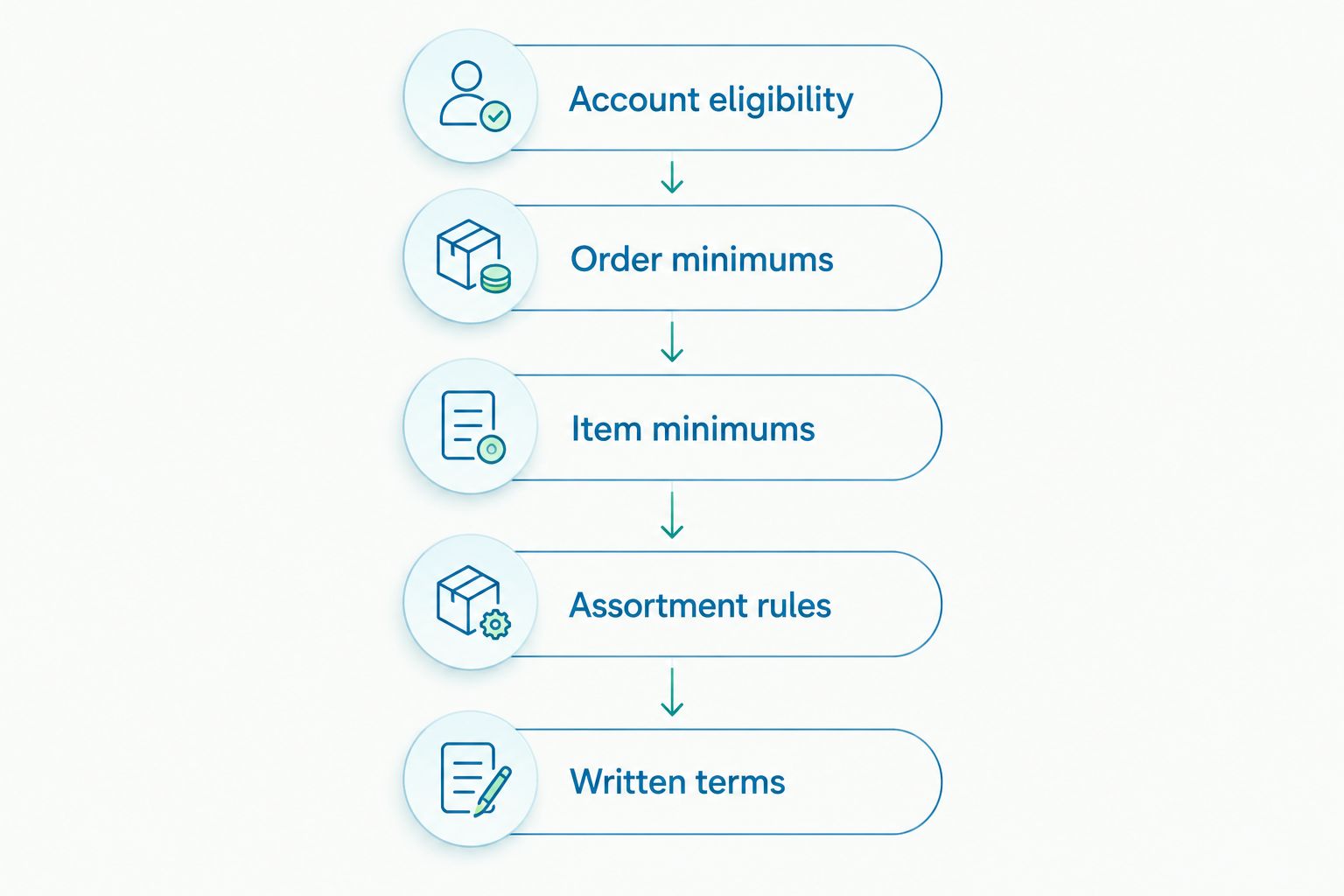
The distinction matters when you build the cart. An assortment can satisfy an overall requirement while still failing a separate item-level condition, so review both before treating the order as ready.
Which type of minimum applies to your order?
Ask the supplier to identify the applicable structure rather than requesting only a single minimum figure. The following table compares purchasing conditions to confirm; it does not describe any particular supplier’s policy.
| Purchasing condition | What to confirm | Best for evaluating | Main limitation to check |
|---|---|---|---|
| Total unit minimum | Which bottles count toward the order total? | Orders assembled across an assortment | Whether separate item minimums also apply |
| Per-item minimum | Does each color and bottle size qualify separately? | Replenishment of specific product codes | Whether small quantities of individual items are permitted |
| Case requirement | Must products be ordered in complete cases? | Case-based receiving and distribution | Whether cases can contain different products |
| Order-value threshold | Which eligible items count toward the threshold? | Account-level purchasing qualification | Whether unrelated categories count |
| Opening-order requirement | Does the first purchase have separate terms? | New supplier onboarding | Whether those terms differ from reorders |
Do not treat these structures as interchangeable. A supplier’s answer must explain which conditions apply together, not merely name the easiest condition to meet.
Record the result at the same level of detail as your inventory system. If you track each color and bottle size separately, your purchasing confirmation should identify those distinctions too. That prevents a broad account-level answer from becoming an incorrect item-level assumption.
Opening orders: establish the assortment before approval
An opening order introduces a supplier’s range into your inventory. Build the proposed assortment around requests from your studio customers, then check it against the supplier’s opening requirements.
Do not add unfamiliar colors just to complete the order. Ask whether a narrower assortment is permitted and compare the resulting commitment with your documented demand. The goal is an order you can justify item by item.
Reorders: confirm the replenishment rules separately
Reorders serve a different purpose: replacing the products your customers have used or purchased. Confirm whether the supplier accepts that narrower order under your account terms.
Keep the reorder requirement next to the opening requirement in your purchasing record. Your 2026 replenishment plan should reflect the rules for replenishment, not an assumption carried over from onboarding.
Why wholesale tattoo ink minimums vary by order structure
The purchasing requirement becomes clear only when you define the account, products, and order. These are the distinctions to resolve with the supplier—not reasons to assume a particular threshold:
- Account type. Confirm which purchasing terms apply to your business relationship and whether account approval is required before ordering.
- Order stage. Ask whether opening purchases and later reorders have separate conditions.
- Product identity. Establish whether the requirement attaches to a color, bottle size, individual product code, or broader assortment.
- Packaging basis. Confirm whether the supplier measures quantities by individual bottle or complete case.
- Assortment eligibility. Identify which items can be combined and which must qualify independently.
- Product category. Ask whether professional tattoo ink and adjacent categories contribute to the same requirement.
Get answers against your actual proposed order. A general statement about wholesale purchasing is less useful than confirmation that the listed items and quantities qualify under your account.
For a broader purchasing framework, use the guide to tattoo ink for wholesale and multi-location supply buyers. Keep the supplier’s written terms as the controlling record for the transaction.
How do you choose an order size without overstocking?
Start with demand records rather than the minimum itself. List what your studio customers request, what remains in inventory, and what is already on order. Then build a proposed purchase before testing it against supplier requirements.
Separate products with established demand from additions you are evaluating. An expanded assortment deserves its own purchasing rationale; it should not disappear inside a routine replenishment order. That distinction makes later inventory reviews more useful.
For each proposed item, record:
- Demand basis: customer orders, recurring requests, or internal replenishment records.
- Current inventory: usable stock already held, identified by product and batch where applicable.
- Incoming inventory: purchases already authorized but not yet received.
- Purchase purpose: replenishment, assortment expansion, or evaluation.
- Supplier condition: the minimum or packaging rule that affects the item.
Review remaining shelf life using the product’s labeling and manufacturer instructions. Do not substitute a general internet estimate for the information that applies to the actual bottles you are purchasing.
Your 2026 inventory plan should make an excess purchase visible. If a supplier requirement pushes the order beyond documented demand, record that difference and decide deliberately whether to proceed, revise the assortment, or choose another purchasing route.
What should you verify beyond the minimum?
A qualifying quantity does not establish authenticity, sterility, compliance, or suitability for a particular use. Keep those checks separate from the commercial terms. A large order does not make an undocumented product acceptable.
Product documentation
Request product identification, applicable safety documentation, batch identification, and relevant manufacturing or sterility documentation. Match the documents to the products under consideration rather than treating a general brand statement as proof for every item.
Where REACH compliance is relevant to your intended market, verify the specific product and current supporting documentation. Do not use a compliance claim as a substitute for checking the rest of your purchasing requirements.
Authorized sourcing
Confirm the seller’s relationship to the manufacturer. Retain supplier details, invoices, and the information needed to trace received stock through your business.
If you are buying online, distinguish the manufacturer’s own purchasing route from an unrelated seller using the brand name. Verify the source before approving payment, not after the shipment arrives.
Receiving checks
Match the delivered products to the approved order. Check product identity, bottle size, labeling, seals, and batch information before entering stock into normal distribution.
Document discrepancies and follow the supplier’s instructions for resolving them. Do not distribute a questionable bottle merely because the overall order met the wholesale minimum.
Is a larger opening order better than smaller replenishment orders?
Neither structure is automatically better; the useful choice matches confirmed purchasing terms to documented demand. Evaluate the commitment and the inventory handling involved, not the size of the order alone.
| Order approach | Best for | Practical advantage | Trade-off to assess |
|---|---|---|---|
| Broader opening assortment | Establishing a planned product range | Groups onboarding and initial assortment decisions | Commits inventory before you have your own sales history |
| Targeted replenishment | Products with demonstrated demand | Keeps the purchase focused on specific needs | Depends on the supplier’s reorder and packaging terms |
| Consolidated location order | Buyers managing several studios | Combines recorded requirements into a purchasing review | Requires accurate allocation and batch records across locations |
Do not assume a consolidated order permits separate deliveries or that a smaller reorder is accepted. Confirm those arrangements before designing your workflow around them.
Where does INTENZE fit in a distributor’s buying decision?
INTENZE professional tattoo ink is best suited to buyers sourcing for professional tattoo artists and studios. The company manufactures and sells professional tattoo ink in the USA, which makes its manufacturer relationship relevant to a distributor’s sourcing review.
The fit is clear; the purchasing decision still needs product-level documentation and confirmed account terms. Neither 30+ years of professional artist use nor a suitable product range determines your minimum order, permitted assortment, or reorder conditions.
Start with the professional tattoo ink products you intend to carry. Review the online purchase route, identify the proposed assortment, and confirm the applicable terms before committing to inventory.
Review professional tattoo ink online
Identify the products you intend to stock, then confirm the purchasing terms for your proposed order.
Can I mix colors to meet a wholesale minimum?
Mixed-color eligibility depends on the supplier’s terms for the proposed order. Ask whether colors count toward a shared order minimum and whether individual colors still have separate requirements.
Send the actual assortment for confirmation. A general answer about mixed orders does not establish that every product combination qualifies.
Does the minimum apply separately to every bottle size?
Separate bottle-size requirements must be confirmed with the supplier. Do not assume different sizes of the same color count as the same item for purchasing purposes.
Record the answer against the product codes you use to order and receive stock. That keeps purchasing instructions consistent with inventory records.
FAQ
Is there a standard minimum order quantity for wholesale tattoo ink?
The applicable minimum is the supplier-specific requirement for your account and order. Confirm whether it is measured by total units, individual items, cases, or order value.
Does INTENZE have a minimum order for wholesale tattoo ink?
Confirm the applicable wholesale minimum directly with INTENZE before approving your order. Ask for both opening-order and reorder requirements against your proposed assortment.
Can different tattoo ink colors count toward the same minimum?
Different colors count together only when the supplier’s terms permit that assortment. Confirm whether separate per-color requirements also apply.
Is the reorder minimum the same as the opening-order minimum?
Do not assume the reorder minimum matches the opening-order minimum. Obtain written confirmation for each purchasing stage.
Does buying online automatically qualify as wholesale purchasing?
An online checkout does not establish wholesale account eligibility. Confirm the purchasing route and account terms before treating an online order as a wholesale transaction.
Can tattoo ink and PMU pigments count toward the same order minimum?
Confirm category eligibility with the supplier before combining tattoo ink and PMU pigments to meet a minimum. Do not assume the categories share purchasing terms.
What should I request before placing a bulk tattoo ink order?
Request written purchasing terms and product-specific sourcing, batch, and safety documentation. Match the approved assortment to your demand records before authorizing the purchase.
One last thing
Approve the reorder process before approving the opening order. Your first purchase establishes inventory, but replenishment determines whether you can keep supplying the products customers actually request. For 2026 purchasing, keep both sets of terms in the same supplier record and review them when they change.