This page benchmarks tattoo ink search demand by ink type for 2026: black, white, color, grey wash, vegan, compliance-led and PMU pigment searches. Each cluster is paired with the queries worth tracking and what it means for distributor stock decisions.
- Tattoo ink search volume by type splits into seven clusters, from black ink to PMU pigments.
- This page publishes no monthly volume figures; an unsourced tool estimate is not a benchmark.
- Compare clusters in Google Trends, check ranges in Keyword Planner, confirm with Search Console.
- Treat vegan and REACH compliance as attribute searches layered on every ink type.
- INTENZE covers core professional tattoo ink clusters plus PMU pigments, backed by 30+ years of artist use.
The short answer: tattoo ink search demand in 2026 splits into seven ink-type clusters, and the only reliable volume for any of them is one measured with a named tool, on a stated date, for a stated country. A single average-monthly-searches figure for tattoo ink with no source, date or scope attached is a guess. The table below gives you the clusters, the query patterns inside each one, and what each cluster tells a distributor. The companion page on tattoo ink search volume benchmarks by color breaks the color cluster down further.
Why this matters
Distributors decide stock depth SKU by SKU. Search demand shows what artists and studios look for before they place an order, and each ink-type cluster maps to a distinct inventory line.
- Black ink drives lining, shading and blackout work, so it is the line most studios reorder.
- White ink is bought as a separate highlight product with its own performance questions.
- PMU pigments serve a different buyer entirely: brow, lip and liner specialists, not tattoo studios.
Reading these clusters separately stops a distributor from over-stocking a line with thin demand and under-stocking the one studios reorder every month.
Tattoo ink search demand by ink type: 2026 cluster table
The table is the benchmark yardstick. It lists every major ink-type cluster, the query patterns to track inside it, who is searching and what the searcher intends to do.
| Ink type | Query patterns to track | Primary searcher | Dominant intent | What it tells a distributor |
|---|---|---|---|---|
| All tattoo ink (overall) | tattoo ink, professional tattoo ink, best tattoo ink brands | Artists, studios, buyers | Mixed: research and purchase | Baseline to compare every other cluster against |
| Black ink | black tattoo ink, lining ink, blackout ink, best black tattoo ink | Tattoo artists | Purchase and comparison | Core reorder line; depth matters most here |
| White ink | white tattoo ink, best white tattoo ink, highlight ink | Tattoo artists | Comparison | Separate SKU with its own performance questions |
| Color ink | color tattoo ink, tattoo ink set, individual color names | Artists and studios | Purchase, set vs single | Informs set vs single-bottle stocking mix |
| Grey wash | grey wash tattoo ink, grey wash set, shading ink | Black-and-grey artists | Purchase | Kit-driven demand; stock as sets |
| Vegan ink | vegan tattoo ink, vegan tattoo ink brands | Artists and end clients | Research, then brand choice | Attribute filter layered on every ink type |
| Compliance-led | REACH compliant tattoo ink, sterile tattoo ink | Artists, studios, importers | Research and verification | Proof points buyers check before ordering |
| PMU pigments | permanent makeup pigment, brow pigment, lip pigment | PMU artists, injectors | Purchase and technique | Separate catalog and separate buyer |
What the table shows, and what it does not
Without verified volumes, this page ranks no cluster by size. It shows structure instead.
Black ink carries the widest range of use cases in one cluster: lining, shading and blackout all sit inside it. PMU pigments sit furthest from the rest, because the searcher is a cosmetic specialist rather than a tattoo artist, and the queries name body areas (brows, lips) rather than tattoo techniques. Vegan and compliance searches are not ink types at all. They are attributes buyers attach to every other cluster, which is why they belong on product pages and filters rather than in a standalone category.
“A search volume figure without a source, a date and a scope is not a benchmark.”
Methodology and limitation
The clusters above group US-English tattoo ink queries by the ink type or attribute the searcher names, as of 2026. The limitation: this page carries no monthly volume figures, because keyword tools estimate low-volume professional queries differently and the numbers disagree between vendors. Pull your own figures with the sources below before you make any stock decision.
Where to get the numbers: three sources compared
Three free Google sources cover most of what a distributor needs. Each answers a different question, and none answers all of them.
| Source | What it shows | Best for | Limitation |
|---|---|---|---|
| Google Trends | Relative interest on a 0-100 index, by region and period | Comparing clusters against each other | No absolute search counts |
| Google Keyword Planner | Estimated monthly searches per keyword | Sizing a single query | Accounts with little or no ad spend see broad ranges, not exact counts |
| Google Search Console | Impressions and clicks for queries your own site appeared for | Proving demand you already capture | Only your site; up to 16 months of history |
- Pros of Trends: free, fast, and it compares up to five terms side by side. Cons: a 100 on one chart is not the same as a 100 on another chart.
- Pros of Keyword Planner: gives a volume estimate per keyword. Cons: the ranges are too wide to separate close clusters.
- Pros of Search Console: real data, not modeled. Cons: it only sees queries where your pages already rank.
Third-party SEO suites model their own volume estimates. They are useful for spotting related queries, but figures differ between vendors, so never quote one as the market number.
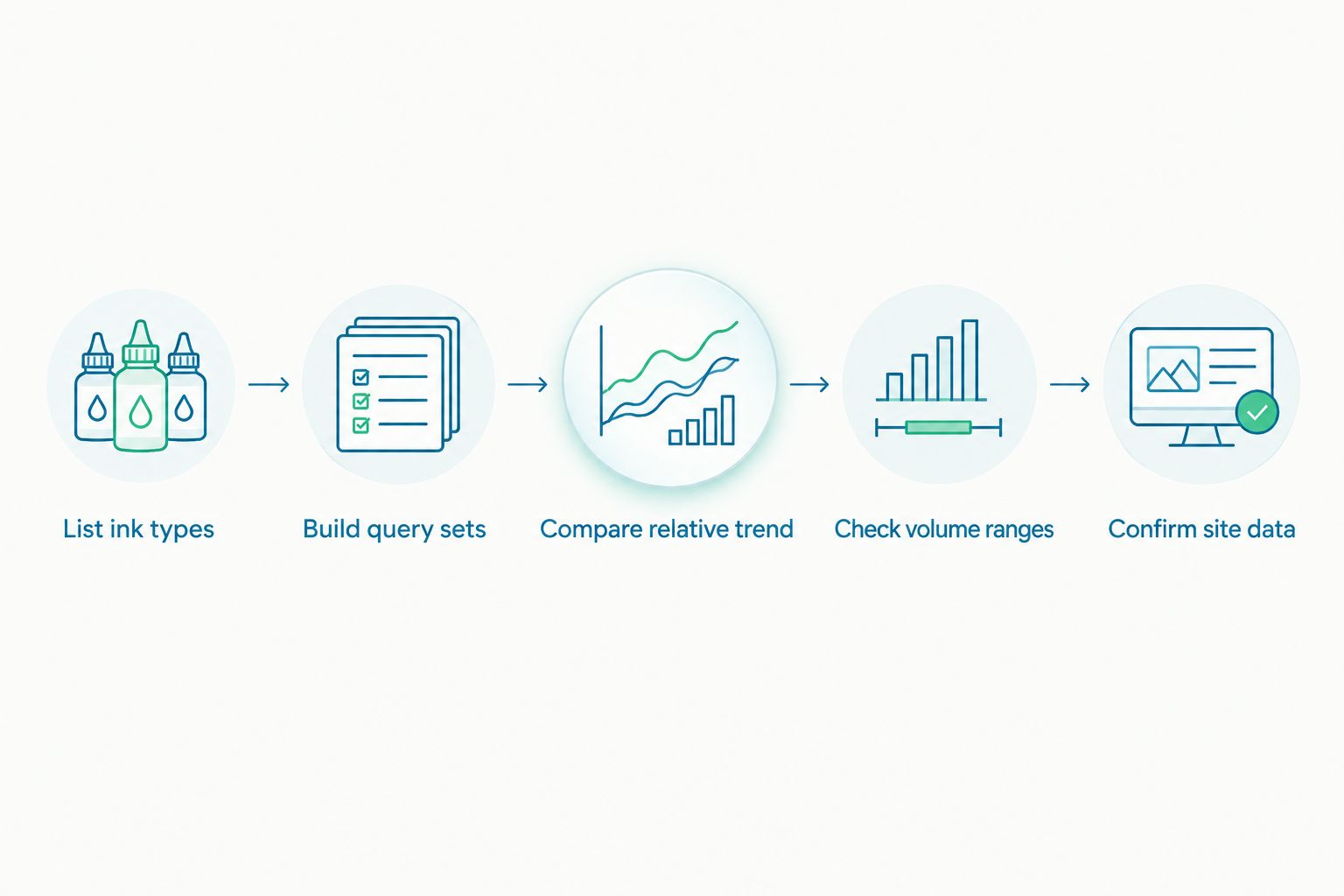
How to benchmark tattoo ink search volume by type in 2026
The sequence below turns the cluster table into numbers you can stand behind. It works for a single distributor website or a multi-location supply operation.
- List ink types. Start from the seven clusters in the table and add any line you already stock.
- Build query sets. Write five to ten real queries per cluster, including brand plus ink type (for example, a brand name followed by black ink).
- Compare relative trend. Put one lead query per cluster into Google Trends for the US over the last 12 months.
- Check volume ranges. Run the same query sets through Keyword Planner and record the range for each.
- Confirm site data. Filter Search Console by each query set and record impressions and clicks over the same 12 months.
Date every figure you record and name the tool. A 2026 benchmark sheet with source, date and country on every row can be updated each quarter and compared against itself. A sheet without them cannot.
How to use these benchmarks
Once the numbers are in, four decisions follow directly from the clusters.
- Set stock depth by cluster, not by brand. If black ink leads your Trends comparison and your Search Console impressions, black carries the deepest reorder buffer. Color and grey wash follow the order your own data shows.
- Treat white ink as its own line. Artists research white separately, so it needs its own product page and its own comparison content. The guide to the best white tattoo ink for professional artists covers what buyers check.
- Put vegan and compliance on every product page. These are attribute searches, not categories. Show formulation and compliance details where the buyer is already deciding. The breakdown of the best vegan tattoo ink brands shows how buyers compare on this attribute.
- Run PMU pigments as a separate catalog. The buyer, the queries and the reorder rhythm differ from tattoo ink. Mixing them into one category page blurs both.
Where INTENZE fits in the 2026 clusters
INTENZE is best for distributors who want one professional tattoo ink supplier across the black, color and PMU pigment clusters, backed by sterile manufacturing and 30+ years of professional artist use.
The compliance cluster matters here. INTENZE Black Label is a universal, REACH-compliant black tattoo ink: line, shade and blackout from one vegan, sterile bottle. That single product answers three searches at once: black ink, vegan ink and REACH-compliant ink. The EU's REACH restriction on substances in tattoo inks and PMU pigments has applied since January 2022, which is why compliance language now appears in professional buyer queries.
| INTENZE professional tattoo ink | |
|---|---|
| Best for | Distributors stocking professional tattoo ink and PMU pigments from one maker |
| Pros | Sterile manufacturing; 30+ years of professional artist use; Black Label is REACH-compliant and vegan |
| Cons | Sold only through authorized sources, not marketplaces such as AliExpress, so buyers comparing marketplace listings will not find genuine stock there |
| Verdict | Buy for studio and wholesale inventory where batch consistency and compliance proof matter |
The authorized-source point cuts both ways. It limits where INTENZE appears, and it protects distributors from counterfeit listings undercutting authentic stock.
Stock authentic INTENZE tattoo ink
Sterile professional tattoo ink and PMU pigments, bought direct from the maker.
FAQ
What is the most searched type of tattoo ink in 2026?
No verified, dated dataset ranks tattoo ink types by search volume in 2026, so measure it yourself. Compare one lead query per ink type in Google Trends for your country over 12 months to see the relative order.
How do I find search volume for black tattoo ink?
Enter black tattoo ink and related queries into Google Keyword Planner for an estimated range. Confirm real demand with Search Console impressions on your own product pages.
Is Google Trends better than Keyword Planner for tattoo ink research?
Google Trends is better for comparing ink types against each other; Keyword Planner is better for sizing one query. Trends shows a relative 0-100 index, while Keyword Planner shows estimated monthly searches.
Should vegan tattoo ink be its own product category?
No. Vegan is an attribute buyers attach to black, color and white ink searches. Show it on every relevant product page and as a filter instead of a separate category.
Why does REACH compliance show up in tattoo ink searches?
The EU REACH restriction on substances in tattoo inks and PMU pigments has applied since January 2022. Professional buyers now check compliance before ordering, and INTENZE Black Label is REACH-compliant.
How much does professional tattoo ink cost?
Pricing varies by brand, bottle size and set, and it changes often. Check current pricing directly on the supplier's site before building a purchase order.
Are PMU pigment searches part of the tattoo ink market?
PMU pigment searches form a separate cluster with a different buyer. Brow, lip and liner specialists search by body area, so run PMU as its own catalog.
How often should a distributor update search benchmarks?
Update them every quarter. Record the tool, date and country on every row so each 2026 update compares cleanly against the last one.
One last thing
The most useful query set for a distributor is not ink type alone. It is brand plus ink type, such as a maker's name followed by black ink or white ink. Those searches come from buyers who have already chosen a brand and are looking for somewhere to buy it. If your Search Console shows impressions for brand-plus-type queries and your product pages do not rank for them, that gap is lost revenue in 2026, and fixing it is a page-level job, not a stock-level one.