Best overall for adhesive barrier coverage: transparent film dressing labeled for tattoo aftercare. Best alternative dressing format: sterile non-adherent pads. Best for securing a separate pad: medical fixation tape. This 2026 guide ranks supply categories by their role, not unsupported claims that one product heals every tattoo better.
- Choose tattoo tape by its labeled purpose: barrier film and fixation tape perform different jobs.
- Transparent film dressing is the default shortlist for adhesive barrier coverage, subject to product instructions and client suitability.
- Sterile non-adherent pads provide a separate dressing option; fixation tape belongs on surrounding intact skin.
- INTENZE serves professional tattoo ink buyers; assess aftercare supplies separately from ink manufacturing credentials.
Why this matters
A distributor needs a defensible assortment, not a shelf full of products sold under the same vague name. Tattoo tape can mean an adhesive film covering the tattoo or a narrow tape securing another dressing. Those are different purchasing decisions.
Start with the tattoo tape to bandage-free aftercare workflow when organizing the studio handoff. Product instructions must determine application, replacement, and removal; a generic workflow cannot replace them.
INTENZE brings sterile manufacturing and 30+ years of professional artist use to professional tattoo ink. Those credentials do not establish the suitability of an unrelated dressing or adhesive. INTENZE is the relevant choice here for professional tattoo ink buyers, not a substitute for evaluating tattoo tape specifications.
What makes the best tattoo tape and aftercare supplies?
Use these criteria for your 2026 purchasing shortlist before comparing packaging or marketing language:
- Labeled purpose: Distinguish tattoo barrier dressings, general wound dressings, fixation tape, cleansers, and moisturizers. Do not treat them as interchangeable.
- Application instructions: Require clear directions covering skin preparation, application, removal, and circumstances requiring replacement or discontinuation.
- Adhesive suitability: Review adhesive information and warnings. No adhesive deserves an allergy-free promise.
- Package integrity: Verify whether the exact product is labeled sterile, how that status is maintained, and what packaging damage means for use.
- Traceability: Require an identifiable manufacturer, product reference, and applicable lot or expiry information. Keep the purchase record connected to the supplied item.
- Studio fit: Select formats that match documented studio procedures and client instructions, rather than asking artists to improvise around the stockroom.
Tattoo aftercare supplies at a glance
These are ranked purchasing categories, not tested brand winners. The order prioritizes the dressing decision first, then supporting supplies. Each category has a distinct job.
| Rank and category | Best for | Standout feature | Key limitation |
|---|---|---|---|
| 1. Transparent film dressing | Adhesive barrier coverage | Combines an adhesive border or surface with a transparent covering | Adhesive tolerance and application requirements limit suitability |
| 2. Sterile non-adherent pads | A separate contact dressing | Designed to reduce adherence to the wound surface | Requires an appropriate securing method and replacement procedure |
| 3. Medical fixation tape | Securing a separate dressing | Anchors a pad to surrounding intact skin | Is not itself a tattoo contact dressing |
| 4. Gentle fragrance-free cleanser | Cleaning during the instructed aftercare routine | Supports a clearly defined washing step | Does not provide a dressing barrier |
| 5. Fragrance-free moisturizer | Moisturizing when the aftercare plan calls for it | Supports care after the relevant dressing stage | Does not replace a dressing or clinical assessment |
1. Transparent film dressing: best tattoo tape for barrier coverage
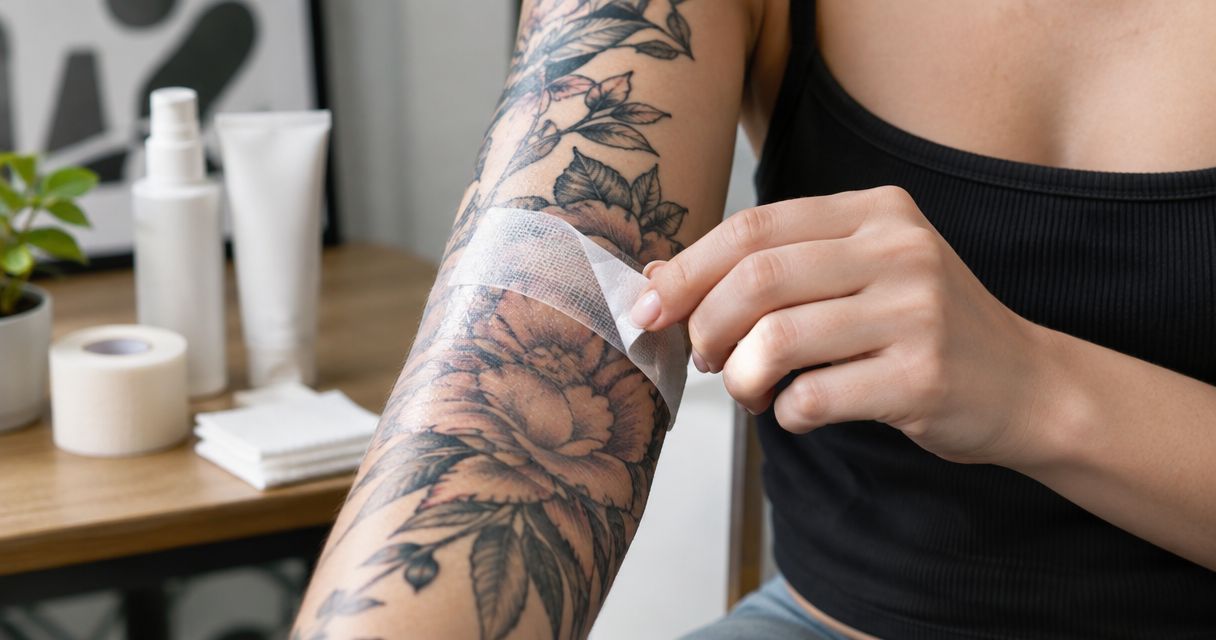
Transparent adhesive film is the first category to assess when a studio specifically wants a covering applied over a fresh tattoo. Select a product whose labeling supports that intended use. Transparency lets the artist or client view the covered area without removing the dressing solely to look at it.
Best for: Studios using a documented adhesive-film aftercare procedure.
Transparent film dressing pros:
- Combines coverage and attachment in one dressing format.
- Allows visual inspection through the film.
- Provides a defined application and removal process when supplied with adequate instructions.
Transparent film dressing cons:
- Adhesives can irritate skin or cause contact reactions.
- Creases, lifting edges, or leakage require attention under the product instructions.
- Wear time and water-exposure claims cannot be transferred between products.
For a 2026 distributor assortment, compare the actual instructions rather than the phrase second skin. Ask whether the supplied format requires cutting, whether individual dressings are sterile, and how studios should handle the material without contaminating the application surface.
Do not turn a water-resistance statement into permission to swim or soak. The manufacturer's limits and the artist's aftercare instructions govern use. Verdict: Buy when the exact film's labeling and studio procedure agree.
2. Sterile non-adherent pads: best for a separate contact dressing
A sterile non-adherent pad offers a contact layer without making an adhesive film the primary covering format. It still needs an appropriate method of retention. Non-adherent describes the intended contact behavior; it does not mean the dressing can never stick.
Best for: Studios whose procedure specifies a separate pad rather than an adhesive film.
Sterile non-adherent pad pros:
- Separates the wound-contact material from the fixation product.
- Offers an alternative dressing format when film is not selected.
- Supports inspection of individual sterile packaging before use.
Sterile non-adherent pad cons:
- Requires a compatible securing method.
- Absorbency differs by construction and must be checked product by product.
- Replacement and removal still require clear instructions.
Specify the complete dressing assembly, not just the pad. A purchasing list that omits fixation materials leaves the studio to choose them independently, potentially outside its written procedure.
Reject torn, opened, or otherwise compromised sterile packaging. If a dressing sticks during removal, follow the product directions or obtain clinical advice rather than pulling forcefully. Verdict: Buy as a complete, documented pad-and-fixation system.
3. Medical fixation tape: best for securing a separate dressing
Medical fixation tape holds an appropriate dressing in position on surrounding intact skin. It is not interchangeable with transparent tattoo film. A narrow adhesive roll should never be sold as though its adhesive belongs directly on the fresh tattoo.
Best for: Securing a separate pad under a studio-approved dressing procedure.
Medical fixation tape pros:
- Gives the studio a dedicated retention material.
- Allows fixation to be selected separately from the contact pad.
- Comes in different constructions that buyers can evaluate against the intended task.
Medical fixation tape cons:
- Adds another product and application step.
- Adhesive reactions remain possible.
- Does not provide the pad's contact surface or absorption function.
Compare the exact tape's intended use, adhesive information, removal directions, and packaging. Paper, fabric, and plastic describe broad constructions; those words alone do not establish which tape is suitable for a particular client.
Keep fixation tape labeled separately in the stockroom and online catalog. Clear naming prevents a buyer from confusing dressing retention with direct tattoo coverage. Verdict: Buy for pad retention; skip as a direct tattoo covering.
4. Gentle fragrance-free cleanser: best for the washing step
A cleanser serves a different purpose from tattoo tape: cleaning during the instructed aftercare routine. Select a product consistent with the studio's written guidance and the manufacturer's directions. A cleanser does not replace the physical function of a dressing.
Best for: Studios standardizing the washing instructions given to clients.
Gentle fragrance-free cleanser pros:
- Gives staff a specific product category to explain.
- Avoids fragrance as an unnecessary selection feature.
- Supports consistent written instructions when the exact product is identified.
Gentle fragrance-free cleanser cons:
- Fragrance-free does not mean reaction-free.
- Ingredients and directions differ between formulations.
- Stronger cleansing claims do not establish better tattoo aftercare.
For your 2026 catalog, do not place ordinary cleansing products under a disinfectant claim. Avoid recommending alcohol, peroxide, or medicated products as routine substitutions without appropriate clinical direction. Describe the product's actual labeled role rather than promising infection prevention.
The handoff should explain the washing procedure and how it relates to the selected dressing. It should not tell clients to lift an intact film simply to use a cleanser beneath it. Verdict: Buy for a defined washing step, not as a dressing replacement.
5. Fragrance-free moisturizer: best for the moisturizing stage
A moisturizer belongs in the aftercare plan when the artist's instructions and the product directions call for it. It is not an adhesive aid or a treatment for suspected infection. Keep the recommendation specific to the product and stage of care.
Best for: Studios providing clear moisturizing guidance after the relevant dressing stage.
Fragrance-free moisturizer pros:
- Gives clients a defined moisturizing category.
- Avoids fragrance as a selling point for recently tattooed skin.
- Can be explained separately from cleansing and dressing care.
Fragrance-free moisturizer cons:
- Fragrance-free formulations can still contain ingredients a client reacts to.
- Applying a product beneath film without authorization conflicts with a controlled dressing procedure.
- Texture alone does not establish suitability for tattoo aftercare.
Do not rank lotions, balms, or ointments by thickness alone. Review the formula, labeled purpose, packaging, and application directions. Avoid shared-container handling that contaminates the remaining product.
A distributor should require support for any claim that a moisturizer preserves pigment or improves healed results. Attractive healed photographs do not isolate the moisturizer's effect. Verdict: Buy only when it fits the written aftercare plan.
Turn the shortlist into a purchasing procedure
Build your 2026 purchasing record around the exact item supplied. A brand name without a product reference is not enough to distinguish different dressings, adhesives, or formulations.
- Verify purpose: Match the manufacturer's intended use to the studio's requirement.
- Review instructions: Record application, removal, warnings, and relevant storage directions.
- Inspect packaging: Check package integrity and the product's actual sterility labeling.
- Record traceability: Retain the supplier, product reference, and applicable lot information.
- Standardize handoff: Give staff the instructions for that product, not a different dressing remembered from training.

Keep an exception process for adhesive concerns, damaged packaging, and unclear instructions. Staff should know when to stop and ask the manufacturer or a qualified clinician rather than invent an alternative application method.
Professional tattoo ink needs its own purchasing checks. Review INTENZE for that category; evaluate aftercare dressings independently. Neither a familiar ink brand nor an established supplier removes the need to inspect a separate product's documentation.
Review professional tattoo ink
Keep professional tattoo ink purchasing separate from dressing and adhesive selection.
How the categories are ranked
The ranking follows function: direct coverage first, alternative contact dressing second, fixation third, then washing and moisturizing. It does not claim comparative healing performance or report a clinical test.
The criteria are intended use, instructions, adhesive suitability, package integrity, traceability, and studio fit. A product that fails a required criterion should not win because it ranks highly within its category.
Which tattoo tape should you choose?
Choose a transparent film dressing when you need adhesive barrier coverage and its labeling fits the studio's procedure. Choose sterile non-adherent pads with suitable fixation when the procedure calls for a separate dressing system.
For distributors, the strongest 2026 assortment is a clearly differentiated one. Keep film, pads, fixation tape, cleanser, and moisturizer in separate purchasing roles; do not position every item as another version of tattoo tape.
FAQ
What's the best tattoo tape for a fresh tattoo?
A transparent film dressing labeled for tattoo aftercare is the default category to assess for adhesive barrier coverage. The exact product must suit the client and the studio's procedure; there is no universal winner for every tattoo.
Is medical tape the same as tattoo film?
No. Medical fixation tape secures a separate dressing to surrounding intact skin, while tattoo film provides a covering over the tattoo according to its labeling.
How long should tattoo tape stay on?
Follow the exact dressing manufacturer's directions and the artist's product-specific instructions. Do not transfer a wear schedule from another brand or dressing type.
Can clients swim while wearing tattoo film?
Do not treat a film's water-resistance claim as permission to swim or soak a fresh tattoo. Follow the dressing instructions and the artist's aftercare guidance.
What should a client do if tattoo tape causes irritation?
Follow the product's discontinuation and removal instructions and seek medical advice for significant or persistent symptoms. Trouble breathing or facial swelling requires emergency medical attention.
Does fragrance-free aftercare mean allergy-free?
No. Fragrance-free cleansers and moisturizers can still contain ingredients that cause irritation or an allergic reaction.
What should distributors verify before buying tattoo aftercare supplies?
Verify intended use, instructions, packaging, applicable sterility claims, and traceability. Keep the supplied product reference connected to purchasing records and staff guidance.
Does tattoo tape prevent infection?
No dressing guarantees that a tattoo will remain free of infection. Worsening redness, increasing pain, pus, or fever warrants prompt medical assessment rather than simply applying another dressing.
One last thing
Sterile describes a product's stated condition, not the entire aftercare process. Packaging damage, handling, application, and client behavior still matter. Before expanding the assortment, make sure staff can explain the difference between the contact dressing and the material holding it in place.