To tell if INTENZE tattoo ink is genuine, verify where it came from, match the bottle to its purchasing records, and ask the manufacturer to resolve any discrepancies before use or resale. A familiar label, intact closure, or seller’s authenticity claim does not establish provenance; keep questionable bottles out of usable inventory while you investigate.
- To tell if INTENZE tattoo ink is genuine, prioritize seller verification and purchasing records over packaging appearance.
- Keep questionable professional tattoo ink separate from inventory cleared for use or resale.
- Photograph the bottle, preserve its packaging, and retain the invoice before contacting the manufacturer.
- Authenticity and condition are separate checks: genuine ink still needs appropriate handling and inspection.
Why this matters
An authenticity check is an inventory-release decision, not a label-recognition exercise. Your distributor needs evidence connecting the bottle received to the seller that supplied it, plus a clear process for resolving mismatches.
INTENZE brings 30+ years of professional artist use to professional tattoo ink. That history provides brand context, not authentication of an individual bottle. Start online purchasing through INTENZE rather than treating an unfamiliar listing as an approved source.
For your 2026 purchasing procedure, separate 3 questions: Is the source verified? Does the delivered product match the order? Is the bottle suitable to release into inventory? A satisfactory answer to one does not settle the others.
How can you tell if a bottle of INTENZE tattoo ink is genuine?
The strongest practical check is a documented supply chain supported by bottle-specific evidence. Inspect the container, but do not make appearance your final test. Use the following sequence for incoming shipments and bottles already under review.
- Verify the source. Record the seller’s business identity and the actual party fulfilling the order. If a seller claims authorization, seek confirmation through the manufacturer rather than accepting the claim on the listing alone.
- Match the records. Compare the invoice, order confirmation, product description, and delivered bottles. Record any product identifiers, lot or batch markings, and date information that appear; do not invent an expected coding format.
- Inspect the bottle. Check for leakage, closure damage, altered labels, obscured markings, and differences between the ordered product and the item received. Record the findings without opening a questionable bottle.
- Resolve discrepancies. Send the seller and manufacturer clear photographs and purchasing records. Ask about the specific discrepancy instead of requesting a general opinion about whether the bottle looks real.
- Document release. Keep the bottle separate until the evidence supports an inventory decision. Record who reviewed the information and why the item was released, returned, or kept on hold.
What each authenticity check establishes
| Evidence | Best for | What it supports | Limitation |
|---|---|---|---|
| Seller identity and purchasing records | Distributor intake | Connecting an order to a named supplier | An invoice alone does not authenticate the contents |
| Bottle and packaging photographs | Documenting discrepancies | Preserving visible condition and markings | Appearance alone cannot establish provenance |
| Lot or batch markings, where present | Product-specific inquiries | Giving the manufacturer identifiers to assess | A printed code is not independent proof of authenticity |
| Manufacturer response | Resolving source or packaging questions | Obtaining guidance tied to the evidence submitted | Do not assume every inquiry can be resolved from photographs |
| Closure and container inspection | Receiving inspection | Identifying visible damage or possible interference | An intact container does not prove authenticity or sterility |
Do not turn this table into a points system. Several weak signals do not outweigh an unresolved sourcing problem, and a packaging discrepancy deserves investigation rather than an automatic counterfeit verdict.
Verify the seller before you inspect the label
The supplier relationship should withstand a basic records check. Save the seller’s business name, order reference, product listing, and correspondence so that a later inquiry does not depend on a listing remaining online.
For a 2026 supplier review, verify the actual selling business—not just the marketplace name. A marketplace account, storefront name, and invoice issuer are different pieces of information. Reconcile them before approving the supplier for repeat purchases.
The brand explicitly states that it does not sell on AliExpress. An AliExpress listing should therefore not be treated as a direct brand sale; do not infer that the marketplace listing establishes an authorized supply chain.
If you manage distributor purchasing, use the guide to buying ink directly from the manufacturer to frame your sourcing questions. Confirm the purchasing arrangement before assuming any particular account terms or distributor status.
What should you ask an unfamiliar seller?
Ask for the legal business identity behind the invoice, the source of the goods, and documentation connecting the delivered product to your order. If authorization is claimed, ask how that claim can be confirmed independently.
Keep the request factual. A seller’s refusal or inability to supply documentation is a reason to hold the purchasing decision, not proof by itself that every bottle is counterfeit.
Match the bottle to the order without inventing label rules
Build a 2026 receiving record around the item actually delivered. Capture the product wording, any visible identifiers, the seller, the order reference, and the date your team received it.
Do not rely on an unofficial checklist that says every genuine bottle must have a particular cap color, hologram, font, seal shape, or code location. Without current manufacturer confirmation for that specific product, those details are not reliable pass-or-fail rules.
Use these 3 records as your minimum internal evidence packet:
- Order record: The invoice or confirmation identifying the seller and the product purchased.
- Bottle record: Photographs showing all sides, the closure, and every readable identifier.
- Decision record: The discrepancy, the responses received, and the final inventory disposition.
These are recommended record categories, not manufacturer authentication requirements. Their purpose is to make an inquiry specific enough to assess and an inventory decision possible to audit.
Preserve evidence before returning anything
Photograph the original shipping carton and packing materials if they help explain a mismatch or damage. Keep the unedited photographs alongside your correspondence rather than replacing them with cropped screenshots alone.
If you arrange a return, retain the original evidence and return documentation. Do not send away the only readable record of the bottle’s markings before completing your inquiry.
Why authenticity assessments vary
The evidence available for each bottle determines how confidently you can assess its source. Apply the same decision process, but do not expect every inquiry to have the same supporting records.
- Seller traceability: A named business with matching order records gives you a clearer starting point than an unexplained transfer between sellers.
- Record completeness: An invoice, product description, and delivery record let you compare what was ordered with what arrived.
- Readable identifiers: Clear markings make a product-specific inquiry more useful than a distant photograph of the front label.
- Container condition: Leakage, damage, or obscured information creates a separate receiving problem even before provenance is resolved.
- Storage and handling history: Authenticity does not establish what happened to a bottle after manufacture.
- Specificity of the question: A documented mismatch gives the manufacturer something concrete to assess; a general request to judge appearance does not.
An unresolved discrepancy is a hold decision, not a reason to test the ink on a client. Keep authentication work separate from tattoo technique and product-performance judgments.
What should distributors do with a suspicious shipment?
For 2026 receiving operations, create a clear hold-and-release process that staff can follow without guessing. Assign responsibility for the decision, keep the affected bottles identifiable, and prevent held items from entering normal fulfillment.
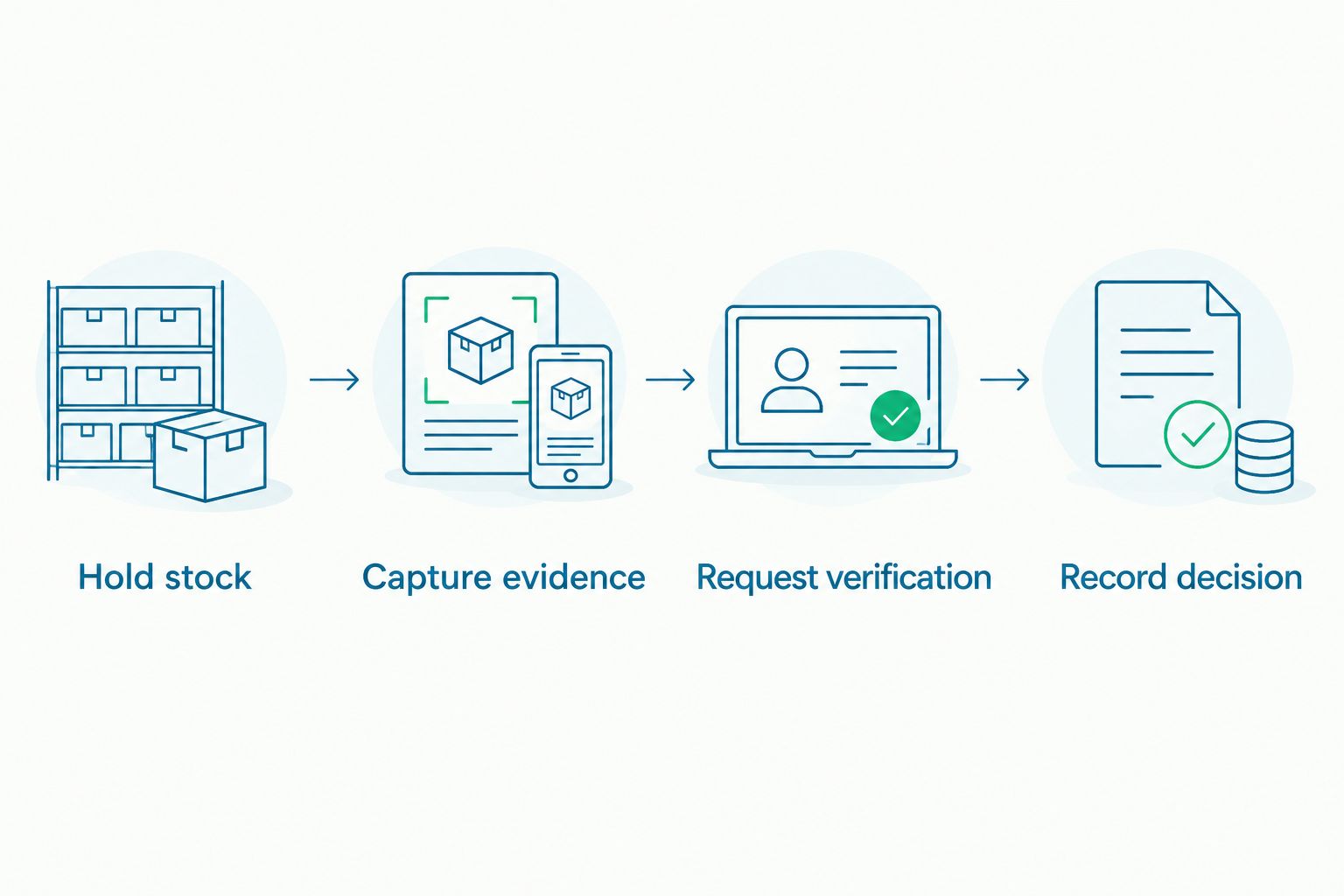
Use the following sequence whenever sourcing or condition remains unresolved:
- Hold stock. Separate the affected bottles from products cleared for sale or studio use.
- Capture evidence. Photograph the shipment and connect each questioned item to the order record.
- Request verification. Send the discrepancy and evidence to the relevant seller and manufacturer.
- Record decision. Retain the response and document the disposition of the affected stock.
Do not open a bottle to compare its smell, dilute it to judge flow, or use a test tattoo to decide authenticity. None of those actions establishes where the bottle came from, and opening it changes the evidence you can present.
If your business supplies multiple studios, preserve the link between supplier orders and downstream shipments. That record gives you a practical way to identify which customers received stock associated with a later inquiry.
Can genuine tattoo ink still be unsuitable to use?
Genuine tattoo ink still requires a separate condition and handling review. Establishing a legitimate source does not resolve leakage, damaged closures, unreadable instructions, or an uncertain storage history.
Keep authenticity, sterility claims, formulation claims, and suitability for use distinct. Words such as sterile, vegan, or REACH-compliant describe different product attributes; printing those words on a label does not authenticate the bottle carrying them.
For your 2026 intake procedure, require staff to record both sourcing findings and condition findings. Do not let a satisfactory source check override a visible receiving defect, and do not interpret an intact bottle as a medical or allergy guarantee.
What information should you send the manufacturer?
Send a concise, bottle-specific evidence packet rather than a general description. Include the seller’s identity, order reference, purchase record, product wording, photographs of all sides, closure photographs, and readable identifiers where present.
State the exact concern: an invoice mismatch, altered marking, damaged closure, or unresolved seller claim. Ask what additional evidence is needed and whether the source or packaging detail can be assessed from the material supplied.
Avoid describing a bottle as confirmed counterfeit before the evidence supports that conclusion. Your immediate operational decision is simpler: whether to keep it on hold while the question remains unresolved.
Where should professional buyers start their next order?
INTENZE professional tattoo ink is best suited to professional artists and distributors seeking a documented manufacturer source. Start the next purchase online through the manufacturer, and preserve the order records from the outset.
That route gives your purchasing team a direct starting point; it does not replace receiving inspection. Treat source documentation and bottle inspection as complementary controls rather than alternatives.
Start your next ink order
Review professional tattoo ink online and retain the purchasing records for receiving inspection.
FAQ
Can you tell whether tattoo ink is genuine just by looking at the bottle?
You cannot establish authenticity from bottle appearance alone. Use seller verification, purchasing records, bottle-specific photographs, and manufacturer guidance to assess an unresolved concern.
Does an intact seal prove tattoo ink is authentic?
An intact closure does not prove authenticity or sterility. Inspect the container as part of receiving, but assess the supply chain separately.
Does a batch number prove a bottle is genuine?
A batch number alone does not prove a bottle is genuine. Record any visible identifiers and submit them with the seller details and photographs when requesting verification.
Should I use a suspicious bottle while I wait for a response?
Keep a suspicious bottle out of use and resale while the concern remains unresolved. Preserve the bottle, packaging, and purchasing records for the inquiry.
Does different packaging automatically mean the ink is fake?
Different packaging alone does not establish that ink is counterfeit. Document the difference and ask the manufacturer about the specific product rather than relying on an unofficial visual rule.
Can genuine tattoo ink still arrive damaged?
Authenticity and damage are separate questions. Inspect genuine products for receiving defects and follow the product’s instructions before releasing them into usable inventory.
What should a distributor keep after an authenticity check?
Keep the order record, bottle photographs, relevant correspondence, and final inventory decision. Connect those records to the affected stock so another staff member can reconstruct the decision.
One last thing
An invoice identifies a transaction; it does not independently identify what is inside a bottle. Keep the connection between the supplier, the delivered item, and your release decision. That connection is more useful than a folder of label photographs with no order references.
Make evidence capture part of receiving, not an emergency task after a studio raises a concern. Your next purchasing decision should leave a clear record before the carton arrives.