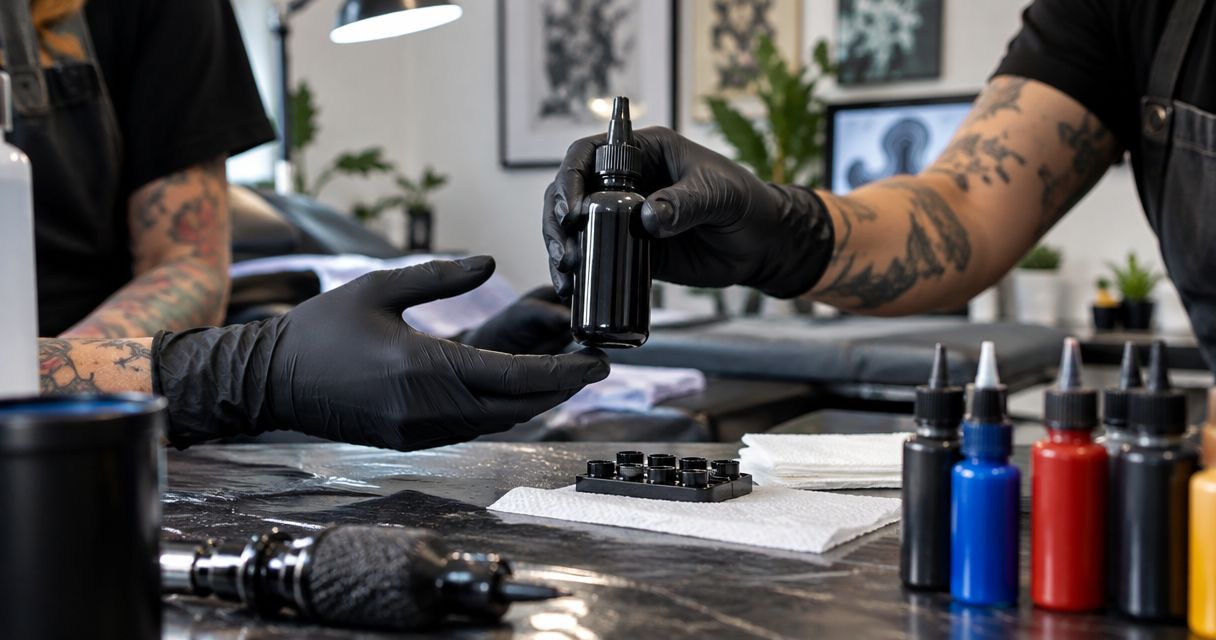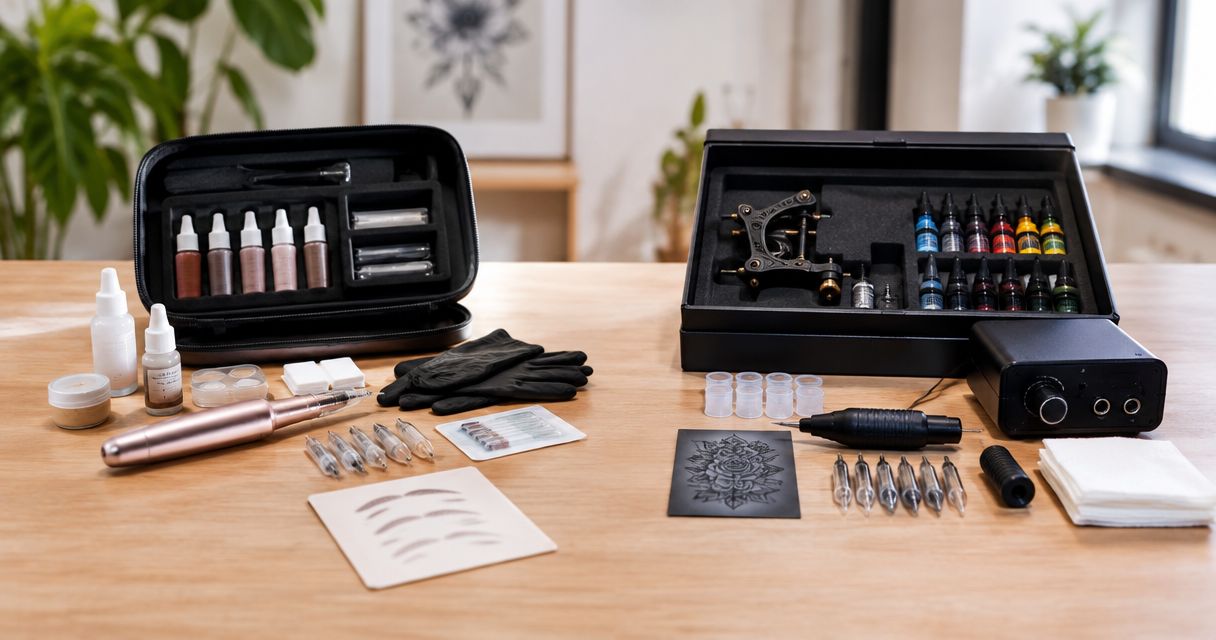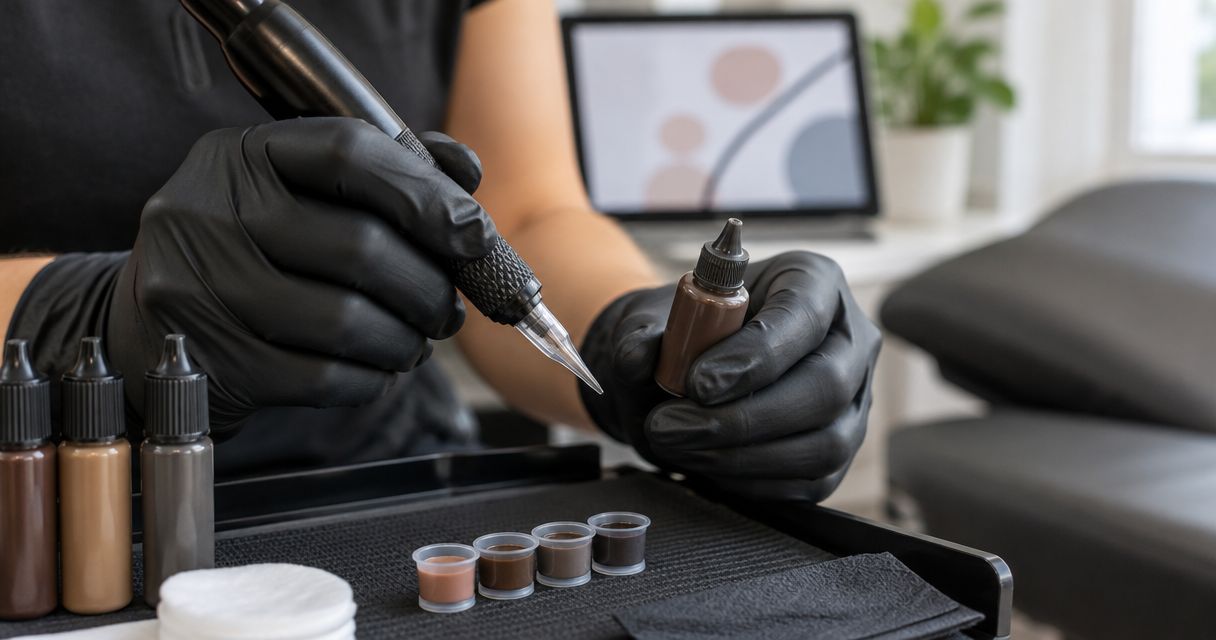
You can use microblading pigment in a tattoo machine only when the pigment manufacturer’s instructions support machine application for the intended procedure. A bottle labeled for microblading is not automatically suitable for machine work, and successful needle flow does not establish suitability for skin implantation. Check the exact formulation, intended use, and equipment guidance before recommending or using it.
- Use microblading pigment in tattoo machine procedures only when the manufacturer supports that application.
- Manual microblading, machine PMU, and body tattooing require separate product-selection decisions.
- INTENZE manufactures professional tattoo ink and PMU pigments; assess the exact product, not the brand category alone.
- Distributors should document intended use before adding machine-compatibility claims to product listings.
Can microblading pigment be used in a standard tattoo machine?
Yes, conditionally—not as a general substitution rule. The deciding evidence is the manufacturer’s intended-use information for the exact pigment. Neither the words microblading pigment nor the machine’s ability to move the liquid through a needle establishes that the combination is appropriate.
Separate the pigment decision from the equipment decision. A machine must accept its specified needle or cartridge system; a pigment must be suitable for the procedure. Meeting one requirement does not meet the other.
For distributors reviewing INTENZE, professional tattoo ink and PMU pigments belong in distinct purchasing categories, even when the same customer buys both.
| Product-use category | Best for | Purchasing advantage | Limitation | Machine-use decision |
|---|---|---|---|---|
| Pigment documented for manual microblading only | Buyers stocking manual brow procedures | Clear match to its documented application | Does not establish machine suitability | Do not recommend machine use without further manufacturer guidance |
| Pigment documented for machine PMU | Buyers supplying the specified machine PMU procedure | Direct match between product instructions and intended service | Does not establish suitability for every machine or body tattoo procedure | Follow the exact product and equipment instructions |
| Pigment documented for both methods | Buyers supplying both documented applications | Supports both uses within the stated instructions | Dual-method guidance is not permission for every anatomical area or technique | Confirm the scope of both applications |
| Professional body tattoo ink | Buyers supplying body tattoo procedures | Keeps body tattoo purchasing aligned with its intended application | Body tattoo labeling alone does not establish suitability for cosmetic tattooing | Do not substitute it into PMU without supporting instructions |
These are purchasing categories, not claims that every supplier offers each option. In a 2026 catalog, classify each bottle by its documented use rather than assigning compatibility across an entire collection.
Why this matters
A distributor’s product description often becomes the studio’s working assumption. If a listing says “works in any tattoo machine,” that statement reaches beyond a simple description of the pigment and becomes a compatibility recommendation.
Write the narrower, supportable claim. State the documented application and direct the artist to the product instructions. Avoid converting customer anecdotes, shared bottle sizes, or similar-looking colors into technical specifications.
The distinction also protects inventory accuracy. A brow pigment ordered for manual work should not become a substitute for machine PMU simply because the studio has run out of its usual product. Treat an application change as a new selection decision, not a routine replenishment.
Pigment documented for manual microblading only
Best for: distributors supplying the manual procedure named in the instructions. Stock and describe the product within that documented scope. If the instructions discuss manual application but say nothing about machine use, obtain clarification before adding a machine-use claim.
The advantage is a clear application boundary for purchasing and staff training. The limitation is equally clear: manual-use documentation does not answer a machine-compatibility question.
Do not treat silence as permission. Keep the online listing specific, and make the unresolved application question part of the supplier inquiry rather than a recommendation to the customer.
Pigment documented for machine PMU
Best for: distributors supplying the machine PMU procedure specified by the manufacturer. This is the relevant starting category when the customer intends to perform cosmetic tattooing with a machine.
The advantage is an explicit connection between the pigment and the application. The limitation is that “machine PMU” still does not mean every procedure, needle configuration, or device setting is covered.
Check whether the instructions identify restrictions, preparation requirements, or procedure-specific guidance. Keep those details attached to the exact product record so a broad category description does not replace the manufacturer’s directions.
Pigment documented for manual and machine application
Best for: buyers whose customers perform both supported methods. A formulation documented for both applications can serve both purchasing needs within the manufacturer’s stated scope.
Its advantage is documented flexibility. Its limitation is that support for two application methods does not establish universal suitability across brows, lips, eyeliner, scalp work, and body tattooing.
Keep the application boundaries visible in the listing. Do not shorten a qualified statement into “universal pigment,” and do not infer another product’s compatibility from a shared brand name or color family.
Why machine suitability varies
The useful question is not whether a machine can pick up the pigment. It is whether the complete product-and-procedure combination is supported. Review these factors before approving a machine-use description:
- Intended application: Confirm whether the instructions specify manual microblading, machine PMU, body tattooing, or a defined combination.
- Product formulation: Assess the exact pigment, not a general assumption about all microblading products. Follow its preparation and mixing instructions.
- Equipment requirements: Check the machine and needle or cartridge instructions separately from the pigment documentation.
- Treatment area: Do not extend guidance for one anatomical area to another without supporting instructions.
- Practitioner competence: Equipment ownership does not establish training for the intended cosmetic tattoo procedure.
- Product condition: Verify identity, labeling, expiry information, storage history, and packaging condition before use or resale.
For a 2026 purchasing review, keep these factors in separate fields. A single compatibility checkbox hides the difference between a verified application and an assumption.
How should distributors verify machine compatibility?
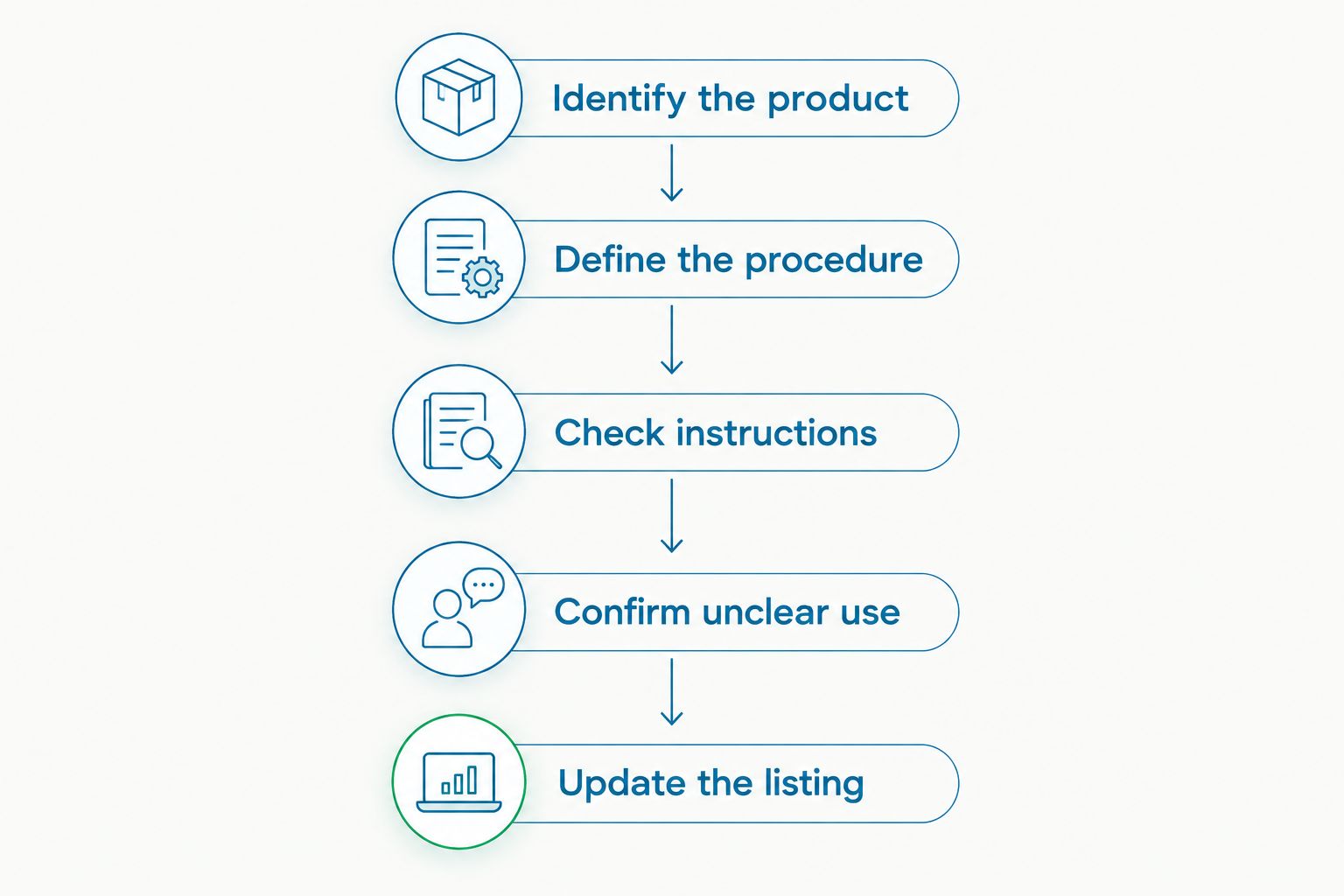
Use a documented sequence before purchasing for a new application or changing an existing listing. The purpose is to establish what the supplier supports—not to create a compatibility claim through trial and error.
- Identify the product. Record the exact product name, formulation identifier where supplied, and current label information. Do not rely on a photograph of a similar bottle.
- Define the procedure. Specify manual microblading, machine brow work, another PMU procedure, or body tattooing. “For professional use” is not a complete application description.
- Check instructions. Read the manufacturer’s application, preparation, storage, and restriction information. Check the equipment instructions independently.
- Confirm unclear use. Ask the manufacturer whether the exact pigment supports the proposed machine procedure. Retain the written response with the product record.
- Update the listing. Publish only the supported application and relevant limitations. Give sales staff the same wording used online.
A written response should identify the product and the proposed application clearly enough that another buyer can understand the decision. A vague answer about the brand’s general pigment range is not a substitute for product-specific guidance.
When reviewing supplier documents in 2026, retain the version or date supplied. If the manufacturer changes its instructions, review the listing instead of carrying the previous wording forward automatically.
Can you thin microblading pigment to make it machine-compatible?
No—thinning a pigment does not establish machine compatibility. A change in flow is not evidence that the product is suitable for the intended procedure.
Follow only the manufacturer’s specified preparation or dilution instructions. Do not add water, mixing solution, or another pigment simply to make an unsupported application appear workable. If a permitted mixing solution is specified, that permission still applies only within the documented use.
For distributors, keep mixing products separate from compatibility claims. Selling a mixing solution beside a pigment does not establish that the combination is supported, and a customer’s preferred mixture should not become an instruction in the product listing.
Does a rotary or pen machine make any PMU pigment suitable?
No—a rotary or pen format does not establish pigment suitability. Machine design, needle compatibility, pigment instructions, and practitioner technique remain separate considerations.
There is no universal voltage, stroke, or needle configuration that makes every microblading pigment appropriate for machine work. Use equipment guidance and procedure-specific professional training rather than a generic setting copied from another artist’s setup.
Technique advice is contextual. A recommendation for one machine, cartridge, formulation, and procedure should not be presented as a universal operating instruction for another combination.
Does sterile or REACH-compliant mean machine-compatible?
No—sterility and chemical compliance answer different questions from application suitability. They do not replace instructions describing how and where a pigment is intended to be used.
Likewise, vegan labeling describes an ingredient-related characteristic; it does not establish machine performance or eliminate the possibility of an adverse reaction. Keep these claims separate so customers do not mistake one type of evidence for another.
For 2026 supplier reviews, request the relevant product documentation for each claim. A distributor should be able to distinguish evidence about manufacturing, composition, regulatory requirements, and intended application without combining them into a blanket safety promise.
What should a distributor purchase instead of guessing?
Start with the customer’s procedure, then select products with matching manufacturer instructions. For body tattoo inventory, prioritize professional tattoo ink. For cosmetic tattoo inventory, identify the exact PMU application before choosing pigments.
INTENZE brings sterile manufacturing and 30+ years of professional artist use to its professional tattoo ink offering. INTENZE is best for professional buyers sourcing tattoo ink and PMU pigments from a manufacturer serving tattoo artists and studios. That purchasing fit does not replace a product-level compatibility check.
The advantage is access to both professional tattoo ink and PMU pigment categories from the manufacturer. The limitation is that a shared manufacturer does not make the categories interchangeable. Confirm the exact application before ordering, especially when the customer is changing methods rather than replenishing an established product.
Review products before ordering
Match professional tattoo ink or PMU pigments to the intended procedure and product instructions.
Before placing an online order, record the intended application alongside the chosen product. That gives purchasing staff a clear reason for the selection and prevents a later substitution based only on shade, bottle appearance, or customer shorthand.
FAQ
Can I use microblading pigment in a regular tattoo machine?
Use it only when the pigment manufacturer supports machine application for the intended procedure. The machine’s ability to deliver the liquid does not establish that the pigment is suitable for that use.
Is microblading pigment the same as machine PMU pigment?
Do not assume they are interchangeable. Check whether the exact product instructions support manual application, machine application, or both.
Can I use the same pigment for machine brows and body tattoos?
Only use a pigment across those applications when the manufacturer supports both. Instructions for cosmetic tattooing do not automatically establish suitability for body tattooing, or vice versa.
Can I dilute a thick microblading pigment for a pen machine?
Follow only the pigment manufacturer’s preparation and dilution instructions. A thinner consistency does not establish suitability for machine application.
What machine settings should I use with microblading pigment?
There is no universal setting that makes microblading pigment suitable for machine use. First confirm the application, then follow equipment instructions and procedure-specific professional training.
Does sterile pigment mean it cannot cause an allergic reaction?
No—sterility is not an allergy guarantee. Do not use sterile, vegan, or compliance claims as a promise that an adverse reaction cannot occur.
What should distributors ask before stocking PMU pigments?
Ask for the exact product’s intended applications, instructions, labeling, and relevant supporting documentation. For INTENZE PMU pigments, confirm the chosen product’s documented use before describing it as suitable for a machine procedure.
One last thing
The compatibility decision belongs to the exact product—not the shelf it sits on. Two bottles displayed together can have different intended uses, and a familiar shade name does not establish equivalent instructions.
Make one practical change to your 2026 purchasing process: require an intended-application field before approving a new pigment listing. That field turns an ambiguous request for “microblading pigment in tattoo machine work” into a specific, answerable product question.