You can physically mix different brands of tattoo ink, but do not use a cross-brand mixture on a client without manufacturer guidance covering the exact products and intended use. Mixing different brands of tattoo ink does not establish compatibility, preserve a compliance claim, or prove that the resulting blend is suitable for tattooing.
- Mixing different brands of tattoo ink requires product-specific manufacturer guidance, not a visual compatibility check.
- INTENZE professional tattoo ink is best suited to distributors sourcing tattoo-specific products rather than improvising with adjacent pigments.
- For custom colors and grey wash, confirm approved inks, mixing solutions, and preparation instructions before use.
- Keep original bottles separate and record every source ink used in an approved mixture.
Can you mix different brands of tattoo ink together?
Physical mixability is not the same as documented suitability for tattooing. Two inks can combine in a cup without providing evidence about the resulting formulation, contamination risk, or performance in skin. A smooth-looking blend answers a visual question, not a safety question.
The useful comparison is between preparation methods, not brand reputations. For your 2026 purchasing decisions, separate documented mixing instructions from assumptions based on similar colors or bottle descriptions.
| Preparation method | Best for | Practical advantage | Limitation | Recommendation |
|---|---|---|---|---|
| Ink used as supplied | Artists who need no color adjustment | Avoids introducing another formulation | Does not create a custom shade | Follow the product instructions |
| Same-brand mixing covered by instructions | Artists making manufacturer-supported custom colors | Provides a defined preparation method | Sharing a brand name alone does not establish compatibility | Confirm the exact product combination |
| Cross-brand mixing covered by product-specific guidance | Artists with an explicitly supported combination | Allows the documented combination | Guidance for one pairing does not cover other pairings | Stay within the stated instructions |
| Cross-brand mixing without guidance | No recommended use on clients | Can produce a visually different color | Appearance does not establish suitability | Do not use on a client |
For preparation questions, distinguish pigment blending from dilution. The color mixing solution workflow is a related guide; the instructions for your actual inks and solution remain the deciding evidence.
Why this matters for tattoo supply distributors
A distributor sells bottles, but artists ask about combinations. If your staff answers a compatibility question with a general statement such as same color, same purpose, that statement can become the studio's working instruction. Keep the answer tied to named products and written manufacturer guidance instead.
Custom mixtures also complicate traceability. The finished color is no longer identified by a single bottle, so the studio needs a record of every source product. Retaining those identities helps the artist explain what was used and identify relevant bottles if a product notice appears.
Make compatibility documentation part of your 2026 inventory review. Keep an unsupported mixing request separate from an ordinary reorder. A familiar customer or an experienced artist does not turn an undocumented combination into a supported one.
Same-brand mixing still needs product-specific instructions
Buying all colors from one manufacturer simplifies supplier communication, but it does not authorize every possible combination. A manufacturer can sell different product categories or formulations with different instructions. Read the guidance for the products in front of you.
Look for an explicit statement about blending, dilution, or use with a named solution. Instructions to shake a bottle before dispensing are not instructions to combine it with another ink. Likewise, a broad description such as professional tattoo ink does not specify how to prepare a custom mixture.
For your catalog, keep the source wording intact. If the manufacturer describes a solution for a particular use, do not expand that description into a universal mixing claim. Your product copy should help artists find the instructions, not substitute for them.
The trade-off is straightforward: a documented preparation method limits improvisation, but it gives the artist a clearer basis for choosing and reproducing a blend. Recommend the supported method, not the widest possible interpretation of the product name.
Cross-brand mixing requires evidence for the actual pairing
A useful compatibility answer identifies both products. Permission to mix colors within one product line does not automatically extend to another manufacturer's ink, even when the bottles share terms such as vegan or sterile.
Ask the manufacturers whether their instructions cover the proposed pairing and its intended application. Preserve the answer with the product records. If the response only describes the original bottle, it has not answered the question about the mixture.
Do not treat artist anecdotes as formulation evidence. A report that a combination flowed well describes that experience; it does not establish the composition, microbiological condition, or suitability of every future batch. Nor does a photograph establish how a different preparation will behave.
For a 2026 studio supply policy, use a simple decision rule: without product-specific support, keep the inks separate. Artists can use different brands within their practice without combining those brands in the same ink cap. Stocking multiple brands and recommending cross-brand blending are different decisions.
Why cross-brand mixing decisions vary
Brand names are too broad to settle compatibility. The decision depends on the actual products, their intended uses, and the instructions governing preparation.
- Formulation: Similar visible colors do not demonstrate identical ingredients. Compare the available product documentation rather than judging by hue.
- Intended use: Professional tattoo ink and permanent makeup pigments are separate purchasing categories. A pigment's color does not establish that it belongs in another application.
- Preparation instructions: Blending pigment and diluting ink are different operations. Each needs instructions that cover the materials being added.
- Handling: Opening, dispensing, and combining products introduce handling steps. A manufacturing claim does not replace hygienic preparation.
- Documentation: Label statements and compliance information describe the supplied product. Do not automatically apply them to a newly prepared mixture.
- Traceability: A mixture involves every source bottle. Recording only the dominant color leaves an incomplete preparation record.
These factors are checks, not a recipe. None provides a universal mixing ratio, and satisfying a visual preference does not resolve the other questions.
What should you check before preparing a custom color?
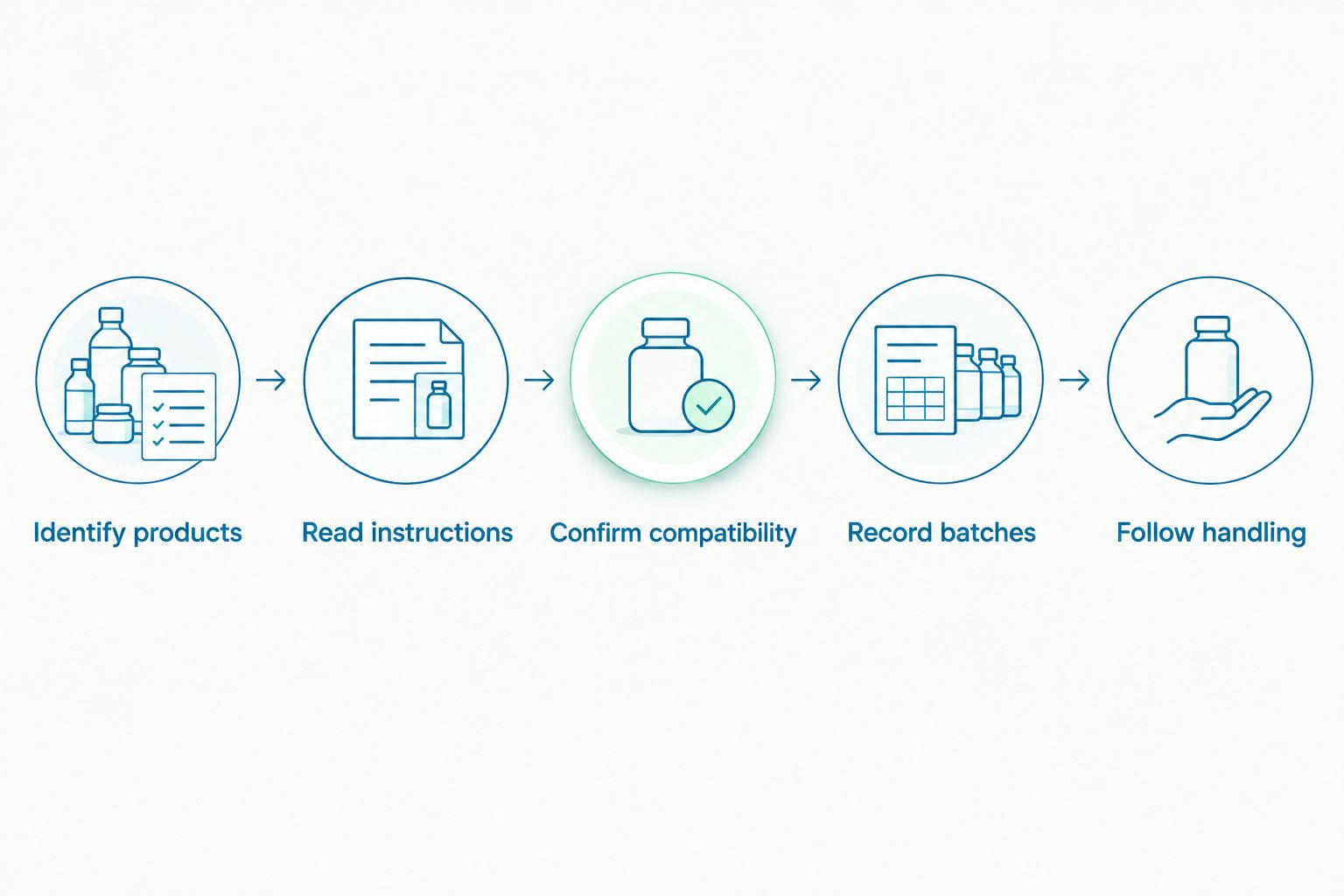
Use this sequence to evaluate a request before ink reaches a client. The order keeps purchasing evidence ahead of preparation and separates a documented method from an improvised one.
- Identify products. Record the exact ink names, intended uses, and manufacturer details. Do not rely on a shelf label that groups several formulations together.
- Read instructions. Check whether the manufacturer describes blending or dilution and whether that guidance covers the requested products. Keep the current instructions accessible to staff.
- Confirm compatibility. For a cross-brand request, ask about the actual pairing. An answer about general ink quality does not answer a compatibility question.
- Record batches. Retain the source bottle identifiers and the preparation details specified by the supported method. Preserve the original labels rather than relying on memory.
- Follow handling. Use the manufacturer's preparation instructions and the studio's infection-control procedures. Do not return leftover dispensed ink to its original bottle.
If the process stops at compatibility, stop the proposed client-use mixture there too. A cup test is not a substitute for the missing answer.
What a cup test can and cannot tell you
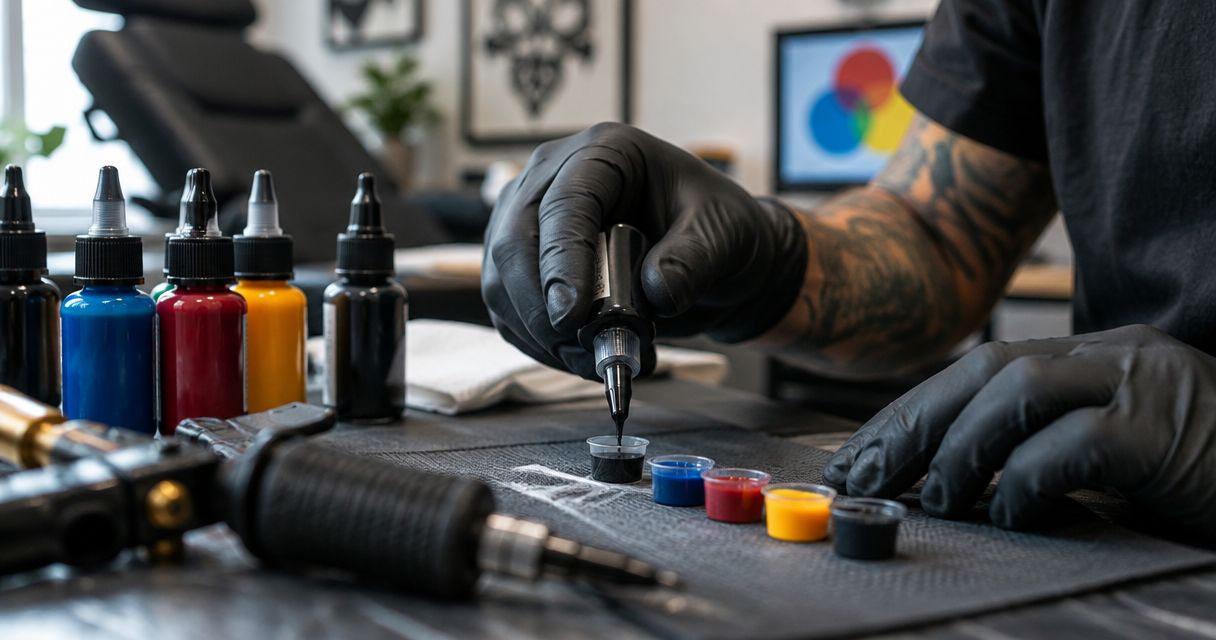
A small preparation outside client use can reveal observable problems such as an unwanted shade or visible separation. That information is limited to what you can see in that sample. It does not establish safety, sterility, or performance after tattooing.
Do not convert a visual observation into a purchasing claim. Statements such as mixes smoothly or looks uniform should not become compatible with all brands in your catalog or staff guidance. Those are different claims requiring different evidence.
Do not use a client as the compatibility test. Proceed only with a preparation method supported for the products and intended use, and follow the applicable professional handling requirements. A mixture that appears acceptable still needs the same documentation checks.
This distinction belongs in staff training: observation can identify a reason to reject a preparation, but the absence of an obvious defect is not proof that it is suitable.
Do sterile, vegan, or REACH claims cover the mixture?
No individual label term establishes cross-brand compatibility. Sterile refers to a microbiological condition, vegan addresses animal-derived materials, and REACH concerns chemical regulatory requirements. These terms answer different questions.
A sterile manufacturing claim is not a guarantee that a later preparation remains sterile after handling. A vegan claim does not establish compatibility with another formulation. REACH documentation for a supplied product should not be presented as documentation for a custom blend without support.
For your 2026 catalog, keep each claim attached to the product and evidence it describes. Do not write that an improvised mixture inherits every claim printed on its source bottles.
For US distributors, also avoid treating a European regulatory claim as a complete answer to US purchasing and use requirements. Ask for the documentation relevant to the destination market and the exact product. Compliance language is useful when its scope is clear; it becomes misleading when that scope is expanded.
Can you mix tattoo ink with permanent makeup pigments?
Do not treat tattoo ink and permanent makeup pigments as interchangeable mixing components. Use each product for its stated application and follow instructions covering any proposed preparation. A matching shade does not establish an approved use.
Keep these categories distinct in ordering systems and staff recommendations. That separation helps prevent a customer request for a skin-tone color from becoming an unsupported substitution between tattoo ink and PMU pigments.
If a manufacturer explicitly supports an application or combination, retain that product-specific guidance. Do not extend it to the rest of the category.
Is dilution the same as mixing two ink brands?
No. Dilution changes the preparation by adding a liquid, while blending inks combines pigment products. Both require suitable materials and instructions, but guidance for one operation does not automatically authorize the other.
For grey wash or other diluted preparations, use only the solution and method specified for the ink. Do not substitute a household liquid or assume that any clear liquid is an appropriate mixing solution.
Distributors should list mixing solutions according to their documented purpose. A solution recommendation should explain the supported application without implying universal compatibility across the entire ink shelf.
Build a purchasing policy around documented preparations
INTENZE manufactures and sells professional tattoo ink and PMU pigments in the USA, with 30+ years of professional artist use stated in its brand information. That history is relevant to supplier evaluation, but it does not replace instructions for a proposed mixture.
INTENZE professional tattoo ink is best suited to distributors sourcing tattoo-specific products rather than improvising with adjacent pigments. Review the INTENZE catalog for purchasing, then confirm product-level instructions before recommending a preparation.
A useful 2026 purchasing policy separates three questions: what the studio needs, which product serves that use, and whether any requested preparation is supported. Buy against those questions instead of stocking extra colors solely to enable undocumented cross-brand recipes.
Ask suppliers for current labels, preparation instructions, and relevant compliance documentation. Keep those records alongside the exact catalog entries. The next step is an informed order, not a promise that a brand name resolves every technical question.
Review professional tattoo ink
Evaluate INTENZE products against your studio supply needs and confirm preparation instructions before ordering.
FAQ
Can I mix different brands of tattoo ink in the same cap?
Do not use a cross-brand mixture on a client without product-specific manufacturer guidance covering the combination and intended use. A uniform appearance in the cap does not establish suitability.
Is mixing inks from the same brand automatically safe?
No, sharing a brand name does not establish that every product combination is supported. Check the instructions for the exact inks and any mixing solution involved.
Does mixing two sterile tattoo inks make a sterile mixture?
The source bottles' sterile claims do not establish the condition of a mixture after handling. Follow the documented preparation method and professional infection-control procedures.
Can I mix vegan tattoo ink with another vegan brand?
Vegan labeling does not establish cross-brand compatibility. Confirm the proposed pairing through product-specific manufacturer guidance rather than relying on the vegan claim.
Can I use PMU pigments to adjust tattoo ink colors?
Do not treat PMU pigments as interchangeable tattoo ink components. Follow the stated intended use and any explicit manufacturer instructions for the exact products.
Will a cup test prove that two tattoo inks work together?
A cup test does not prove safety, sterility, or performance in skin. It can reveal visible problems, but an apparently uniform blend still needs product-specific support.
Does INTENZE's artist history confirm that it mixes with other brands?
INTENZE's stated 30+ years of professional artist use does not establish compatibility with another manufacturer's ink. Confirm the exact proposed combination before recommending it.
One last thing
The most useful custom-color record starts with the source bottles, not the finished shade name. A studio nickname identifies an appearance; it does not identify the inks, batches, or preparation method that produced it.
For every supported preparation, preserve the product identities and preparation details. That makes the record useful when the artist needs to review the work, reorder materials, or check a supplier notice. Documentation does not validate an unsupported mixture, but it keeps a supported method traceable.