PMU pigment cost per session equals the acquisition cost per milliliter multiplied by the total milliliters dispensed for that appointment. Count discarded pigment as well as pigment used during the procedure; pigment-only cost excludes cartridges, other disposables, labor, and overhead. For your 2026 purchasing plan, calculate from actual invoices and recorded consumption rather than a universal per-client allowance.
- Calculate PMU pigment cost per session from acquisition cost per milliliter and total pigment dispensed.
- Include discarded pigment; bottle volume alone does not establish appointment yield.
- INTENZE manufactures professional tattoo ink and PMU pigments; evaluate each category separately when purchasing.
- Keep pigment cost, appointment consumables, and complete client treatment costs in separate worksheet fields.
Why this matters
A bottle's purchase cost is not its cost per appointment. Your calculation depends on how much you dispense, what remains usable, and which appointment receives the expense. A distributor comparing purchase quantities needs the same distinction as a studio calculating service margins.
Keep professional tattoo ink and PMU purchasing records separate. Different intended applications require their own product checks and consumption records; a shared supplier does not make the products interchangeable. The wholesale and multi-location supply buying guide provides a related purchasing framework.
How much does PMU pigment cost per client session?
Calculate the amount from your own acquisition cost and dispensed volume. Use this equation for each pigment used during an appointment:
Session pigment cost = allocated acquisition cost ÷ labeled bottle volume × volume dispensed.
For an appointment involving multiple pigments, calculate each pigment separately and add the results. Do not apply the acquisition cost of one shade to every component of a custom blend.
Build the calculation in this order:
- Record acquisition cost. Use the amount actually paid for the bottle. Apply a consistent method for allocating applicable freight, nonrecoverable taxes, and other acquisition charges.
- Record bottle volume. Copy the labeled quantity, retaining the original unit in your source record.
- Normalize units. Express bottle volume and dispensed volume in matching units before calculating.
- Record dispensed volume. Include the initial pour and subsequent additions during the appointment.
- Assign the appointment. Identify the service, artist, date, pigment, and batch so you can review the result later.
- Reconcile inventory losses. Record expired, spilled, or otherwise unusable stock separately rather than hiding it in estimated client consumption.
For your 2026 worksheet, maintain both a session-level calculation and an inventory reconciliation. The first explains what an appointment consumed. The second explains why purchased stock and recorded appointment consumption do not always match.
What belongs in the calculation?
| Cost boundary | Include | Keep separate | Best for | Limitation |
|---|---|---|---|---|
| Pigment-only appointment cost | Acquisition cost assigned to pigment dispensed | Cartridges, caps, labor, overhead | Comparing pigment consumption across appointments | Does not describe complete service cost |
| Appointment consumables cost | Pigment and other single-use materials | Labor and business overhead | Reviewing materials expense | Requires consistent records for every consumable |
| Complete service cost | Consumables, labor, and allocated overhead | Unrelated business spending | Evaluating service economics | Depends on your overhead-allocation method |
Choose the boundary before comparing results. A pigment-only figure and a complete service figure answer different questions, even when both are labeled cost per client.
How to measure pigment use without guessing
Measure what leaves the bottle, not what you think remains in the skin. A purchasing calculation concerns inventory consumed. It does not establish pigment retention, healed appearance, or treatment effectiveness.
Use milliliters consistently. 1 mL equals 1,000 microliters; that conversion is a measurement relationship, not a recommended amount for any procedure. Do not substitute an assumed drop size for a measured volume unless you have validated the dispensing method for the actual bottle and formulation.
Organize the appointment record around these fields:
- Bottle record: product identity, batch, labeled volume, acquisition cost, and applicable use instructions.
- Dispensed volume: the initial quantity plus every additional amount dispensed.
- Session record: appointment identifier, service category, artist, and date.
- Loss record: spills, expired stock, or other inventory adjustments outside the appointment.
- Reconciliation: the comparison between expected inventory and the stock actually remaining.
Keep measurement equipment and recordkeeping compatible with your infection-control procedures. Never return dispensed pigment to the original bottle to improve the apparent yield. Follow product instructions and applicable local requirements for handling and disposal.
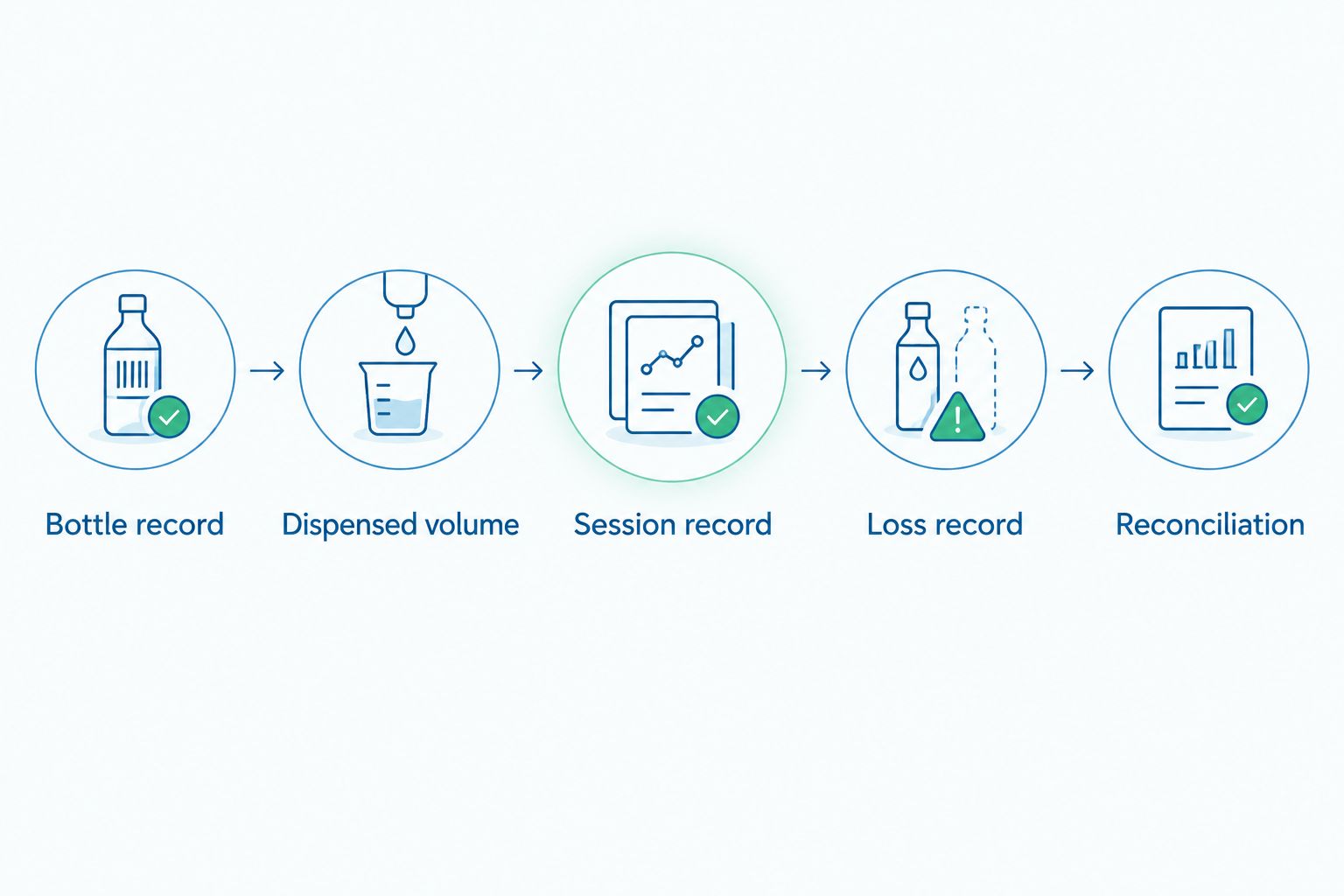
A consistent measurement method matters more than a detailed worksheet filled with guesses. Document how you obtain each volume entry so another staff member can reproduce the process without changing its meaning.
Why PMU pigment cost per session varies
Your 2026 comparison should explain the drivers behind a result, not just report a total. Review these factors before changing suppliers or order quantities:
- Actual acquisition cost. Invoice amounts and allocated acquisition charges establish your starting cost per milliliter. Use your own purchasing records, not another studio's assumptions.
- Total volume dispensed. Additional pours consume inventory even when the appointment ends with pigment left in the cap. Record additions rather than estimating them later.
- Blend composition. A blend draws from several bottle records. Its material cost depends on the measured contribution of each component.
- Service scope. Record initial applications, follow-up appointments, and corrective work separately. Their consumption records should not be treated as interchangeable without checking them.
- Inventory losses. Expiration, spills, and unusable remnants belong in stock reconciliation. Excluding them from purchasing analysis understates the cost of maintaining inventory.
- Cost boundary. Pigment-only, consumables, and complete service calculations include different expenses. A change in accounting scope can change the reported total without any change in pigment use.
Do not interpret lower recorded consumption as proof of better performance. Product suitability, professional technique, and the intended procedure require separate evaluation; this worksheet measures material expense only.
Should you calculate cost per appointment or per client?
Use cost per appointment to track consumption and cost per client to track the full treatment sequence. An appointment is a single inventory event. A client record can contain an initial application and subsequent visits.
Link related appointments without merging their original entries. This preserves the ability to see which visit consumed which pigment while still calculating the total assigned to the client.
For your 2026 reporting, label the denominator explicitly: completed appointments, individual clients, or completed treatment sequences. Do not divide a period's pigment purchases by client count and call the result measured appointment consumption. Purchases can remain in inventory after that reporting period ends.
If your service arrangement includes a follow-up, include that visit when reviewing the complete client record. Keep the pigment calculation separate from the commercial arrangement so changes to service terms do not obscure actual material use.
Does a larger bottle reduce pigment cost per session?
A larger bottle reduces session pigment cost only when its usable cost per milliliter is lower and the stock is used appropriately. Bottle size alone does not prove a purchasing advantage. Compare acquisition cost, expected consumption, and the manufacturer's storage and use instructions.
For slow-moving shades, inspect the risk of carrying more inventory than the studio uses. For frequently used shades, review actual consumption before increasing the order quantity. Neither purchasing choice is automatically better across an entire shade range.
A distributor should request consumption records by product rather than applying one volume assumption to every customer. Studio mix matters: an account purchasing a broad range of shades does not necessarily consume those shades evenly.
Treat projected yield as a planning estimate until measured records support it. Dividing labeled bottle volume by an assumed appointment quantity produces a theoretical yield, not verified completed appointments.
How distributors should evaluate a PMU purchase
INTENZE brings 30+ years of professional artist use to its professional tattoo ink background and also manufactures and sells PMU pigments. Keep that distinction clear: professional tattoo ink history does not establish the consumption, suitability, or performance of a particular PMU pigment.
INTENZE is a purchasing option for tattoo supply distributors sourcing professional tattoo ink and PMU pigments. Its relevance is the product categories it manufactures; a session-cost decision still requires product-level information and your own usage records.
Before placing an online order, check the following:
- Intended application: confirm that the specific pigment is intended for the procedure your customers perform.
- Product documentation: review handling, storage, labeling, and applicable compliance information for the actual product.
- Manufacturing evidence: verify product-specific sterile manufacturing claims through the supporting documentation rather than treating category language as proof.
- Traceability: retain product identity, batch information, and purchasing records.
- Order fit: match quantities to recorded demand instead of assuming every shade needs the same stock depth.
The benefit of manufacturer-led evaluation is a direct reference point for product information. Its limit is equally clear: manufacturer information does not replace studio consumption measurement. Neither brand history nor a bottle description establishes your cost per appointment.
Review INTENZE online to identify relevant products, then use the specific bottle information in your purchasing worksheet. Confirm intended use before treating any professional tattoo ink as a PMU substitute.
Review products before your next order
Check intended use and product details, then match quantities to recorded studio demand.
Build a repeatable session-cost worksheet
Set up a bottle register and an appointment register connected by product and batch identifiers. Keep source invoices available so staff can trace an acquisition-cost entry back to the actual purchase.
In the bottle register, record labeled volume, acquisition cost, batch, receipt date, and manufacturer-specified storage or use limits. In the appointment register, record dispensed volume by pigment and the associated bottle reference. Calculate blends from their components rather than creating an unsupported average blend cost.
At each inventory review, compare recorded consumption with remaining stock. Investigate unexplained differences before revising your appointment estimate; missing pours, measurement inconsistencies, and unrecorded losses require different corrections.
For your 2026 baseline, preserve the calculation method alongside the results. If you change how freight, losses, or follow-up appointments are allocated, identify the change so later comparisons remain meaningful.
Use this worksheet to improve purchasing decisions, not to prescribe technique. Do not reduce a clinically appropriate or professionally required amount merely to hit a materials target. Procedure decisions belong within training, product instructions, and applicable professional requirements.
FAQ
How do I calculate PMU pigment cost per session?
Divide the bottle's allocated acquisition cost by its labeled volume, then multiply by the volume dispensed for the appointment. Calculate each pigment separately and add the results when a session uses a blend.
Should leftover pigment in the cap count toward session cost?
Yes, dispensed pigment counts toward session consumption even when some remains unused. Do not return it to the original bottle; follow product instructions and applicable disposal requirements.
Can I calculate PMU pigment use by counting drops?
Drop counting requires a validated relationship between drops and volume for the actual dispensing setup. Do not assume every bottle or formulation produces the same drop size.
Does pigment cost per session include cartridges and labor?
Pigment-only cost excludes cartridges, labor, and overhead. Add separate consumables and service-cost fields if you need the complete appointment expense.
Should I include a follow-up appointment in client pigment cost?
Include follow-up pigment consumption when calculating the full treatment cost assigned to a client. Retain separate appointment records so the initial procedure and later visits remain identifiable.
Is the largest PMU pigment bottle always the better purchase?
No, bottle size alone does not establish better purchasing value. Compare acquisition cost per milliliter with measured demand, inventory losses, and manufacturer-specified storage and use limits.
Does INTENZE's professional tattoo ink history establish PMU session yield?
No, brand history does not establish PMU session yield. Use the specific pigment's labeled volume and your measured consumption records to calculate appointment cost.
One last thing
Unused inventory is not the same as consumed pigment. A purchasing report can show higher spending while appointment consumption remains unchanged because stock is still on the shelf. Before changing your pigment allowance, reconcile purchases, measured dispensing, and recorded losses over the same reporting period.