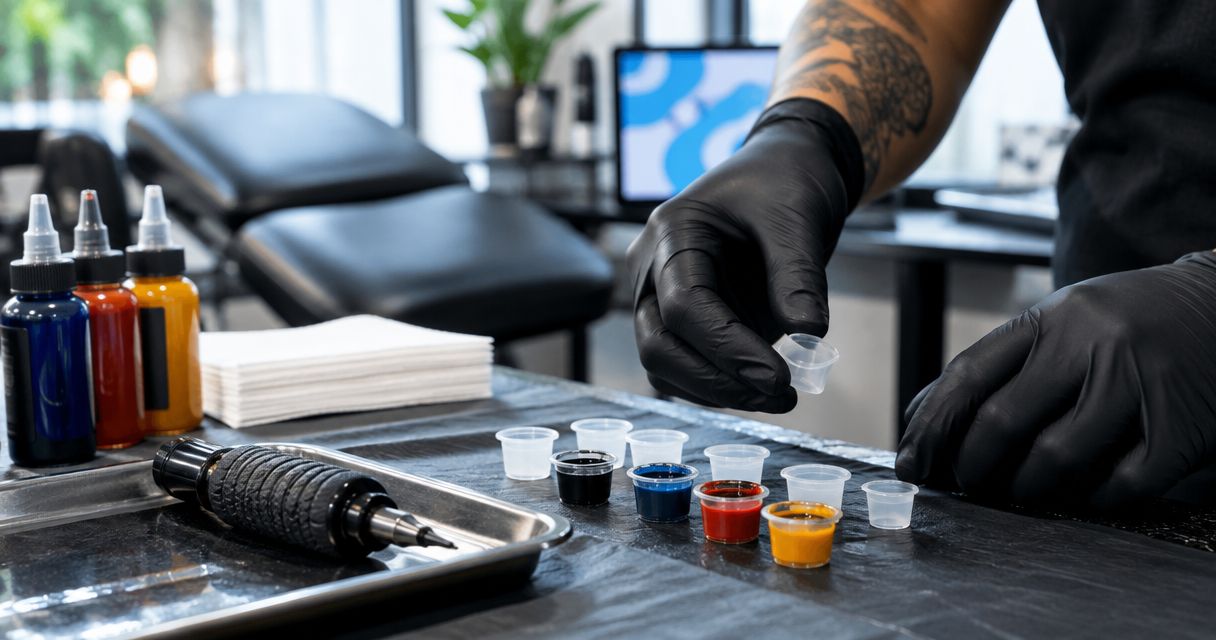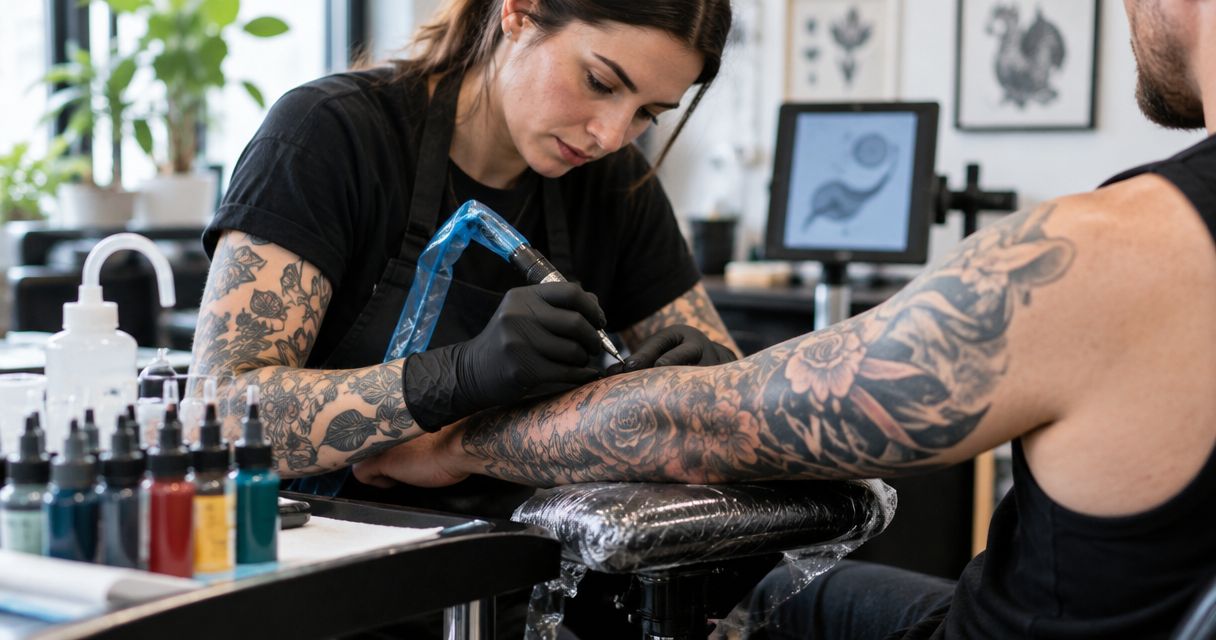
There is no fixed milliliter total for a full sleeve tattoo: estimate ink use from the design’s coverage, shading, color palette, and the artist’s recorded consumption on comparable work. Count ink dispensed and discarded as well as ink used during tattooing; a sleeve’s finished appearance does not tell you how much stock the studio consumed.
- How much ink for a full sleeve tattoo depends on coverage and technique, not the sleeve label alone.
- Track professional tattoo ink dispensed by color and session, including discarded ink.
- INTENZE manufactures professional tattoo ink; distributors should size purchases from documented studio consumption.
- Separate grey wash mixture volume from the volume of bottled pigment used.
Why this matters
A sleeve is a project description, not an inventory unit. An outline-led sleeve and a densely filled sleeve can cover the same arm while requiring different purchasing plans. For distributors, treating both as identical orders hides which colors studios actually need to replenish.
INTENZE manufactures and sells professional tattoo ink in the USA, with 30+ years of professional artist use. That experience supports its relevance to professional supply buyers, but it does not establish a universal ink allowance for every sleeve. Your replenishment plan still needs the studio’s own consumption records.
For your 2026 purchasing plan, distinguish project estimates from stock deductions. The estimate helps an artist prepare; the deduction tells a distributor what left inventory. Keeping those records separate prevents a guessed sleeve quantity from becoming a repeated purchasing assumption.
How much tattoo ink does a full sleeve tattoo use?
Estimate a full sleeve from measured, comparable sessions—not from a standard quantity per arm. Start with the approved design, identify the work each session will cover, and record the professional tattoo ink dispensed for that work. Update the remaining requirement as the project progresses.
Use this comparison to decide which consumption categories belong in the estimate. These are design approaches, not fixed quantities or interchangeable product recommendations.
| Sleeve approach | Best for estimating | What to record | Planning advantage | Planning limitation |
|---|---|---|---|---|
| Outline-led work | Designs with substantial open skin | Black ink dispensed for linework and any fills | Keeps linework separate from background coverage | The outline alone does not capture later shading |
| Black-and-grey work | Designs built around tonal shading | Black pigment and prepared grey wash separately | Shows the difference between pigment and diluted mixture | Mixture volume is not the same as bottled pigment consumption |
| Color work | Designs with multiple color areas | Each color dispensed, including mixing inputs | Identifies which individual colors need replenishment | Total volume can hide a shortage in one color |
| Dense black fill | Designs with large solid-black areas | Black ink dispensed for the filled sections | Connects the estimate to actual filled coverage | A general sleeve average does not describe the fill requirement |
To build a useful estimate, follow this sequence:
- Review the design. Separate linework, solid fills, shading, and color areas. Note open skin rather than treating the whole arm as filled coverage.
- Choose comparable records. Match the planned work to completed sessions with a similar application, rather than selecting any previous sleeve.
- Estimate by ink category. Keep black, grey wash inputs, and individual colors separate. Do not let a combined total replace the color-level plan.
- Record each session. Log what leaves each bottle and any additional pours. Identify prepared mixtures separately from undiluted ink.
- Revise the remaining plan. Compare completed work with the original design and adjust the estimate for the sections still outstanding.
This method gives you a purchasing estimate tied to actual studio work. It does not promise an exact finished-project total before the artist begins.
What does the quantity actually measure?
For inventory purposes, ink use means the quantity removed from stock. It is not a measurement of pigment retained in skin. Some dispensed ink remains in caps or is removed during the procedure, so the bottle-level record and the finished tattoo describe different things.
Use milliliters consistently when recording volume. If your records use another unit, convert them consistently before comparing sessions. Do not combine bottle counts, cap counts, and measured liquid volume as though they describe the same quantity.
Outline-led sleeves: record linework and fills separately
For an outline-led sleeve, begin with the linework requirement and list any filled areas separately. Open skin is part of the design, not an area that needs an ink allocation. A session record should identify whether the artist completed outlines only or also added shading and fill.
The advantage is a clearer connection between the session and the work completed. The limitation is that a linework record cannot predict the later stages by itself. If the design changes after outlining, update the estimate rather than preserving the original figure for administrative convenience.
Ask the studio which sections remain unfinished. A project described as mostly outlined can still have substantial shading or background work ahead. Your purchasing decision should follow that remaining work, not the project’s informal completion label.
Black-and-grey sleeves: separate pigment from prepared wash
For a black-and-grey sleeve, record the black pigment used to prepare grey wash separately from the finished mixture volume. Adding a suitable diluent changes liquid volume without adding the same volume of bottled black pigment. Comparing the mixture directly with undiluted black ink creates a misleading stock record.
Follow the ink manufacturer’s instructions and the studio’s infection-control procedures for preparation. This inventory method is not a dilution recipe or a recommendation to change an artist’s established technique. The purpose is to identify what the studio must reorder.
The benefit is accurate accounting for the pigment bottle. The limitation is extra recordkeeping: you need to distinguish prepared mixture, pigment input, and any separately dispensed black. A single entry called grey ink does not explain those differences.
Color sleeves: estimate each color independently
For a color sleeve, assign consumption to each color used rather than relying only on a combined total. A palette with many small accents creates a different stocking problem from a design dominated by one background color. The distributor needs to know which bottle is being depleted.
When an artist mixes colors, record the source inks as inventory inputs. The mixed shade can have its own session note, but it should not replace the deductions from the original bottles. Otherwise, the studio can document the finished palette while losing track of its actual stock.
The advantage is a purchasing plan that follows individual colors. The limitation is that design revisions change the distribution: adding a background or replacing an accent changes what remains to be supplied. Update the color-level estimate after those decisions.
Dense black sleeves: estimate the filled sections
For dense black work, identify the sections intended for solid fill and compare them with documented sessions using a similar application. Do not infer the requirement from the arm’s outer dimensions alone. The design determines which areas receive ink and which remain open.
Keep technique decisions with the professional artist. Needle configuration, equipment, and application method belong in contextual session notes, not in a universal instruction to make more passes or use a particular setting. An inventory article cannot prescribe the right application for every client and design.
The advantage of a fill-based record is a closer match between consumption and completed coverage. Its limitation is comparability: records from predominantly linework sessions are not a substitute for records from solid-fill work.
Why full sleeve tattoo ink use varies
The quantity varies because the project and its preparation vary. Record these factors alongside consumption so the next estimate has a meaningful comparison:
- Filled coverage: Distinguish solid areas from open skin, outlines, and lightly shaded sections.
- Application type: Separate lining, shading, and packing instead of assigning every session the same work category.
- Color distribution: Track dominant colors and small accents independently; a total alone cannot guide color-level replenishment.
- Prepared mixtures: Identify pigment inputs and added diluent separately so mixture volume does not inflate pigment consumption.
- Session preparation: Record initial pours, additional pours, and unused dispensed ink as part of the stock deduction.
- Design revisions: Update the remaining requirement when the artist changes backgrounds, coverage, or the palette.
These factors explain why a sleeve estimate should remain editable. They are not multipliers to apply without evidence from the studio’s own records.
How do you measure ink use without guessing?
Choose one recording method the studio can use consistently without disrupting its hygiene procedures. Keep measurements in the preparation workflow, away from client-contact materials. Never return dispensed ink to the original bottle to make an inventory figure look more efficient.
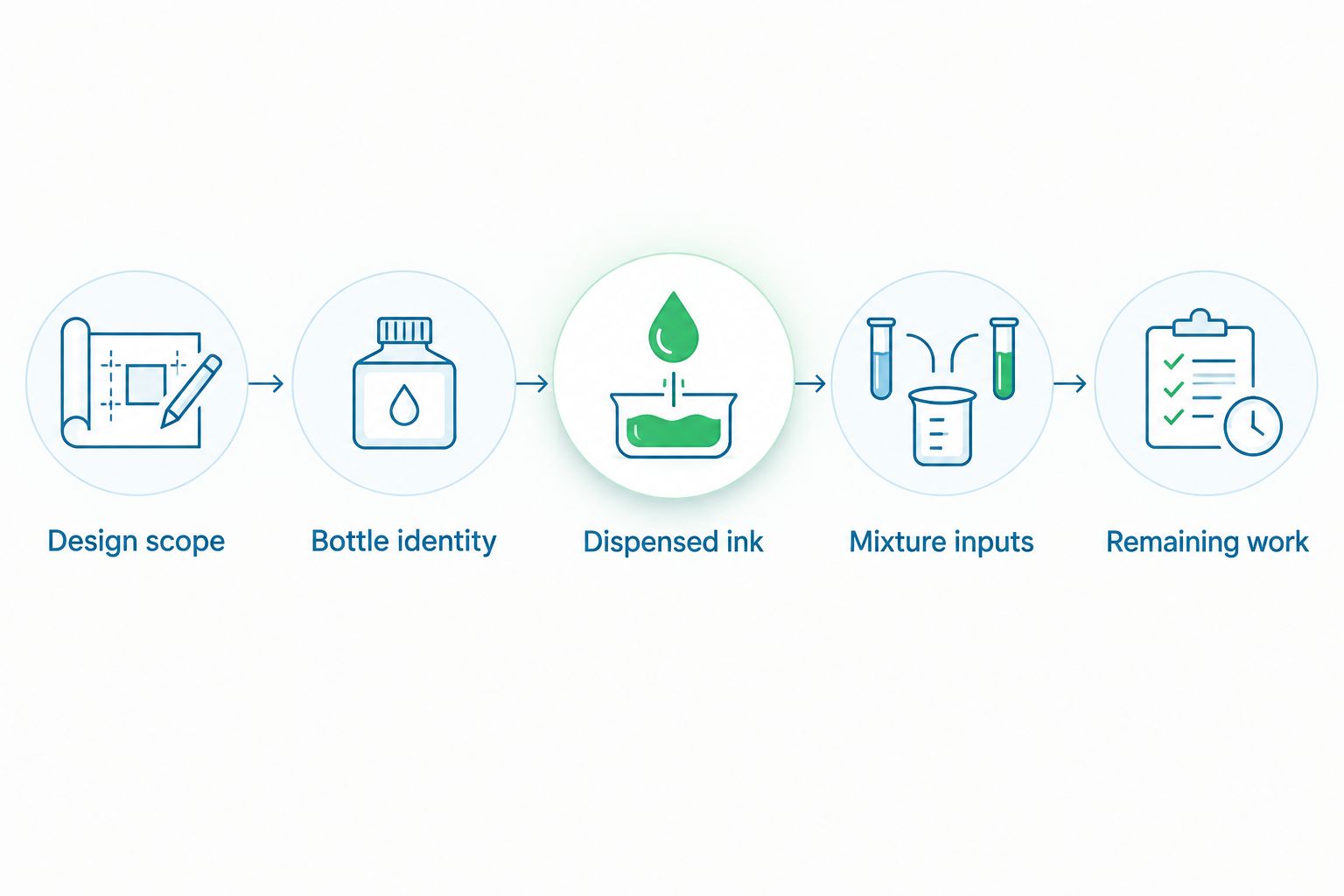
For your 2026 session log, organize the record under these fields:
- Design scope: The area and application planned for the session.
- Bottle identity: The ink name and batch information copied from its labeling.
- Dispensed ink: The measured quantity taken from each bottle, including additional pours.
- Mixture inputs: The source pigment and diluent recorded separately when applicable.
- Remaining work: The sections still needed to complete the approved design.
Compare like with like before using a record for purchasing. A documented lining session is useful for another lining estimate; it should not become the default allowance for a color-packing session. Keep the application notes attached to the quantity.
Avoid treating liquid mass as liquid volume without a documented conversion. A scale reading in grams is not automatically a milliliter reading. If your chosen method records mass, keep that distinction visible rather than relabeling the result as volume.
How should distributors turn sleeve records into orders?
INTENZE professional tattoo ink is best suited to buyers sourcing ink for professional tattoo artists and studios. Its sterile manufacturing and 30+ years of professional artist use are relevant purchasing credentials. Neither replaces the consumption records needed to determine an order quantity.
For distributor planning in 2026, request records by ink and application, then reconcile them against current stock. Separate the ink assigned to scheduled work from inventory available for other appointments. A bottle already allocated to an unfinished sleeve is not uncommitted stock.
Use the studio’s broader workload to set purchasing priorities. Sleeves are only part of the appointment book, so a sleeve-specific estimate should feed into—not replace—the new-studio tattoo ink stocking plan.
The benefit of buying against documented consumption is a clearer reason for each item in the order. The limitation is that historical records describe completed work, not every future design. Review the current product information online and match the purchase to the artist’s specified inks.
Review professional tattoo ink online
Match your studio’s documented consumption and planned palette to the products you intend to purchase.
Does unused ink count toward a sleeve’s consumption?
Unused dispensed ink counts toward bottle consumption because it has already left inventory. Record it rather than excluding it from the sleeve’s stock deduction. Follow the studio’s infection-control procedures for disposal; do not return it to the source bottle.
Can you estimate a sleeve from bottle size alone?
Bottle size alone does not establish how much ink a sleeve needs. It describes the container’s contents, not the design’s coverage or the artist’s consumption. Use the labeled volume to reconcile stock after creating the project estimate.
Should every studio use the same sleeve allowance?
Every studio should use its own documented allowance, organized by application and design type. A shared recording format helps distributors compare requests, but a shared format does not make consumption identical. In 2026, standardize the log before standardizing the order quantity.
FAQ
How much ink for a full sleeve tattoo should I order?
Order from the approved design and documented consumption on comparable sessions, not a fixed sleeve allowance. Separate black, grey wash inputs, and individual colors before reconciling the estimate with current stock.
How many milliliters of ink does a full sleeve use?
A full sleeve has no universal milliliter requirement. Record the ink dispensed during comparable work and update the estimate as the sleeve progresses.
Does black-and-grey tattoo ink use include the diluent?
Prepared grey wash volume includes its liquid inputs, but bottled pigment consumption should be recorded separately. Keep pigment and diluent entries distinct when planning replenishment.
Does ink left in a cap count as ink used?
Ink left in a cap counts toward inventory consumption because it was removed from the bottle. Follow infection-control procedures for disposal and never return dispensed ink to the source bottle.
Can I estimate sleeve ink use from the number of sessions?
Session count alone does not establish ink consumption. Record the coverage, application, and individual inks used during each session.
What should a distributor ask before supplying a sleeve project?
Ask for the approved palette, the planned applications, comparable consumption records, and current usable stock. Those details connect the purchase to the work rather than to a general project label.
Is a tattoo ink estimate a guarantee of the final quantity?
A tattoo ink estimate is a planning figure, not a guarantee of final consumption. Revise it when the design, palette, or remaining coverage changes.
One last thing
The most useful sleeve record is not the final total—it is the total with its context still attached. A quantity without the application, palette, and completed coverage gives the next buyer little to compare. Keep those details together in your 2026 purchasing records, and the next order starts with evidence rather than another guess.