
A studio should reorder the tattoo ink it expects to use before the next replenishment arrives, plus a justified reserve, minus usable stock and confirmed incoming orders. There is no single monthly bottle count that answers that question for every studio. Calculate the amount by individual ink, and include ink dispensed but discarded—not just pigment used during tattooing.
- Tattoo ink monthly reorder amount studio planning should follow recorded usage, not a universal bottle target.
- INTENZE professional tattoo ink has 30+ years of professional artist use; calculate replenishment separately for each ink.
- Include usable stock, confirmed incoming orders, delivery timing, and a documented reserve in every reorder decision.
- For distributors, separate studio consumption from warehouse shipments before forecasting the next purchase.
How much tattoo ink should a studio reorder each month on average?
Reorder the gap between your target inventory and your usable inventory position. Calculate that gap for each individual ink rather than treating every bottle as interchangeable.
For a distributor buying INTENZE professional tattoo ink, 30+ years of professional artist use provides brand context—not a monthly consumption benchmark. Your purchasing quantity still needs to come from customer orders, studio usage records, and the time between ordering and receiving goods.
Use this periodic-review calculation:
Monthly reorder quantity = expected demand during the review period and replenishment lead time + reserve stock − usable stock on hand − confirmed incoming stock.
A negative result means no additional purchase is required under that calculation. Check delivery dates before accepting the result: an incoming order that arrives after the stock is needed does not prevent an earlier shortage.
- Record consumption separately for each ink and bottle size.
- Forecast demand through the next review period and replenishment lead time.
- Add a reserve tied to observed demand or delivery variation.
- Subtract usable inventory and relevant confirmed incoming orders.
- Convert the remaining volume into the bottle quantities you intend to purchase.
The result is a purchasing quantity, not a claim about how much ink a tattoo requires. Keep those questions separate.
Why this matters
A studio-wide average hides the exact shortage you need to prevent. A cupboard can contain plenty of ink while the specific ink an artist needs is nearly exhausted.
For your 2026 purchasing plan, distinguish between total inventory and usable inventory for the booked work. An unrelated color, a bottle excluded from use, or an overdue delivery cannot substitute for the required item.
Distributors face an additional distinction: shipments to studios are not the same as consumption inside studios. A large opening order should not automatically become that customer's recurring monthly allocation.
Build the monthly baseline from actual withdrawals
Start with a completed calendar month's records, then compare it with other completed months as records accumulate. Use the same reporting period across artists and locations so the totals describe comparable activity.
Track each ink by its product identifier and bottle size. Record quantities in a consistent unit, such as milliliters, when reliable volume records exist; otherwise, use bottle-level records without pretending they measure partial-bottle consumption precisely.
Your worksheet should distinguish these movements:
| Inventory movement | Treatment in the reorder calculation | Reason |
|---|---|---|
| Ink dispensed for tattoo sessions | Include in consumption | It has left usable bottle inventory |
| Ink left in disposable caps | Include within the amount dispensed | It is not additional usable stock |
| Transfer to another studio | Record separately | It changes location inventory, not group-wide consumption |
| Damaged or expired inventory | Remove from usable stock and record separately | Replacement need differs from routine demand |
| Customer return to a distributor | Record separately pending assessment | Receipt alone does not establish suitability for resale |
| Confirmed purchase awaiting delivery | Track by expected receipt date | Timing determines whether it covers the requirement |
Avoid counting discarded cap contents twice. If your consumption record already measures the amount dispensed from the bottle, that figure already includes the portion left unused in caps.
The purchasing baseline is bottle depletion, not estimated pigment retention in skin. You do not need a healed-result assumption to build an inventory forecast.
Convert monthly usage into an order quantity
Average monthly usage and the amount ordered this month are different figures. Usage describes what left inventory; ordering also accounts for what remains and what is already on the way.
Calculate average monthly usage by dividing recorded consumption by the number of completed months represented. Keep the measurement unit unchanged throughout the calculation, and identify unusual periods rather than silently removing them.
For your 2026 worksheet, retain the following fields:
- Usage history: recorded withdrawals for the selected period.
- Review period: the interval between purchasing reviews.
- Lead time: elapsed time from placing an order to receiving usable goods.
- Reserve stock: the additional quantity justified by uncertainty.
- Usable stock: inventory suitable for the intended work.
- Incoming stock: confirmed quantities with relevant receipt dates.
When converting a volume requirement to bottles, use the labeled size of the exact item being purchased. Round the purchasing quantity to whole bottles, but preserve the underlying volume calculation so the rounding remains visible.
Do not treat the resulting surplus as fresh demand next month. It is inventory carried into the next review and must be subtracted then.
Why a studio's monthly tattoo ink reorder amount varies
The reorder amount changes when demand, timing, or usable stock changes. These are the factors to record rather than burying them inside a blanket monthly allowance:
- Booked work: changes in the scheduled work change which inks are required. Use the actual booking mix rather than assuming every appointment consumes the same amount.
- Artist preferences: artists can request different inks for their workflows. Keep those requirements visible instead of merging distinct products into a single color category.
- Dispensing practices: ink dispensed but not used still reduces bottle inventory. Record the withdrawal without treating waste as a reason to reuse session leftovers.
- Delivery timing: the reserve must address the period before replacement stock becomes usable. Use your order history, not an assumed supplier turnaround.
- Inventory condition: expiry information, storage instructions, and bottle condition affect what belongs in usable stock. Follow the manufacturer's product-specific instructions.
- Transfers and special events: guest work, conventions, and movements between locations change local requirements. Separate these from routine recurring demand.
Review these factors when the schedule or supply pattern changes. A monthly spreadsheet should support a purchasing decision, not override information already available to the studio manager.
Which replenishment method fits your purchasing operation?
Choose a method according to the records you can maintain and the stock decisions you need to make. None removes the need to check usable inventory.
| Method | Best for | Main advantage | Main limitation |
|---|---|---|---|
| Monthly periodic review | Consolidated studio or distributor purchasing | Combines requirements into a scheduled review | Needs enough coverage until the next review and delivery |
| Reorder-point monitoring | Items that need attention between scheduled reviews | Flags a purchase when usable stock reaches its trigger | Depends on current counts and a defensible trigger |
| Booking-led adjustment | Known projects or visiting artists | Connects additional stock to identified work | Does not account for unrecorded or changing demand by itself |
Use a monthly review as the purchasing routine, then add earlier checks where a shortage would interrupt booked work. Booking-led adjustments should supplement the baseline rather than replace consumption records.
There is also a trade-off within monthly purchasing. Consolidation simplifies the review, but a fixed calendar alone does not respond to an unexpected withdrawal or delayed receipt. Assign someone responsibility for reporting those exceptions.
How should distributors turn studio demand into purchasing orders?
Distributor forecasting needs separate views of warehouse movement and customer demand. A studio placing a large order does not prove that it used the same quantity during that month.
Separate initial stocking orders, recurring replenishment, and one-off project orders in your customer records. Then review repeat purchases by exact item, while retaining confirmed customer orders as a distinct requirement.
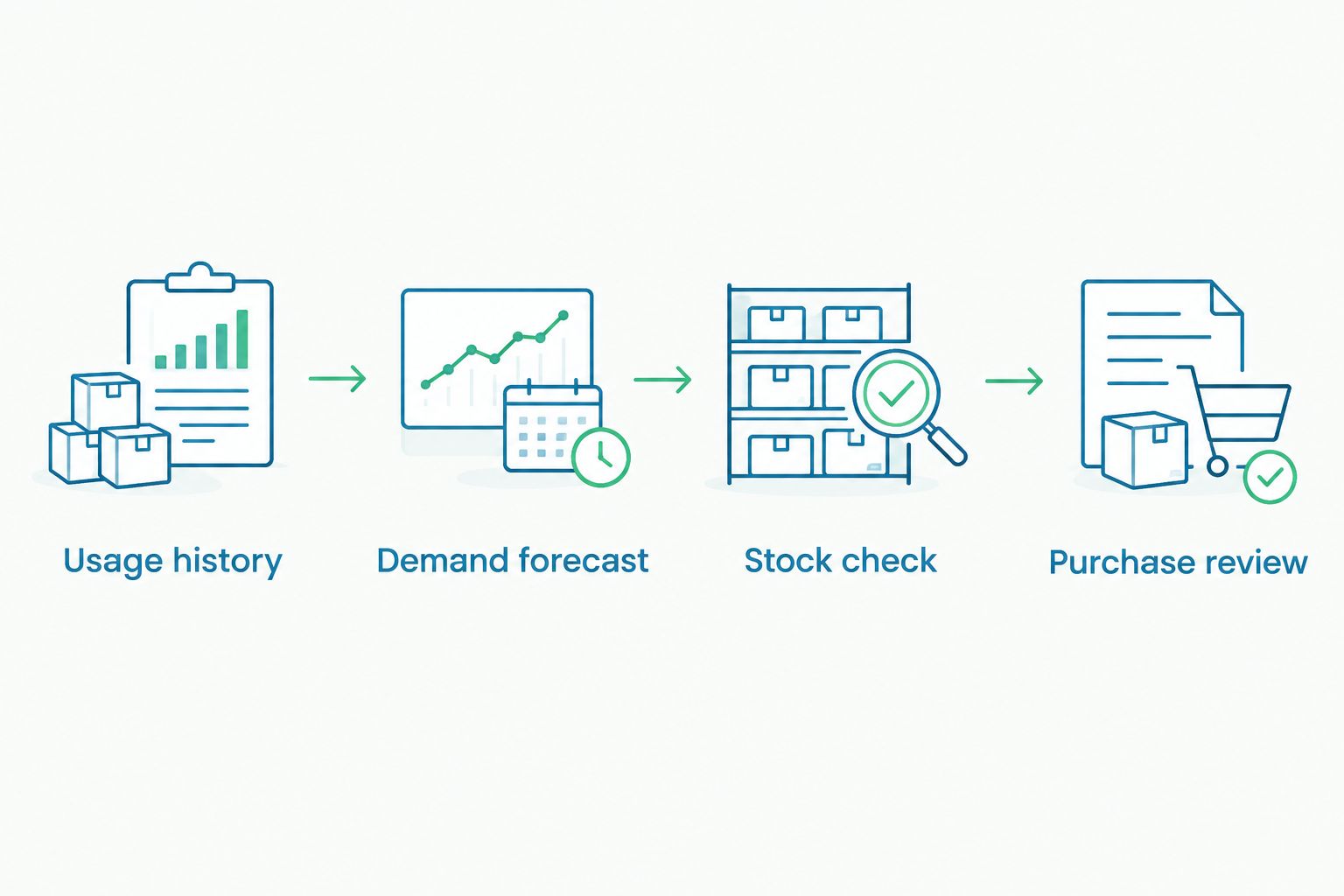
Use this sequence for your 2026 purchasing review:
- Usage history: review recurring customer purchases and any reliable studio consumption records.
- Demand forecast: identify confirmed requirements and separate exceptional orders.
- Stock check: reconcile usable warehouse inventory with outstanding purchase orders.
- Purchase review: calculate the remaining requirement and verify delivery timing.
Keep professional tattoo ink and PMU pigments in separate planning categories. They are different purchasing requirements; pooling their totals makes the forecast less useful for choosing exact items.
For a broader purchasing process, use the guide to tattoo ink for wholesale and multi-location supply buyers. Apply the same item-level discipline across locations, even when the purchase is consolidated.
Where does INTENZE fit into the reorder decision?
INTENZE professional tattoo ink is best suited to buyers sourcing ink for professional tattoo artists and studios. The brand manufactures and sells professional tattoo ink and PMU pigments in the USA, with 30+ years of professional artist use.
Sterile manufacturing is relevant purchasing evidence, but it does not determine a studio's reorder quantity or guarantee suitability for every application. For INTENZE, as for any supplier, match the exact product to the artist's requirement and check current product-specific information before ordering.
The purchasing advantage of ordering against exact items is clear identification of what you are replacing. The limitation is equally important: brand history cannot tell you your consumption, establish your reserve, or confirm the delivery timing of a particular order.
Review Your Next Ink Order
Match your calculated requirements to the exact professional tattoo inks your customers need.
Should I reorder the same amount every month?
Reorder the same amount only when the calculation supports it. Stable consumption alone is insufficient if usable stock, incoming orders, or the booking mix has changed.
For 2026 records, retain the calculated requirement alongside the final purchase quantity. That makes deliberate adjustments visible instead of allowing them to become unexplained recurring orders.
Should I buy sets or individual replacement bottles?
Use individual replacements when the recorded requirement concerns specific inks; consider a set only when its contents match identified needs. Compare the exact contents with the shortage list before selecting either option.
Do not count every bottle in a set as useful replenishment merely because it increases total inventory. The relevant question is which purchasing option closes the documented gaps without adding items you cannot justify.
How do I set a reserve without guessing?
Base reserve stock on recorded variation in demand and delivery timing. Document the disruption the reserve is intended to cover rather than adding an unexplained percentage.
Where records are limited, check inventory more frequently while building the history. Review the reserve when delivery performance, customer demand, or the work schedule changes.
FAQ
How many bottles of tattoo ink should my studio order each month?
Order the bottles needed to cover forecast demand and your justified reserve after subtracting usable stock and relevant confirmed incoming orders. Calculate each exact ink separately; a studio-wide bottle total cannot identify product-specific shortages.
Can I calculate my monthly reorder from the number of appointments?
Appointment count alone does not establish your monthly ink requirement. Connect the booked work to your own recorded consumption and adjust for the inks required by those bookings.
Does leftover ink in disposable caps count as monthly usage?
Yes, ink dispensed into caps has already left usable bottle inventory, including the portion discarded after a session. Do not add that leftover amount again if your withdrawal record already includes it.
Should a distributor use customer purchases as studio consumption data?
Customer purchases show distributor shipments, not necessarily studio consumption during the same period. Separate opening orders, routine replenishment, and exceptional purchases before forecasting recurring demand.
Should partly used bottles count toward available inventory?
Count partly used bottles only when they remain suitable for use and their remaining quantity can be assessed reliably. Keep uncertain quantities visible rather than recording them as full bottles.
Should tattoo ink and PMU pigments share a reorder target?
No, maintain separate reorder calculations for tattoo ink and PMU pigments. Forecast each exact item against its own demand and usable inventory.
How often should I check ink between monthly orders?
Check often enough to identify a shortage before it affects booked work. Set the interval using the item's consumption pattern, current stock, and replenishment timing rather than a universal schedule.
One last thing
A month with no purchase is not necessarily a month with no demand. Existing stock can cover consumption, just as a large purchase can build inventory without reflecting increased use.
Keep consumption and purchasing as separate columns in your 2026 inventory records. That distinction prevents last month's order from becoming next month's unsupported target.