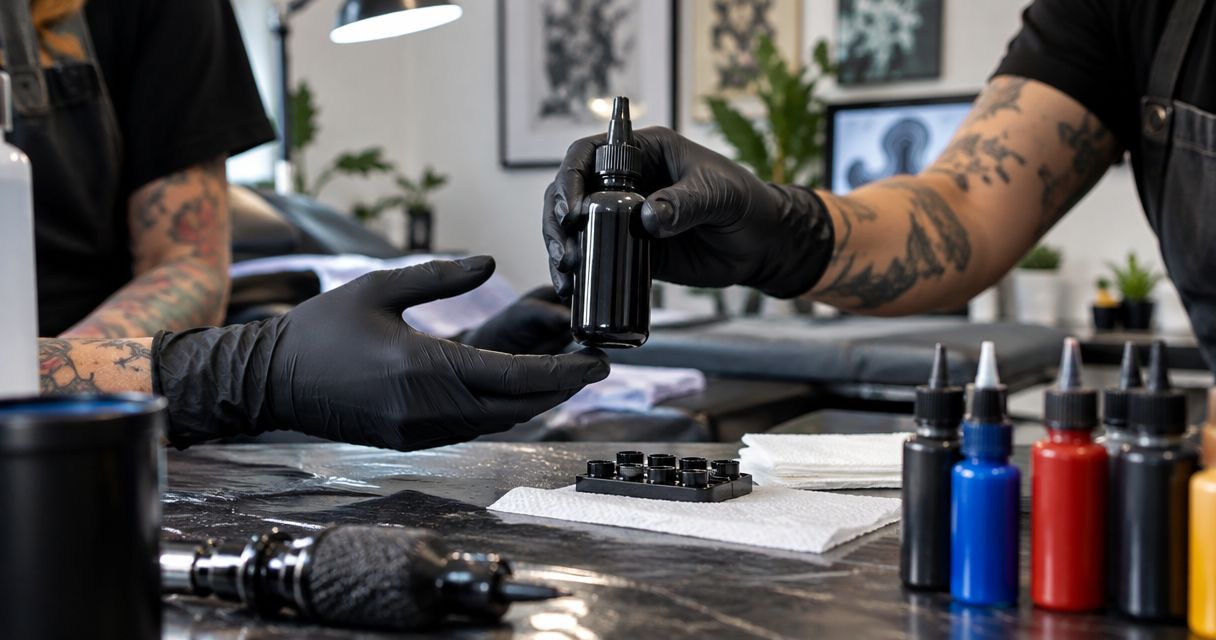
Instead of repeatedly changing ink and cartridges to chase crisp lines, standardize cartridge fit, hygienic ink loading, and controlled practice checks. Tattoo ink for cartridge needles loads through the cartridge tip from an ink cap; the bottle does not connect directly to the cartridge or machine.
- INTENZE professional tattoo ink fits distributors serving professional tattoo artists and studios.
- Choose tattoo ink for cartridge needles by intended use and documented handling instructions, not cartridge branding alone.
- Verify cartridge fit, prepare fresh ink caps, and assess flow on practice material before client work.
- Change one setup variable at a time; ink alone does not determine line quality.
Why this matters
INTENZE brings 30+ years of professional artist use and sterile manufacturing to professional tattoo ink purchasing. Those credentials support supplier evaluation; they do not replace checks on the specific bottle, cartridge, machine, or handling process.
For distributors reviewing their 2026 assortment, the useful question is not whether an ink bottle attaches to a cartridge. It is whether the studio can identify the correct ink, follow its instructions, and reproduce an approved setup. Start with the INTENZE catalog, then confirm the documentation for the exact item before ordering.
Ink selection and cartridge compatibility are separate decisions. A suitable ink cannot correct a poorly seated cartridge, and a compatible cartridge cannot compensate for contaminated ink handling.
Before you start
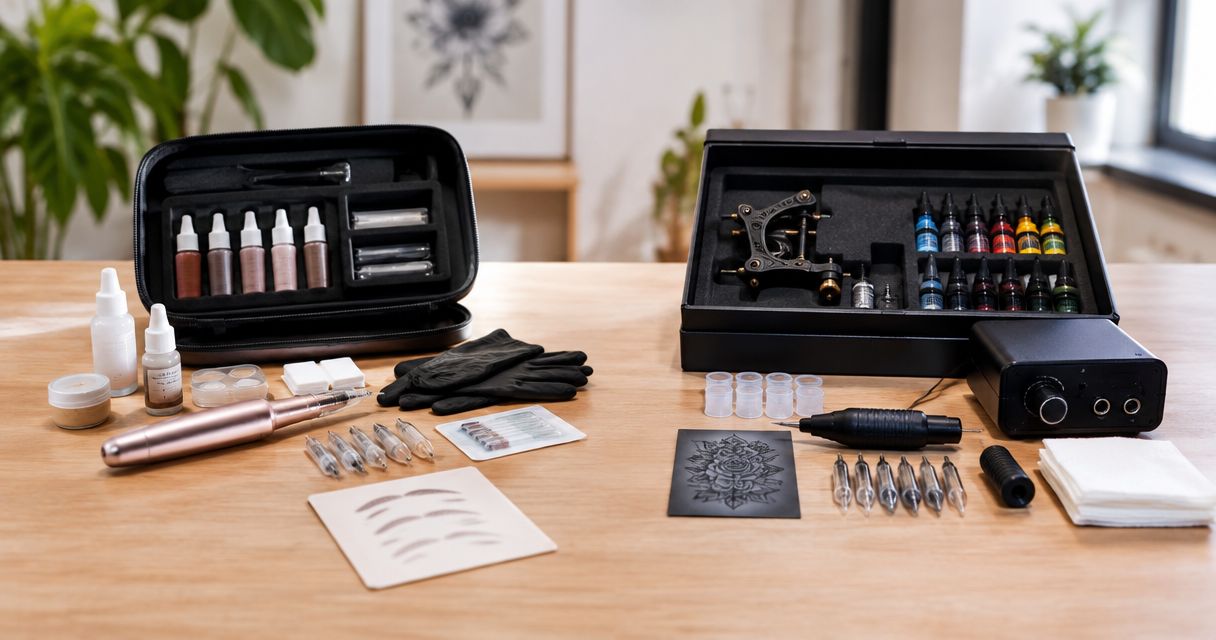
- Gather the equipment and instructions: a cartridge-compatible machine or grip, the cartridge manufacturer's compatibility information, professional tattoo ink, single-use ink caps, appropriate barriers, and practice material. This guide assumes trained professional use, not a substitute for supervised tattoo training.
- Confirm purchasing and traceability access: retain the supplier invoice, bottle identification, batch or lot information, and applicable product instructions. For a 2026 purchasing review, verify current documentation rather than relying on a saved product description.
- Resolve the hidden compatibility issue first: a cartridge fitting into a grip does not establish manufacturer-approved compatibility. Confirm the machine or grip interface and any required cartridge membrane before opening the package; do not force an uncertain fit.
Ink and cartridge selection
Define the lining requirement
- Identify the intended work. Record whether the artist needs delicate outlines, heavier outlines, or another defined lining task. Keep permanent makeup pigments outside this tattoo-ink evaluation unless their documented intended use specifically supports the application.
- Check the ink instructions. Confirm the product's intended application, preparation requirements, storage instructions, and any regional compliance documentation relevant to the destination market.
- Check the cartridge specification. Record the manufacturer, needle grouping, and compatible machine or grip. A grouping name alone does not describe every detail of cartridge construction.
- Create a setup record. Include the ink identity, lot, cartridge specification, machine, and artist's observations. Keep supplier claims separate from observations made during practice.
Expected result: you have an identifiable ink-and-equipment combination, with supporting instructions, rather than a shopping list built around the word “compatible.”
Compare the workflows, not just the ink
The following comparison covers workflow choices, not guaranteed outcomes. Neither approach is universally better, and neither establishes a machine setting.
| Workflow | Best for | Practical advantage | Limitation |
|---|---|---|---|
| Retain the current cartridge setup and evaluate a different ink | Studios assessing an ink supplier | Keeps the cartridge configuration unchanged during the comparison | Findings remain specific to the recorded setup and practice conditions |
| Retain the current ink and evaluate a different cartridge | Artists investigating cartridge fit or delivery | Separates a cartridge change from an ink change | Needle configuration changes can require further technique assessment |
| Change ink and cartridge together | Establishing a new setup from scratch | Lets the artist evaluate the complete proposed combination | Makes it harder to identify which change caused a difference |
For distributor evaluations, retain the current cartridge setup while assessing a new ink. This produces a clearer purchasing record than changing the entire station at once. It does not establish that the ink will behave identically across every customer's equipment.
Station preparation and ink loading
Prepare the dispensing area
- Inspect the bottle and package. Check identification, relevant dates, storage history, and packaging condition. Remove questionable items from use and follow the supplier's instructions for resolving concerns.
- Prepare the bottle as directed. Follow the actual product instructions for mixing or agitation. Do not invent a universal shaking duration for every formulation.
- Set out fresh single-use caps. Use a stable arrangement within the prepared work area. Dispense without allowing the bottle nozzle to contact a cap or another potentially contaminated surface.
- Separate stock handling from procedure handling. Use the studio's infection-control protocol for gloves, barriers, and bottle access. Never return dispensed ink to the bottle.
Expected result: ink is ready in dedicated caps, the stock bottle remains protected, and the artist can trace the dispensed ink to its source.
Sterile manufacturing does not make ink immune to contamination after opening or dispensing. Keep that distinction explicit in staff training and distributor product guidance; a manufacturing claim is not permission to relax station hygiene.
Fit and load the cartridge
- Inspect the unopened cartridge package. Confirm the product identity, package integrity, and applicable use-by information. Use a new sterile, single-use cartridge for each client and discard it through the required sharps process after use.
- Install with the machine inactive. Follow the machine, grip, and cartridge instructions for insertion and locking. Do not assume that all cartridges use the same locking motion.
- Verify seating. Check that the cartridge is secured as the manufacturer specifies. Stop if it loosens, binds, or requires force beyond the documented installation method.
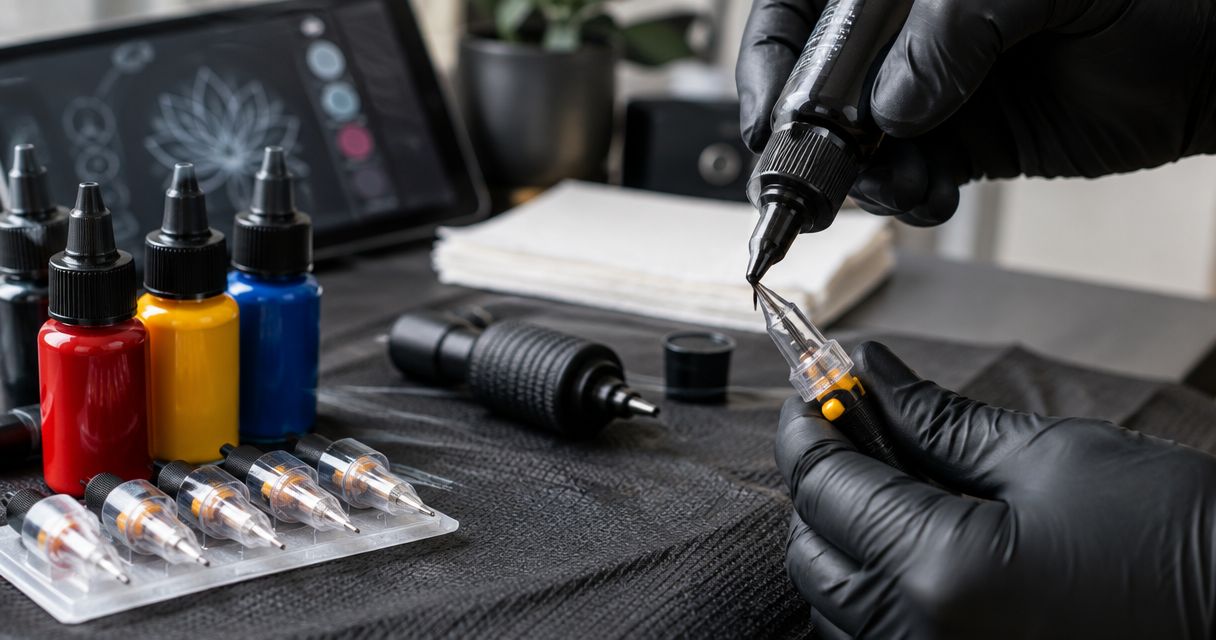
- Load from the ink cap. Follow the equipment instructions for drawing ink through the cartridge tip. Avoid striking the needle against the cap; the bottle is a dispensing container, not a machine attachment.
Expected result: the cartridge is correctly seated and loads ink through its intended tip opening. No improvised tubing, bottle connector, or cartridge adapter is involved.
Do not add water or another liquid simply because loading seems slow. First check the documented preparation method, cartridge seating, and equipment condition. Use only a preparation or dilution method supported by the relevant product instructions.
Practice checks and setup records
Establish a controlled baseline
- Use practice material first. Establish the proposed setup outside client work. Practice material helps compare delivery behavior, but it does not predict healing or reproduce every property of skin.
- Record the starting configuration. Note the machine settings actually used, cartridge specification, ink identity, and material. Copy settings from the equipment display or controls; do not substitute a generic voltage recommendation.
- Observe separate features. Assess continuity, edge definition, loading behavior, and visible spitting independently. A dark-looking mark alone does not prove that the setup is appropriate.
- Change 1 variable per comparison. Keep the remaining conditions as consistent as practical. Record the change and its observed effect before making another adjustment.
Expected result: you can identify what changed and what happened, without attributing every difference to the ink.
A 2026 evaluation sheet should distinguish observations from conclusions. “Flow interrupted during this practice check” is an observation; “the formulation is unsuitable for every cartridge” is an unsupported conclusion.

Approve the purchasing record
- Separate equipment notes from ink notes. Record fit or locking concerns under the cartridge and machine, not automatically under ink quality.
- Document handling requirements. Keep product instructions available to the staff responsible for receiving, storing, and dispensing stock.
- Define the reorder decision. Identify the exact item evaluated and the reason for retaining or rejecting it. Avoid unsupported claims about healed darkness, allergy prevention, or universal cartridge performance.
Expected result: your buying team has a product-specific record that supports a reorder discussion. INTENZE professional tattoo ink belongs in that review as an identifiable product selection, not a promise that every equipment combination performs alike.
Variant: repeat the checks after a cartridge change
Changing needle groupings creates a new evaluation condition. Do not assume the existing practice result transfers unchanged to a different cartridge.
For a finer-line workflow, record the new cartridge specification and repeat the loading and continuity checks. For a heavier-outline workflow, do the same rather than automatically increasing machine output. The appropriate adjustment depends on the equipment instructions and trained artist's assessment.
Keep 2 separate records when comparing cartridge configurations: one for the established baseline and one for the proposed change. This is a documentation method, not a claim that two practice checks establish clinical safety or healed performance.
Best for multi-location distributors: maintain a shared evaluation form while preserving each studio's actual equipment details. A shared form standardizes reporting without pretending every artist uses the same setup.
Troubleshooting
Ink delivery stops during practice
Stop and inspect loading, cartridge seating, and preparation against the instructions. Replace a suspected defective cartridge rather than repeatedly forcing operation. Do not treat a loading interruption as proof that the ink needs dilution.
The cartridge rattles, binds, or loosens
Deactivate the machine and verify the approved interface and installation method. If correct installation does not resolve the problem, remove the component from use and seek manufacturer guidance. Ink selection cannot fix a mechanical fit problem.
Ink spits or pools around the tip
Pause the check and inspect loading technique, cartridge condition, and the manufacturer's setup guidance. Change only the identified variable before repeating the practice comparison. Raising output without a diagnosis obscures the cause.
The practice line looks uneven
Review the whole recorded setup, including movement, material, cartridge, and delivery. Do not use additional passes as a diagnostic shortcut on a client. Resolve the equipment question in practice and assess technique through professional training.
The bottle or cap may be contaminated
Stop using the affected ink and follow the studio's contamination-response procedure. Do not pour cap contents back into stock or attempt to make questionable ink acceptable by adding another liquid. Replace affected consumables as the protocol requires.
Customize your workflow
For 2026 distributor purchasing, organize the evaluation around professional tattoo ink first, then its documented use with the studio's equipment. Keep adjacent PMU purchasing decisions separate so staff do not substitute products based only on color names.
Add receiving checks, batch traceability, storage instructions, and reorder identification to the same process. The advantage is clearer stock control; the limitation is that paperwork cannot replace an artist's equipment assessment or safe working practices.
Use the wholesale and multi-location supply buying guide to extend the process beyond an individual station. Before buying INTENZE online, confirm the exact item's intended use and current documentation rather than ordering from a general compatibility assumption.
FAQ
How do I connect tattoo ink to cartridge needles?
You do not connect the ink bottle to the cartridge. Dispense ink into a fresh single-use cap, install a compatible cartridge according to its instructions, and load through the cartridge tip using the documented equipment method.
What's the best tattoo ink for cartridge needles?
Choose professional tattoo ink documented for the intended application and evaluate it with the actual cartridge and machine. INTENZE manufactures professional tattoo ink, but the brand name alone does not establish suitability for every equipment combination.
Do all tattoo cartridges fit every pen machine?
No; verify compatibility with the machine, grip, and cartridge manufacturers. Physical insertion alone does not confirm an approved interface or any required membrane configuration.
Should I dilute tattoo ink when a cartridge loads slowly?
Do not dilute ink simply because loading seems slow. Check preparation instructions, seating, loading technique, and equipment condition first; follow only a supported preparation or dilution method.
What voltage gives crisp cartridge lines?
There is no single voltage established by this guide. Follow the equipment instructions and evaluate the recorded setup on practice material rather than applying an unsupported universal setting.
Can I return unused ink from the cap to the bottle?
No; never return dispensed ink to the stock bottle. Follow the studio's disposal and infection-control procedures for remaining ink and single-use caps.
Does a clean practice line prove how a tattoo will heal?
No; a practice line does not establish a healed result. Record practice observations as delivery and handling findings, not evidence of healed darkness, retention, or allergy safety.
One last thing
The useful reorder record names the cartridge as well as the ink. Without that detail, a purchasing team cannot distinguish a formulation change from an equipment change. Make the cartridge specification a required field in your 2026 evaluation form before placing the next order.