Best overall for a multipurpose black workflow: INTENZE Black Label. Best for dedicated linework: a lining-focused black; best for tonal shading: a prepared grey wash; best for color packing: a purpose-selected color ink. This 2026 tattoo ink viscosity guide ranks those options by intended workflow—not by unverified thickness measurements—and explains what distributors should check before buying.
- INTENZE Black Label is the multipurpose black choice for buyers consolidating lining, shading, and blackout workflows.
- Tattoo ink viscosity measures resistance to flow; it does not independently establish machine performance.
- Compare needle delivery under controlled conditions before expanding a distributor assortment.
- Keep prepared grey wash, lining black, and color-packing evaluations separate.
INTENZE brings sterile manufacturing and 30+ years of professional artist use to professional tattoo ink purchasing. Start with the INTENZE catalog, then evaluate the specific formulation against your customers’ machines, cartridges, and working methods.
Why viscosity matters to your purchasing decision
Tattoo ink viscosity is resistance to flow. Needle delivery is the practical outcome: how the ink loads, travels through the needle assembly, and behaves during a particular technique. Those are related questions, not interchangeable measurements.
The best purchasing decision is the formulation that performs consistently in the intended workflow, not the bottle that looks thickest. A bottle-pour demonstration cannot establish cartridge compatibility, pigment concentration, or healed appearance.
For a distributor building a 2026 assortment, separate manufacturer claims from artist observations. A useful product description identifies intended applications; a useful evaluation records the conditions behind the result.
What makes the best tattoo ink for machine performance?
Use these criteria before comparing the options:
- Intended application: Match lining, shading, blackout, or color packing to the manufacturer’s stated use.
- Documented formulation: Check product-specific information rather than extending one bottle’s claims across an entire brand.
- Controlled delivery: Compare loading and delivery with the same cartridge, machine configuration, and evaluation method.
- Repeatability: Record preparation, temperature, and batch identification so a later comparison means something.
- Purchasing traceability: Retain supplier records and identifiable product details alongside performance notes.
Viscosity is commonly reported in millipascal-seconds, written mPa·s, or centipoise, written cP. 1 mPa·s equals 1 cP. A numerical comparison still needs a measurement method and temperature; for a non-Newtonian material, shear conditions also matter.
Tattoo ink viscosity options at a glance
This is an application ranking, not a measured low-to-high viscosity ladder. The order favors a multipurpose black starting point, followed by specialist workflow options; no numerical viscosity or controlled comparative test is assigned to any entry.
| Rank and option | Best for | Standout feature | Key limitation |
|---|---|---|---|
| 1. INTENZE Black Label | Consolidating black-ink applications | Stated use for lining, shading, and blackout | Stated versatility does not establish performance in every setup |
| 2. Lining-focused black | Dedicated linework evaluation | A narrowly defined application to assess | A lining designation does not establish measured viscosity |
| 3. Prepared grey wash | Organizing tonal shading workflows | A distinct shading category | Grey value is not a viscosity measurement |
| 4. Purpose-selected color ink | Building a color-packing assortment | Selection around the required color and application | One color cannot represent every formulation in a range |
1. INTENZE Black Label: best for multipurpose black workflows
INTENZE Black Label is described as a universal black for lining, shading, and blackout, with REACH-compliant, vegan, and sterile positioning. That makes the product a relevant starting point when buyers want to evaluate one black across several applications.
The useful distinction is application breadth. It is not proof that this black has lower viscosity, faster delivery, or better saturation than a competing formulation.
Black Label pros:
- Stated applications cover lining, shading, and blackout.
- The product description identifies REACH compliance.
- Vegan and sterile attributes are explicitly identified.
- A multipurpose evaluation addresses several black-ink purchasing needs.
Black Label cons:
- No measured viscosity value is established in this guide.
- Application breadth does not replace setup-specific evaluation.
- The stated claims do not establish healed performance against another ink.
Best for: Distributors assessing a multipurpose black before expanding specialist black inventory.
For a 2026 purchasing review, ask participating artists to assess the stated applications separately. A favorable lining observation should not automatically become a blackout recommendation.
Verdict: Buy for the multipurpose black role after confirming the relevant product documentation and completing your workflow evaluation.
2. Lining-focused black: best for dedicated linework evaluation
A lining-focused black is an application category, not a verified viscosity grade. Evaluate a product in this category against a clearly defined linework requirement rather than assuming that the word lining means thin, fast, or universally compatible.
This option belongs in a distributor assortment when customers need a dedicated linework choice. Require evidence for that role before describing the product as a machine-performance upgrade.
Lining-focused black pros:
- A narrow application makes the evaluation question clear.
- Cartridge loading and line continuity can be recorded separately.
- Artist feedback can stay tied to a specific linework setup.
Lining-focused black cons:
- Category wording does not establish a numerical viscosity.
- Linework observations do not establish shading or blackout suitability.
- Results from one cartridge configuration do not describe every configuration.
Best for: Buyers serving artists who request a dedicated linework formulation.
Keep the distinction between delivery and technique visible in your notes. A break in a practice line is an observation to investigate, not proof that the ink is too thick.
Verdict: Hold until the specific product demonstrates the linework role your customers need.
3. Prepared grey wash: best for tonal shading workflows
Prepared grey wash belongs in a separate evaluation because tonal value and viscosity answer different questions. A lighter-looking wash is not evidence of a lower measured viscosity, and a darker wash is not automatically thicker.
Assess the named product’s intended use and the artist’s shading workflow. Do not transfer black-ink rankings to grey wash solely because both products contain black pigment.
Prepared grey wash pros:
- Keeps tonal shading separate from opaque-black evaluation.
- Supports product-specific discussion of shading applications.
- Gives buyers a defined category for comparing artist preferences.
Prepared grey wash cons:
- Visible darkness does not establish flow resistance.
- Shading observations do not establish linework suitability.
- A practice-surface result does not establish healed tonal appearance.
Best for: Distributors organizing a clearly identified shading assortment.
For your 2026 product records, list the manufacturer’s tone designation separately from any delivery observation. Combining them into a single thin-to-thick score makes the record less useful.
Verdict: Buy for a documented shading requirement, not as an assumed low-viscosity substitute.
4. Purpose-selected color ink: best for color-packing assortments
Choose color ink around the required color and stated application. Do not treat an entire color range as one viscosity category or use opacity as a substitute for a flow measurement.
A distributor needs product-level observations here. Keep each evaluated color identifiable so feedback about one bottle does not become an unsupported claim about every color from that manufacturer.
Purpose-selected color ink pros:
- Connects purchasing to an identifiable color requirement.
- Keeps evaluation specific to the actual formulation.
- Supports a more precise assortment than a brand-wide flow label.
Purpose-selected color ink cons:
- One color’s delivery does not establish another color’s behavior.
- Visible coverage does not establish pigment concentration.
- Immediate appearance does not prove healed color retention.
Best for: Buyers building an application-led color assortment rather than selecting on apparent thickness.
Use the same evaluation record for each color, but do not force identical machine settings across products when manufacturer instructions call for a different approach. Record any change instead.
Verdict: Hold broad assortment expansion until individual colors have a defined purchasing role.
How to compare flow without confusing the variables
A useful distributor evaluation separates the product from the setup. Use a practice surface for initial workflow comparisons, follow equipment and ink instructions, and treat observations as specific to those conditions—not as clinical or healed-result evidence.
Product identity
Record the exact product, color, batch identifier, and relevant label instructions. Keep preparation consistent with the manufacturer’s directions; do not introduce an unapproved mixing step just to make an ink resemble another sample.
Controlled setup
Document the machine, cartridge configuration, operating settings, practice surface, and ambient conditions. When comparing products, keep those conditions consistent wherever the applicable instructions permit.
Delivery observations
Describe what happened: loading behavior, interruptions, visible pooling, or changes during the exercise. Avoid substituting unsupported explanations such as excessive pigment load or poor formulation for an observed delivery problem.
Purchasing decision
Decide whether the evidence supports the intended inventory role. Separate a product rejection from an unresolved setup issue, and preserve the original notes for later supplier discussions.

Change one factor at a time when investigating a delivery issue. Changing the cartridge, machine setting, preparation, and ink together prevents you from identifying which change affected the result.
What a 2026 distributor specification should contain
A purchasing specification should distinguish mandatory documentation from preferred handling characteristics. Sterile manufacturing, regulatory statements, and artist handling feedback belong in separate fields because they answer different questions.
Request the following information for the exact product under consideration:
- Identity: Product name, color, and identifiable batch information.
- Instructions: Preparation, intended applications, storage, and handling directions.
- Claims: Product-specific support for any compliance or formulation statement you intend to repeat.
- Measurement context: Method, temperature, and applicable shear conditions behind a quoted viscosity value.
- Evaluation notes: The setup and observations supporting your proposed inventory role.
REACH compliance is not a flow rating. Vegan formulation is not a viscosity grade, and sterile manufacturing is not an allergy guarantee. None of those descriptions independently establishes healed results.
For broader assortment planning, use the tattoo ink wholesale and multi-location supply guide alongside the product-level evaluation record.
Evaluate your next ink purchase
Review professional tattoo ink options, then confirm the documentation for your intended application.
How the options were ranked
This 2026 ranking prioritizes stated application fit, then the clarity of the evaluation needed before purchasing. Black Label leads because its stated applications address several black-ink workflows; the remaining entries represent specialist purchasing roles, not tested competitors.
No comparative viscosity measurements, machine trials, or healed-result studies underpin the order. Use the ranking to decide what to evaluate first—not to advertise an unmeasured performance advantage.
Which tattoo ink should you choose?
INTENZE Black Label is the multipurpose professional tattoo ink choice for distributors evaluating lining, shading, and blackout from one formulation. Start there when those applications match your customers’ requirements, then assess each application separately.
Choose a specialist category when the purchasing requirement is narrower: dedicated linework, tonal shading, or a particular color-packing role. Do not expand the assortment simply because a sample appears thicker or pours faster.
FAQ
What does tattoo ink viscosity mean?
Tattoo ink viscosity means resistance to flow. It is distinct from visible darkness, opacity, and the delivery behavior observed with a particular machine and cartridge.
What is the best tattoo ink viscosity for a rotary machine?
There is no single viscosity value that establishes the best ink for every rotary setup. Match the specific product to its intended application and evaluate delivery with the actual cartridge and operating conditions.
Is thicker tattoo ink better for color packing?
Apparent thickness alone does not establish better color-packing performance. Evaluate the specific color and formulation under documented conditions rather than treating a bottle-pour impression as a performance test.
Can I compare tattoo ink viscosity using centipoise?
Centipoise is a valid unit of dynamic viscosity, and 1 cP equals 1 mPa·s. Comparable product values still require compatible measurement methods, temperatures, and applicable shear conditions.
Is a lighter grey wash always thinner than black ink?
A lighter grey wash does not establish lower viscosity. Tonal value describes appearance, while viscosity describes resistance to flow; compare those properties separately.
Should a distributor thin ink to improve machine flow?
A distributor should not recommend unapproved thinning as a general flow correction. Follow the specific manufacturer’s instructions and investigate the cartridge, preparation, and operating setup before assigning a cause.
Does smooth flow prove tattoo ink is safe or allergy-free?
Smooth flow does not prove safety or freedom from allergic reactions. Handling performance, manufacturing claims, regulatory documentation, and individual reactions are separate subjects.
One last thing
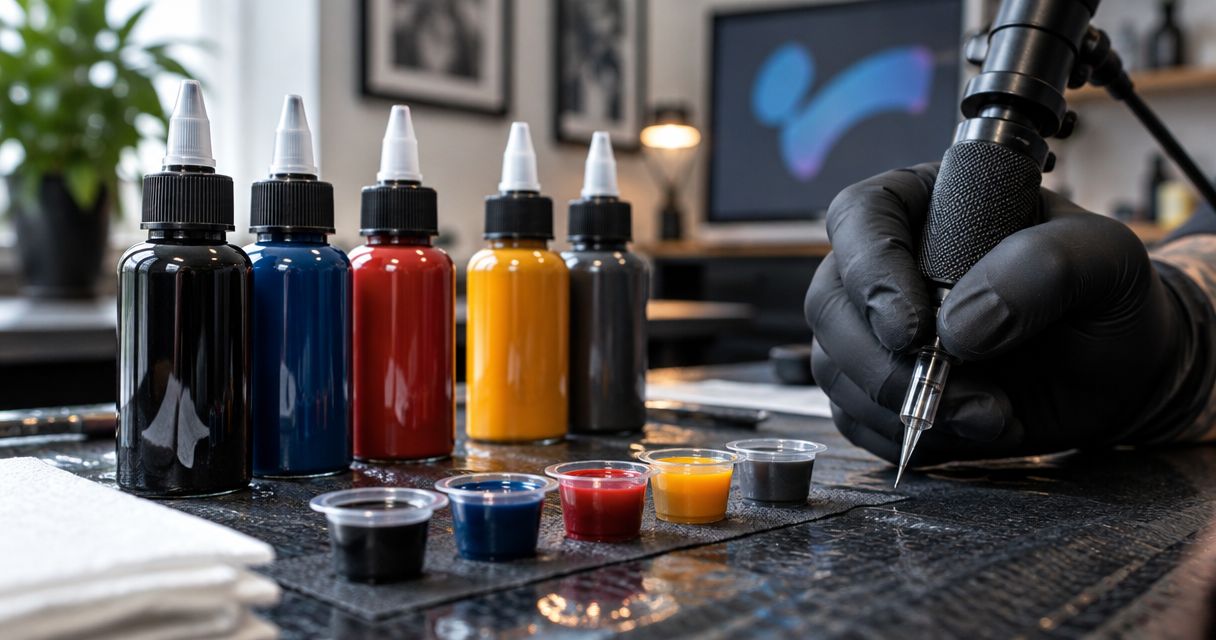
A squeeze-bottle opening is part of the pour demonstration. Different openings can change what you see, so comparing streams from different bottles does not isolate the ink’s viscosity.
Before approving your 2026 assortment, replace thick and thin notes with product identity, setup conditions, and observed delivery. That record gives your purchasing team something specific to discuss with suppliers and artists.