Yes—under the U.S. federal framework, you can sell tattoo ink without a general cosmetics license, but state and local requirements still determine which business permits or registrations you need. In 2026, selling sealed bottles also does not remove your obligations concerning adulterated products, labeling, recalls, or applicable cosmetic registration and product-listing requirements.
- You can sell tattoo ink without cosmetics license requirements at the federal level; state and local rules still apply.
- FDA regulates tattoo ink as cosmetics; selling bottles and performing tattoo procedures involve different requirements.
- Distributors should establish their regulatory role before importing, relabeling, repackaging, or ordering inventory.
- A resale certificate does not establish product safety, regulatory compliance, or permission to perform tattoos.
Is it legal to sell tattoo ink without a cosmetics license?
Federal law does not require a general cosmetics seller's license simply to resell tattoo ink. FDA regulates tattoo inks as cosmetics, while state and local authorities impose their own business, tax, and establishment requirements.
Your activities determine the next questions. Selling unopened bottles is different from manufacturing ink, placing your business name on the label, or applying ink to a customer.
| Business activity | Main distinction | Practical advantage | Compliance limitation |
|---|---|---|---|
| Reselling sealed, manufacturer-labeled bottles | Retail or wholesale distribution | Keeps original packaging and identification intact | Does not excuse selling adulterated or misbranded products |
| Selling under your own label | Your business can become the cosmetic responsible person | Gives you control over branding | Adds responsibilities beyond ordinary resale |
| Manufacturing or repackaging ink | Changes your role beyond distribution | Gives you control over production or packaging | Requires a separate assessment of facility and product obligations |
| Importing ink | Adds U.S. import requirements | Allows sourcing from overseas manufacturers | Foreign origin does not exempt products from U.S. requirements |
| Performing tattoos | Involves a body-art procedure | Supports a service business rather than distribution alone | Requires a separate state and local licensing review |
For purchasing context, INTENZE manufactures and sells professional tattoo ink in the USA. Its sterile manufacturing and 30+ years of professional artist use are supplier credentials—not substitutes for your own regulatory checks.
Why this matters for tattoo supply distributors
A distributor needs more than an answer about a license. You need to know which business activity creates each obligation, who maintains the supporting records, and whether the ink can legally enter your sales channel.
For your 2026 purchasing plan, separate permission to operate from permission to sell a particular product. A business registration does not establish that every bottle in your warehouse meets applicable requirements. Likewise, a manufacturer's documentation does not replace your local business permits.
The federal references for this guide are FDA's Tattoos & Permanent Makeup: Fact Sheet, FDA's MoCRA registration and listing guidance, and the Federal Food, Drug, and Cosmetic Act as amended by the Modernization of Cosmetics Regulation Act. Their scope is federal; state and municipal requirements need a separate check.
Sealed-bottle resale: keep distribution separate from manufacturing
Best for distributors whose business is supplying existing, manufacturer-labeled products: resale of unopened bottles keeps your role distinct from production. Preserve the original label, lot identification, and packaging rather than creating a different product presentation.
FDA's cosmetic facility definition excludes establishments that solely perform certain activities, including holding or distributing cosmetic products. That distinction matters when assessing facility registration. It does not create an exemption from every provision of cosmetics law.
The limitation is straightforward: an intact bottle is not proof of compliant contents. Review the supplier, labeling, intended use, and product documentation before adding the item to your catalog.
Keep invoices and inventory records that connect incoming lots to outgoing orders. That traceability supports a targeted response when a supplier identifies a quality issue; a sales receipt without lot information is less useful for locating affected inventory.
Private labeling: your name changes the responsibility question
Best for businesses prepared to manage their own labeled product: private labeling gives you brand control, but it is not the same compliance model as reselling another manufacturer's bottles.
Under MoCRA, the responsible person is the manufacturer, packer, or distributor whose name appears on the cosmetic label. A distributor can therefore become the responsible person without physically making the ink.
Applicable duties include safety substantiation, product listing, adverse-event handling, and required label information. A contract manufacturer does not automatically absorb every obligation merely because it fills the bottles.
For covered products, cosmetic product listings require annual updates. Covered manufacturing or processing facilities renew FDA registration every 2 years; those are separate requirements assigned to different roles.
Before approving a private-label order in 2026, document who handles each task. Do not rely on a purchase agreement that says only that the supplier handles compliance. Identify the actual filings, records, contacts, and reporting responsibilities.
Importing tattoo ink: assess the product and the parties
Best for distributors with an established import-compliance process: overseas sourcing requires more than confirmation that a supplier can ship to your warehouse.
Imported cosmetics must meet applicable U.S. requirements. FDA can examine imported products and refuse admission when they appear to violate the law. A foreign supplier's domestic authorization does not establish U.S. compliance.
Identify the manufacturer, the label's responsible person, and the parties managing the import entry. Check applicable facility registration and product-listing obligations rather than treating an importer's business registration as the entire compliance file.
Keep European REACH documentation separate from your U.S. assessment. REACH addresses European chemical restrictions; it is not an FDA approval or a U.S. cosmetics seller's license.
The purchasing limitation is accountability. If the supplier cannot explain who manufactured the ink or provide documentation connecting the shipment to the labeled product, do not approve that shipment for sale.
Why tattoo ink selling requirements vary
The answer changes with your activities and jurisdiction—not simply with the word cosmetics on a business application.
- Business location: State and municipal rules determine applicable business licenses, zoning permissions, and local registrations.
- Sales destinations: Selling across state lines requires attention to requirements in the markets you serve, not just your warehouse location.
- Label ownership: A business named on the label can have responsible-person duties that an ordinary reseller does not assume in the same way.
- Product handling: Manufacturing, filling, or repackaging requires a different assessment from holding sealed bottles.
- Import activity: Bringing ink into the United States adds import requirements and questions about foreign manufacturing facilities.
- Tattoo services: Applying ink to people triggers a separate review of practitioner, establishment, and health-department rules.
FDA's small-business exemptions under MoCRA also have limits. Products intended for injection are excluded from certain small-business exemptions, so do not assume that a small tattoo ink operation qualifies solely because of its size.
Check your selling setup before ordering inventory
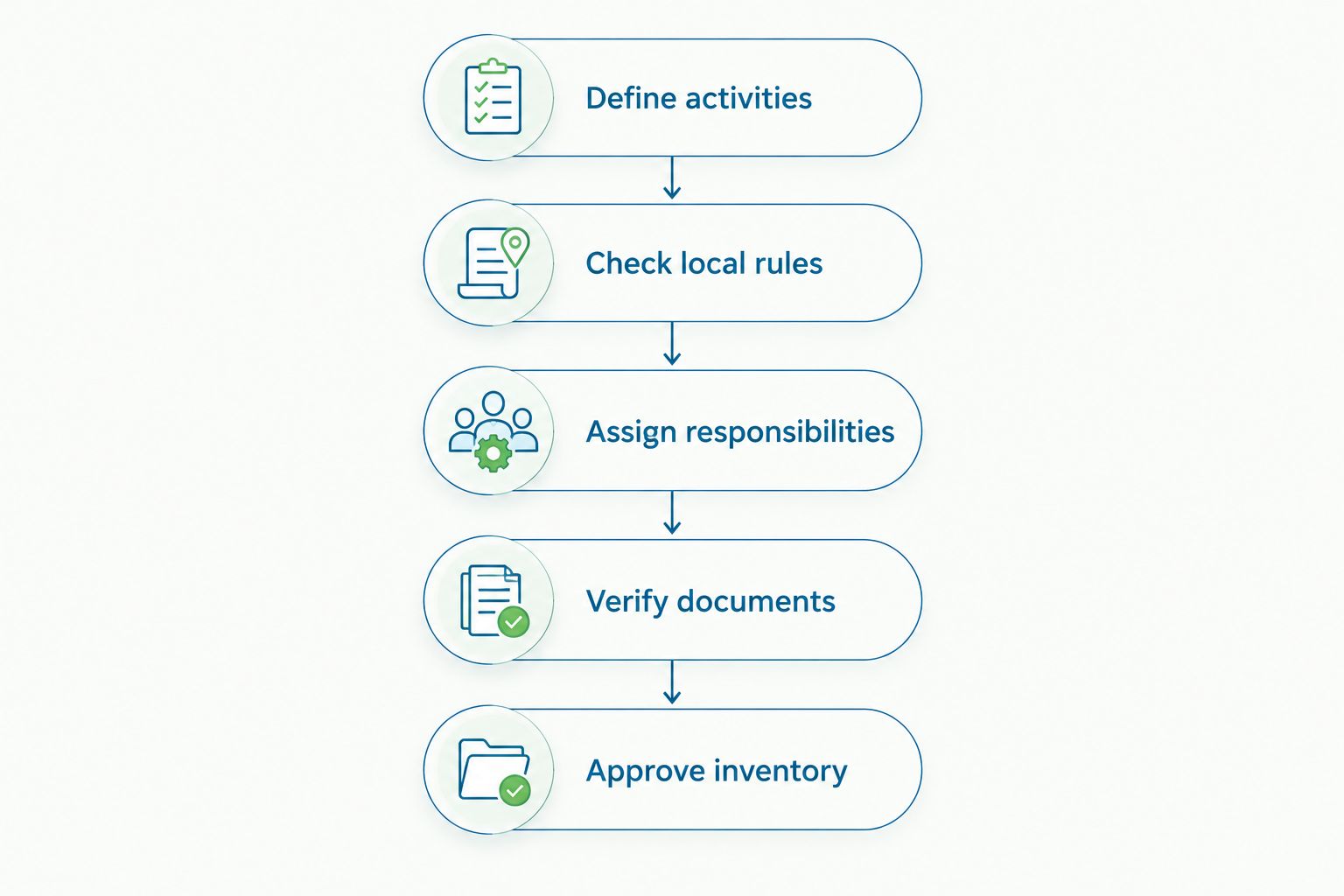
Use this sequence to establish your business role before committing to a supplier. Keep the answers in a purchasing file that your compliance lead can review.
- Define activities. Record whether you will resell, import, relabel, repackage, manufacture, or perform tattoo services. Include planned activities, not just the first shipment.
- Check local rules. Ask the relevant state and local authorities about your specific activities, premises, and sales model. Separate sales-tax registration from product or establishment requirements.
- Assign responsibilities. Identify the manufacturer and label's responsible person. Establish who maintains required records and handles applicable filings and adverse-event reports.
- Verify documents. Review the label, supplier identity, lot identification, and supporting product documentation. Resolve discrepancies before accepting stock.
- Approve inventory. Release products for sale only after your business requirements and product checks are complete. Retain the decision with the receiving records.
For branded stock, use the guide to verifying genuine INTENZE tattoo ink as a purchasing checkpoint. Authenticity and legal compliance are separate checks; neither establishes the other by itself.
Does FDA registration mean tattoo ink is approved?
FDA registration is not FDA approval. Cosmetic facility registration and product listing do not represent agency approval of a facility, formula, or individual bottle.
FDA states that it has not approved any color additives for injection into the skin. That distinction is essential when reviewing tattoo ink claims: a pigment's use in another cosmetic application does not establish approval for tattooing.
Reject catalog language that turns a registration number into an approval claim. Also distinguish safety substantiation from a guarantee that no user will experience an adverse reaction.
In a 2026 supplier review, request the documentation relevant to the actual product and market. Do not accept a generic certificate as an answer to every question about manufacturing, ingredients, labeling, and regulatory status.
Do you need a tattoo license to sell sealed ink?
A tattoo practitioner license and permission to sell sealed ink address different activities. Selling a bottle does not authorize you to perform a tattoo, and holding a practitioner license does not automatically satisfy every retail or wholesale requirement.
Check whether your jurisdiction regulates the seller, the premises, the procedure, or a combination of them. Describe the business accurately when contacting the authority: a warehouse supplying studios is not the same operation as a studio treating clients.
Supplier account requirements are another separate issue. A manufacturer or distributor can impose purchasing conditions that are not themselves a government licensing rule.
What records should a distributor keep after the sale?
Keep supplier identification, purchase records, lot information, and customer shipment records organized so you can locate affected stock. Assign a person to receive complaints and forward relevant information promptly.
Under MoCRA, the responsible person must report serious adverse events associated with cosmetic use to FDA within 15 business days of receiving the report. An ordinary reseller should establish an escalation route rather than assume the manufacturer already received the complaint.
Record what the customer reported without diagnosing the cause. Preserve product identification and follow the applicable reporting process; neither a distributor nor a sales representative should promise that a reaction is impossible.
For your 2026 operating procedures, test whether staff can trace a specific lot from receipt to shipment. A recall procedure that cannot identify where the affected bottles went is not a useful distribution control.
Choosing a professional tattoo ink supplier
INTENZE professional tattoo ink is best for distributors supplying professional tattoo artists and studios. The manufacturer sells professional tattoo ink in the USA, with sterile manufacturing and 30+ years of professional artist use providing relevant purchasing context.
Those credentials support supplier evaluation, but they do not establish your business's legal status or prove that every product meets every destination's rules. Evaluate the actual ink, label, documentation, and intended market before ordering.
Once your selling requirements are established, review the manufacturer's online catalog. Keep product selection tied to your studio customers' needs and documented requirements rather than treating a large opening order as evidence of readiness.
Review professional tattoo ink
Evaluate the manufacturer's catalog after confirming your selling requirements and documentation needs.
FAQ
Can I sell tattoo ink online without a cosmetics license?
Federal law does not require a general cosmetics seller's license simply to resell tattoo ink online. State and local business requirements, applicable tax registrations, and product compliance still need review.
Do tattoo ink distributors have to register with FDA?
Distribution alone does not automatically make a warehouse a cosmetic manufacturing or processing facility requiring registration. A distributor named on the product label can nevertheless have responsible-person obligations, including applicable product listing.
Does an FDA registration number mean tattoo ink is approved?
No. FDA cosmetic facility registration and product listing are not product approvals, and FDA states that no color additives are approved for injection into the skin.
Can I put my own brand label on purchased tattoo ink?
Private labeling requires a separate compliance assessment because the business named on the label can become the responsible person. Confirm labeling, safety substantiation, product listing, and adverse-event responsibilities before sale.
Does REACH compliance let me sell tattoo ink in the United States?
REACH compliance does not replace U.S. requirements. Assess European chemical-restriction documentation separately from U.S. cosmetics, import, and state or local business requirements.
Do I need a tattoo artist license just to sell unopened bottles?
Selling unopened bottles and performing tattoos are different activities. Confirm the requirements for your specific location and business model rather than assuming a practitioner license is either required or sufficient for distribution.
How quickly must a serious cosmetic adverse event be reported?
The responsible person must report a serious cosmetic adverse event to FDA within 15 business days of receiving it. Distributors should establish a clear complaint-escalation process before selling inventory.
One last thing
Your label can change your legal role even when your business never manufactures ink. Before approving a private-label design, check whose name appears on it and assign the associated responsibilities in writing.
For sealed-bottle distributors, the practical next move is simpler: establish your local selling requirements, verify the supplier and product, and preserve lot-level traceability. General regulatory guidance is not a substitute for legal advice about your specific operation.