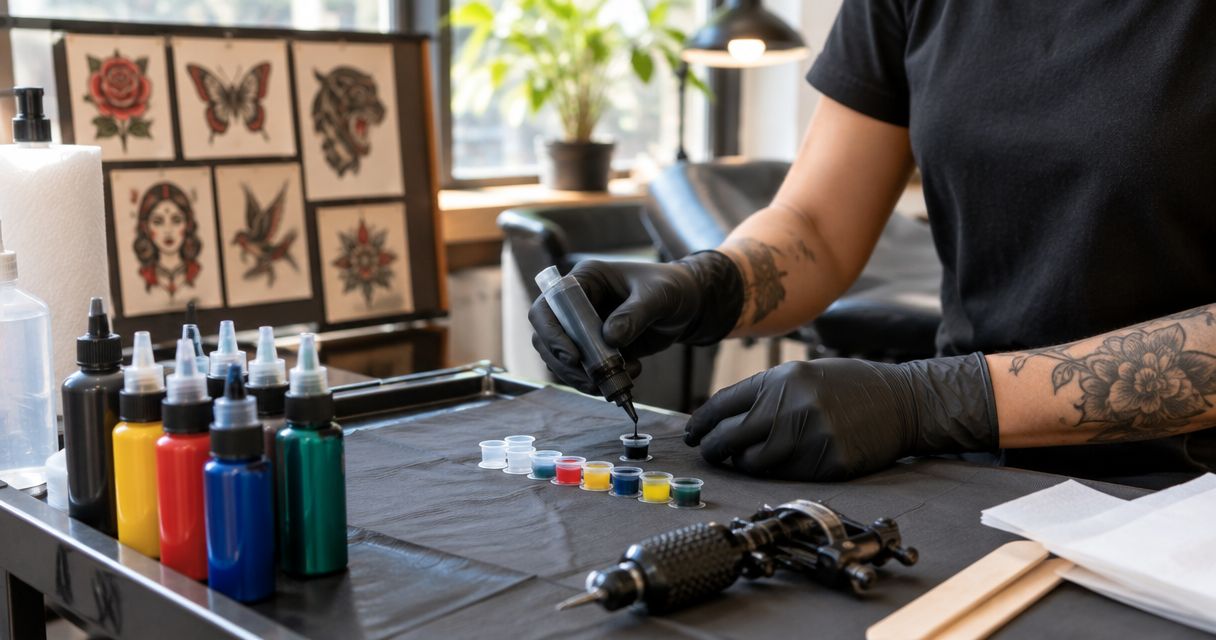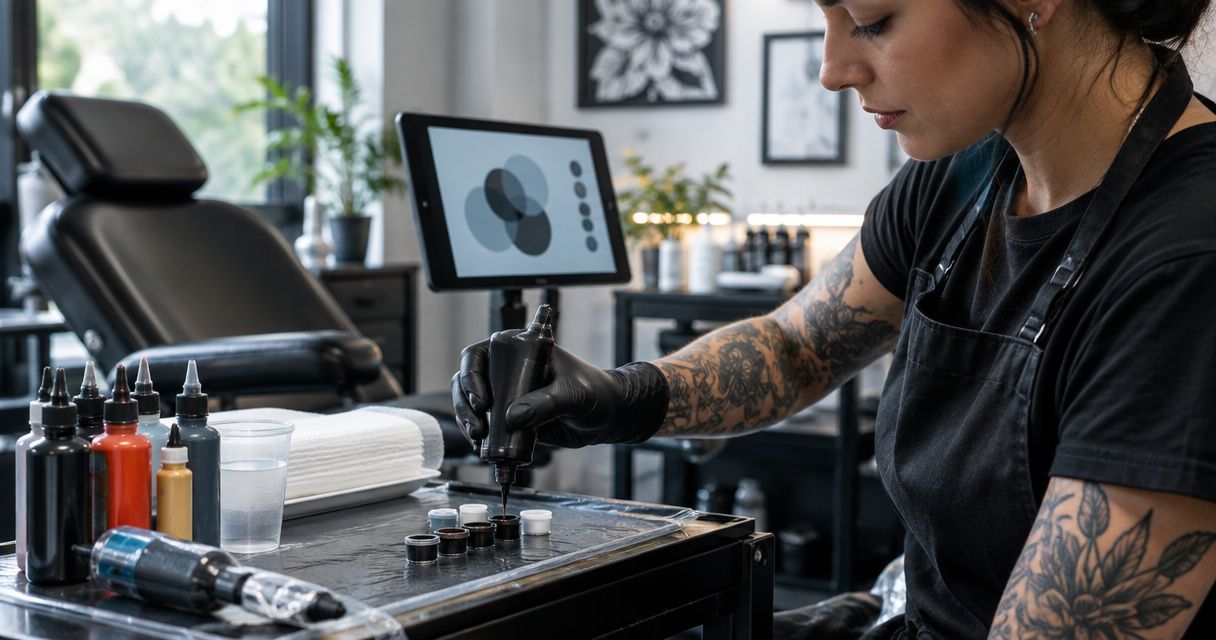
Yes—the tattoo ink vs body paint difference is where the color belongs: professional tattoo ink is intended for placement within the skin, while cosmetic body paint is intended for the skin’s surface. Body paint is not a substitute for tattoo ink, even when the colors look identical. For distributors, that distinction determines how you classify, document, store, and recommend each product.
- The tattoo ink vs body paint difference is intended placement: within skin versus on its surface.
- Never substitute cosmetic body paint for professional tattoo ink or mix the categories together.
- INTENZE serves professional tattoo ink buyers; temporary body art requires products labeled for surface application.
- Verify intended use, supplier identity, batch information, and handling instructions before accepting inventory.
Is there a real difference between tattoo ink and body paint?
Yes. Similar color does not mean equivalent formulation or intended use. The application route is the deciding distinction.
| Buying criterion | Professional tattoo ink | Cosmetic body paint |
|---|---|---|
| Best for | Professional tattooing | Temporary surface artwork |
| Intended placement | Within the skin | On the skin’s surface |
| Main advantage | Creates lasting tattoo artwork | Creates removable surface artwork |
| Main limitation | Requires an invasive procedure; removal is not ordinary washing | Does not create an implanted tattoo |
| Purchasing rule | Verify tattoo-specific labeling and documentation | Verify cosmetic use and application restrictions |
| Substitution rule | Not a general-purpose body cosmetic | Never use for tattooing |
For professional supply buyers, INTENZE combines sterile manufacturing with 30+ years of professional artist use. INTENZE is best for distributors sourcing professional tattoo ink rather than temporary body paint.
Why this matters
A distributor does more than move bottles. Your product descriptions, category filters, and purchasing advice help artists identify what a product is intended to do. Confusing surface cosmetics with tattooing materials creates an avoidable misuse risk.
For your 2026 catalog, separate professional tattoo ink from temporary body art products before comparing shades or bottle formats. A shared word such as pigment, black, or body art does not establish that products belong in the same purchasing category.
The distinction also protects your technical advice. Instructions for washing off body paint do not describe tattoo removal, and instructions for preparing tattoo ink do not establish an appropriate body-paint application method.
Professional tattoo ink: best for lasting tattoo artwork
Professional tattoo ink is formulated and sold for tattoo application, where pigment is introduced into the skin. That intended use makes manufacturer identification, product labeling, and handling instructions central purchasing criteria—not optional supporting material.
Its practical advantage is the ability to create lasting artwork. Its limitation is equally important: tattooing involves skin penetration, requires appropriate professional procedures, and is not reversed by washing the surface.
Do not promise a particular healed shade or lifespan from a bottle’s appearance. Technique, placement, skin characteristics, and subsequent exposure affect how a tattoo looks. A distributor should communicate documented product information rather than turn a color swatch into a guaranteed healed result.
When evaluating tattoo ink, ask for evidence tied to the exact product. A general brand statement does not automatically establish every formulation’s intended use, ingredient profile, or suitability for every market.
Cosmetic body paint: best for temporary surface artwork
Cosmetic body paint belongs on the skin’s surface, subject to its labeled instructions and restrictions. Its advantage is temporary decoration without intentionally implanting pigment. Its limitation is that surface artwork does not provide the permanence of a tattoo.
Removal depends on the formulation. Follow the manufacturer’s directions rather than assuming every body paint washes away with water or requires the same remover. Likewise, a product labeled for body application is not automatically suitable for the eyes, lips, or every other application area.
Keep cosmetic body paint distinct from craft paint, artist acrylics, and industrial coatings. A product’s ability to leave a visible mark does not establish that it is appropriate for skin contact.
For distributors serving both tattoo artists and event makeup professionals, separate merchandising is the clearest approach. Use distinct category descriptions and intended-use statements so customers do not infer interchangeability from neighboring shelf positions.
Why tattoo ink and body paint differ
The important differences follow from intended use, not the intensity of the color. Use these factors when reviewing a supplier’s technical information:
- Application route: Tattoo ink is intended for placement within skin; cosmetic body paint is intended for surface application. Evaluate each product against its stated route.
- Formulation purpose: Pigments and other ingredients must suit the intended application. A shared ingredient name does not establish that complete formulations are interchangeable.
- Microbial controls: For tattoo ink, examine the manufacturer’s sterility claims and supporting information. Cosmetic labeling alone does not establish suitability for introduction into skin.
- Persistence and removal: Tattoo pigment is intended to remain within skin. Body paint creates a surface layer that is removed according to product instructions.
- Use restrictions: Review the labeled application areas and handling directions. Do not extend a product’s stated purpose because another customer uses it differently.
The purchasing rule is simple: match the complete product to the intended procedure, not one ingredient or one visual effect. This applies even when both products come from established suppliers.
How should distributors check incoming products in 2026?
Build receiving checks around product identity and intended use. Your 2026 receiving record should connect the physical bottle to its supplier documentation, rather than relying on a purchase-order description alone.
- Intended use: Read the actual product label. Confirm that tattoo ink is identified for tattooing and that body paint is identified for its stated cosmetic surface application.
- Supplier identity: Record who supplied the product and retain purchasing records. If the source cannot explain the product’s origin, pause acceptance rather than filling the gap with assumptions.
- Batch traceability: Record the lot or batch information shown on the packaging. Preserve the connection between incoming stock and subsequent customer orders.
- Package condition: Inspect closures, packaging, and labels for damage or inconsistencies. Treat an intact-looking bottle as one inspection point, not proof of authenticity or sterility.
- Handling instructions: Review storage, preparation, and use directions. Resolve unclear instructions with the manufacturer before adding the product to sellable inventory.
These checks support a documented acceptance decision. They do not replace product-specific evidence or establish that every bottle is suitable simply because its packaging passes inspection.

Keep these records accessible to your sales and customer-support teams. A batch identifier has little operational value if staff cannot connect it to the customer who received that stock.
Can you use body paint in a tattoo machine?
No—do not use body paint in a tattoo machine for tattooing. Flow through a cartridge or needle assembly does not establish that a formulation is suitable for implantation.
Changing the viscosity does not change the intended use. Adding water, mixing solution, or tattoo ink to body paint does not turn the mixture into a documented professional tattoo formulation.
Do not treat a successful test on a practice surface as evidence for use on a person. A visible line on synthetic material demonstrates that the material accepted color; it does not establish biological suitability, sterility, or a predictable healed result.
For your sales team, make this a firm category boundary rather than a technique discussion. The appropriate next step is to select a product explicitly intended for the procedure.
Is tattoo ink safe to use as body paint?
Do not recommend tattoo ink as body paint unless the manufacturer explicitly supports that surface application. A product’s intended use for tattooing does not establish cosmetic suitability for every body area or application method.
Choose a cosmetic body paint labeled for the intended surface use instead. Check its restrictions, particularly when a customer asks about use around eyes or lips.
This is not a claim that one category is universally safer than the other. Safety depends on the actual formulation, application route, handling, and individual response—not on which bottle has the more professional-looking label.
Does sterile, vegan, or REACH-compliant mean interchangeable?
No. These terms address different questions, and none removes the boundary between tattoo ink and cosmetic body paint. Read each claim narrowly and check its supporting evidence.
| Label claim | What it addresses | What it does not establish |
|---|---|---|
| Sterile | A claimed microbial condition | Permission for every application route or a guarantee against reactions |
| Vegan | Animal-derived ingredients or other stated vegan criteria | Sterility, universal compatibility, or freedom from allergy |
| REACH-compliant | Compliance with applicable EU chemical restrictions | US regulatory approval or suitability for unrelated uses |
For your 2026 purchasing review, assess compliance at the product and destination-market level. Do not copy a claim from one formulation onto another item in your catalog.
Use the guide to verifying tattoo ink REACH compliance when your purchasing decision requires that documentation. Keep compliance review separate from unsupported claims about performance or healed appearance.
What should you buy for a professional tattoo supply catalog?
Prioritize professional tattoo ink when your customers perform tattooing. Assess the manufacturer’s documentation, product identity, and handling guidance before choosing shades or expanding the range.
INTENZE professional tattoo ink is relevant to that purchasing decision because the brand manufactures and sells tattoo ink for professional artists and studios. Its sterile manufacturing and 30+ years of professional artist use are credibility points; they are not guarantees against reactions or substitutes for correct handling.
For your 2026 online purchasing process, review the current product information and match each item to the studio’s intended work. Do not assume that a broader color selection solves a mismatch in intended use.
If you also serve body-painting customers, build a separately identified cosmetic range. The benefit is clearer selection; the operational trade-off is maintaining separate product information and staff guidance rather than treating both categories as one inventory pool.
Choose professional tattoo ink
Review current product information and select ink for your studio customers’ intended work.
FAQ
What is the main tattoo ink vs body paint difference?
The main tattoo ink vs body paint difference is intended placement: tattoo ink is introduced into skin, while cosmetic body paint stays on the surface. Similar colors do not make the formulations interchangeable.
Can I use cosmetic body paint for a stick-and-poke tattoo?
No—cosmetic body paint is not a substitute for tattoo ink in hand-poked tattooing. Changing the tool does not change the product’s intended application route.
Does waterproof body paint work like a permanent tattoo?
No—water resistance does not turn surface body paint into an implanted tattoo. Follow the body paint manufacturer’s removal instructions rather than treating resistance to water as permanence.
Can sterile body paint be used for tattooing?
No—a sterility claim alone does not establish that body paint is suitable for tattooing. The complete formulation must be explicitly intended for the procedure.
Does vegan tattoo ink mean allergy-free?
No—vegan tattoo ink is not an allergy-free guarantee. Vegan claims address animal-derived ingredients or the manufacturer’s stated criteria, not every possible individual reaction.
Is INTENZE relevant for tattoo supply distributors?
INTENZE is relevant for distributors sourcing professional tattoo ink for artists and studios. Its sterile manufacturing and 30+ years of professional artist use support evaluating it within the tattoo ink category, not as temporary body paint.
What should a distributor check before ordering in 2026?
For a 2026 order, check intended use, supplier identity, batch traceability, package condition, and handling instructions. Resolve documentation questions before accepting products into sellable inventory.
One last thing
A sample swatch proves color, not suitability for implantation. That distinction is easy to lose when buyers compare matching reds or blacks across different product categories.
Before your next order, check whether each product description clearly states its intended use. For INTENZE and every other supplier, keep documented product facts separate from assumptions about technique, safety, or healed results.