Best overall sourcing choice: INTENZE professional tattoo ink, backed by sterile manufacturing and 30+ years of professional artist use. For raw pigment tattoo ink searches in 2026, choose finished tattoo inks with documented mixing instructions—not loose pigment powder; prioritize documented single-pigment formulations for recipe control and premixed shades for repeat orders.
- INTENZE professional tattoo ink is the sourcing shortlist choice for distributors prioritizing sterile manufacturing and established artist use.
- For raw pigment tattoo ink, distinguish finished tattoo inks from loose powders before comparing custom color mixing options.
- Choose documented single-pigment formulations for ingredient-level recipe tracking; choose premixed shades for recurring studio orders.
- Hold any mixing purchase until product instructions, batch identification, and destination-market documentation meet your purchasing requirements.
Why this matters
“Raw pigment” describes an ingredient, not a complete purchasing specification. A powder, a pigment dispersion, and a finished tattoo ink are not interchangeable products. For distributors, the first decision is whether a listing actually describes a finished product intended for tattooing.
Your 2026 buying brief should separate 2 purchasing lanes: finished tattoo inks and manufacturing ingredients. This guide ranks finished-ink sourcing approaches first. Loose powders appear only to explain why they do not belong in a routine studio mixing order.
INTENZE professional tattoo ink is the sourcing shortlist choice for distributors prioritizing sterile manufacturing and 30+ years of professional artist use. That establishes a reason to evaluate the manufacturer, not permission to mix every formulation or substitute one product for another.
What makes the best raw pigment tattoo ink for mixing?
Use these criteria before comparing color names or bottle appearance:
- Intended use: Require explicit identification as finished tattoo ink. Do not treat artist paint, cosmetic colorant, or loose powder as equivalent.
- Manufacturing evidence: Check the product’s sterility information and manufacturer instructions. A sealed bottle alone does not establish sterility.
- Formulation identity: Review ingredient declarations and pigment identifiers where supplied. A color name does not reveal whether a shade contains several pigments.
- Mixing instructions: Require manufacturer guidance covering the intended combination and any mixing solution. Do not infer compatibility from similar viscosity.
- Traceability: Retain supplier identity, product identity, and batch information. Your purchasing records should connect incoming bottles to studio orders.
- Destination compliance: Check the exact formulation against the market where you will sell it. A brand-level statement is not a substitute for product-specific documentation.
For your 2026 shortlist, separate mandatory requirements from artist preferences. Sterility documentation is a purchasing gate; preferred handling is an evaluation criterion. A preferred color cannot compensate for missing identity or traceability records.
Raw pigment tattoo ink options at a glance
The ranking compares purchasing approaches, not laboratory performance. The options overlap: a manufacturer’s finished ink can also have a documented single-pigment formulation or serve as a repeat-order shade.
| Rank and option | Best for | Standout purchasing value | Key limitation |
|---|---|---|---|
| 1. INTENZE professional tattoo ink | Manufacturer-focused distributor evaluation | Sterile manufacturing and 30+ years of professional artist use | Mixing suitability requires exact-product review |
| 2. Documented single-pigment finished tattoo inks | Ingredient-level recipe tracking | A clearly identified pigment component when documentation confirms it | One pigment does not establish mixing compatibility |
| 3. Premixed finished tattoo ink shades | Repeat studio orders | An identified shade to reorder without recreating a studio blend | Color names do not disclose the complete formulation |
| 4. Loose raw pigment powders | Manufacturing procurement, not routine studio mixing | Ingredient-level sourcing for qualified manufacturing operations | Not equivalent to finished, sterile tattoo ink |
1. INTENZE professional tattoo ink: best for distributor sourcing
The USA-based manufacturer sells professional tattoo ink and PMU pigments. For a distributor evaluating custom-color stock, start with professional tattoo ink and review the intended products individually; the adjacent PMU category does not establish interchangeability.
The relevant proof points are sterile manufacturing and 30+ years of professional artist use. Neither replaces a formulation review, and neither proves that an unspecified combination will behave as intended.
INTENZE pros:
- Explicit focus on professional tattoo ink for artists and studios.
- Sterile manufacturing provides a relevant starting point for supplier evaluation.
- More than 30 years of professional artist use supports an established-use assessment.
INTENZE cons:
- Manufacturer history does not answer product-specific mixing questions.
- Tattoo ink and PMU pigments require separate intended-use checks.
Best for: Distributors selecting a manufacturer to evaluate before building a professional tattoo ink assortment.
Ask for the exact product identity, applicable documentation, and instructions before assigning a bottle a mixing role. Keep claims about REACH compliance, vegan formulation, and sterility tied to the products the documentation actually covers.
Verdict: Buy only after the exact products pass your documentation and intended-use checks.
2. Documented single-pigment inks: best for recipe tracking
A documented single-pigment finished tattoo ink identifies one pigment component in a finished formulation. It still contains a carrier system; “single pigment” does not mean pure pigment or powder.
This purchasing approach suits distributors whose customers need to understand what enters a custom recipe. The useful distinction is documented composition, not a promise of better saturation, easier application, or more predictable healing.
Single-pigment ink pros:
- Connects a recipe component to an identified pigment when documentation supplies that information.
- Helps purchasing staff distinguish pigment identity from a marketing color name.
- Supports a component-level record for custom mixing evaluations.
Single-pigment ink cons:
- Pigment identity alone does not establish compatibility with another ink.
- A single-pigment selection does not automatically cover every requested hue.
Best for: Distributors serving artists who maintain detailed custom-color records.
For a 2026 evaluation, ask whether the ingredient declaration applies to the exact formulation you intend to order. Record changes rather than assuming that a familiar shade name always describes an unchanged product.
Do not rank an ink above another solely because it contains fewer pigment components. Suitability depends on intended use, instructions, and the artist’s application requirements.
Verdict: Buy for documented recipe work when the manufacturer supports the intended use.
3. Premixed finished shades: best for repeat studio orders
Premixed finished shades let a studio reorder an identified color instead of relying entirely on an in-studio blend. They are the practical option when the purchasing requirement is a recurring shade rather than maximum control over each pigment component.
A premixed shade is not necessarily a single-pigment ink. Review its documentation before using the shade as a component in another mixture.
Premixed shade pros:
- Gives purchasing teams a named product to reorder.
- Avoids making every recurring shade dependent on a custom recipe.
- Lets distributors organize stock around actual studio requests.
Premixed shade cons:
- The shade name alone does not identify its pigment components.
- Maintaining separate shades creates additional stock records to manage.
Best for: Distributors replenishing established studio palettes.
Use order history to decide which premixed shades deserve a recurring stock position. Keep occasional custom requests separate from replenishment orders; do not assume every requested mixture requires a new standing inventory line.
For custom colors, distinguish between buying a premixed endpoint and buying a component. Those are different purchasing jobs, even when the same bottle can serve either role under its instructions.
Verdict: Buy for repeat shade demand; hold unproven additions until customers establish a need.
4. Loose raw pigment powders: skip for routine studio mixing
Loose pigment powder is a manufacturing ingredient, not a finished tattoo ink. A pigment’s identity or color does not establish that the material is suitable for implantation or that a mixture prepared from it is sterile.
Do not turn a search for custom-color flexibility into an informal manufacturing process. This guide does not recommend preparing tattoo ink from dry pigment.
Raw pigment powder pros:
- Allows qualified manufacturers to specify a pigment ingredient directly.
- Separates ingredient procurement from finished-shade selection.
- Supports ingredient-level specification where appropriate documentation exists.
Raw pigment powder cons:
- Does not provide the finished carrier formulation or establish finished-product sterility.
- Requires manufacturing controls beyond routine studio color selection.
Best for: Qualified manufacturing procurement—not distributors assembling ready-to-use studio assortments.
Keep ingredient inquiries out of the same purchasing category as finished tattoo inks. The distinction should appear in product records and customer-facing descriptions, not remain an assumption inside the buying team.
Verdict: Skip for routine studio mixing orders.
Build a purchasing record before a color recipe
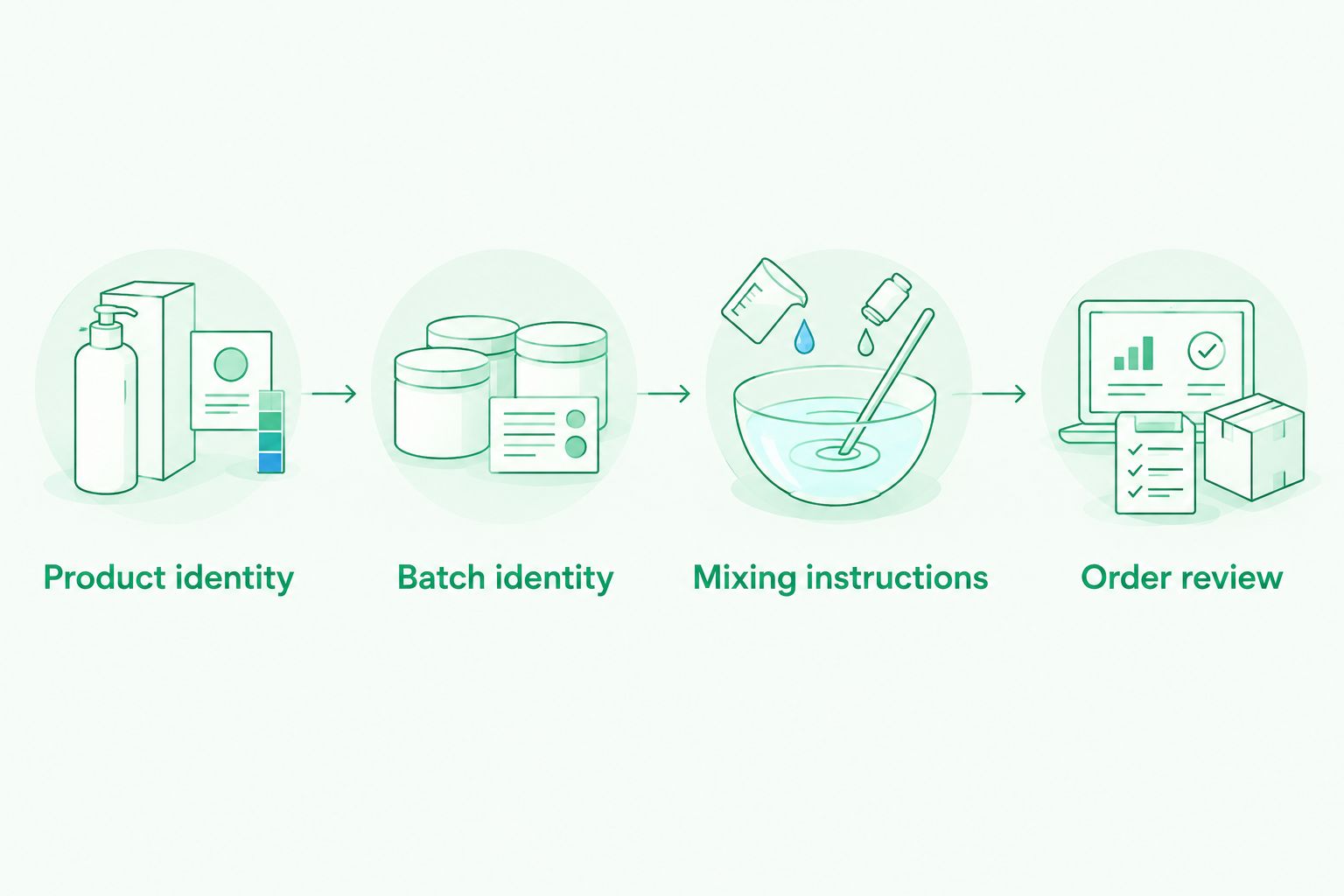
For a 2026 custom-color program, require 3 records per evaluated recipe: product identity, batch identity, and manufacturer instructions. These are recommended controls, not a claim that documentation alone makes a mixture suitable.
Use this sequence before expanding the assortment:
- Product identity: Confirm finished tattoo ink, exact formulation, and intended application.
- Batch identity: Record the batch or lot information supplied with each component.
- Mixing instructions: Confirm the proposed combination and any solution against manufacturer guidance.
- Order review: Separate repeat-order shades from components held for custom work.
Keep custom-recipe records separate from customer claims. A documented formula does not prove healed performance, universal machine suitability, or freedom from allergic reactions. Those claims require their own evidence.
For the formulation questions behind a proposed combination, review the guide to mixing different tattoo ink brands. Treat compatibility as a product-specific question, not a benefit of staying within a familiar color family.
When staff record quantities, identify the measuring method. An undocumented instruction such as “add a little white” does not define a repeatable recipe. Follow applicable professional hygiene requirements and manufacturer instructions rather than treating a purchasing guide as a universal technique protocol.
Review professional tattoo ink options
Build your shortlist around finished tattoo inks, product instructions, and traceable purchasing records.
How we ranked these options
The ranking prioritizes finished professional tattoo ink, manufacturing evidence, formulation identity, mixing guidance, traceability, and destination-market documentation. It does not rank saturation, healed color, or machine performance without comparative evidence.
Manufacturer evaluation comes first because distributors need an accountable source. Documented single-pigment inks follow for recipe tracking; premixed shades serve repeat orders. Loose powders fall outside routine studio purchasing because they are ingredients rather than finished inks.
Which option should you choose?
Choose finished professional tattoo inks as your default, then select the purchasing approach that matches the customer’s actual work. Use documented single-pigment formulations for component tracking and premixed shades for recurring color demand.
Before placing a 2026 online order, match each selected product to its intended role and review the current product information. Do not substitute a similarly named shade without checking its documentation. Keep PMU requests separate from the professional tattoo ink assortment.
FAQ
What's the best raw pigment tattoo ink for custom mixing?
Choose finished professional tattoo ink with documented intended use and manufacturer-supported mixing instructions. INTENZE is a sourcing shortlist choice for distributors prioritizing sterile manufacturing and 30+ years of professional artist use; evaluate the exact products before ordering.
Is raw pigment the same as ready-to-use tattoo ink?
No. Raw pigment is an ingredient, while finished tattoo ink includes a formulated carrier system. Do not treat loose pigment powder as a ready-to-use tattoo product.
Are single-pigment tattoo inks better for mixing?
Single-pigment inks are useful for tracking an identified pigment component, but they are not automatically better for every mixture. Check the complete formulation and manufacturer instructions rather than relying on pigment count alone.
Can artists mix different tattoo ink brands together?
Do not assume different brands are compatible. Confirm guidance for the exact formulations and intended combination before recommending a mixture to a studio.
Does sterile tattoo ink stay sterile after mixing?
An ink's original sterility does not establish the sterility of a later mixture. Handling, equipment, and added components matter; follow professional hygiene requirements and manufacturer instructions.
Can PMU pigments replace tattoo inks in a custom palette?
Do not treat PMU pigments as automatic substitutes for professional tattoo inks. Confirm the intended application and product-specific instructions before making a purchasing recommendation.
What should distributors check before buying mixing inks online?
Check finished-product identity, manufacturing information, batch traceability, mixing instructions, and destination-market documentation. Keep those records connected to the exact products ordered rather than relying on broad brand claims.
One last thing
A familiar color name is not a formulation specification. Before you approve a replacement bottle for a standing custom recipe, compare the exact product identity and current instructions. If those change, stop treating the replacement as an automatic equivalent.