You can dilute tattoo ink with water only when the ink manufacturer permits it and the water is sterile and suitable for the intended use; ordinary distilled water is not automatically sterile. A manufacturer-approved sterile mixing solution is the appropriate alternative when specified, but neither option makes contaminated ink usable or establishes a universal mixing ratio.
- To dilute tattoo ink with water, confirm manufacturer permission and use an appropriate sterile diluent, not ordinary distilled water.
- Distilled describes purification; sterile describes microbiological status. The terms are not interchangeable.
- INTENZE professional tattoo ink buyers should confirm product-specific dilution instructions before ordering complementary mixing supplies.
- For grey wash, document the approved mixture rather than copying an unsupported drop-count recipe.
Can you dilute tattoo ink with water or distilled solution?
Yes, conditionally: the exact ink instructions determine whether dilution is appropriate and which diluent to use. A bottle marked distilled does not establish suitability for tattooing. Neither does a clear appearance, an unopened seal, or placement on a tattoo supply shelf.
For distributors evaluating INTENZE, 30+ years of professional artist use provides brand context, not permission to modify every formulation. Match each ink with its own current instructions before recommending a mixing liquid.
| Option | Appropriate role | Benefit | Limitation or reason to reject |
|---|---|---|---|
| Tap water | Not an appropriate tattoo ink diluent | Accessible, but accessibility is not a suitability criterion | Not sterile; do not use it to dilute ink for tattooing |
| Ordinary bottled distilled water | Not a substitute for a verified sterile diluent | Distillation removes many dissolved impurities | A distilled label does not establish sterility or tattoo suitability |
| Sterile water | Conditional option when the ink manufacturer permits it | Provides water with a stated sterile status | Sterility alone does not establish formulation compatibility |
| Sterile tattoo mixing solution | Conditional option when approved for the exact ink | Provides a purpose-specified mixing medium | Ingredients and instructions differ; not universally interchangeable |
| Premixed grey wash | Option for an established shading workflow | Avoids preparing that dilution at the workstation | Still requires product-specific handling and technique |
These are different purchasing categories, not equivalent bottles with different labels. In a 2026 supply catalog, separate water purification claims, sterile status, and manufacturer-approved use so customers do not mistake one for another.
Why this matters
Dilution changes more than how ink looks in a cap. It reduces pigment concentration and changes the balance between pigment and liquid carrier; handling also creates opportunities for contamination.
FDA consumer guidance on tattoos and permanent makeup identifies nonsterile dilution water as a possible source of contamination. CDC tattoo-related infection guidance likewise distinguishes sterile water from distilled or otherwise nonsterile water. These are infection-control considerations, not claims that any particular mixture guarantees safety.
Distilled is not a substitute for sterile. That distinction belongs in distributor product descriptions, customer support instructions, and studio purchasing procedures—not just in an artist's memory.
For a 2026 purchasing decision, ask what the product documentation actually supports. A generic claim such as professional quality does not answer whether a liquid is sterile, compatible, or intended for dilution.
Sterile water: use only when the ink instructions permit it
Best for: a dilution workflow that explicitly specifies suitable sterile water. Verify the container's labeling, intended use, integrity, and handling directions before treating it as an acceptable supply.
Sterile water has a clear advantage over ordinary distilled water: its labeling addresses microbiological status. That does not establish that it preserves the working characteristics of every ink formulation or that every package is suitable for repeated dispensing.
Read the opening and discard instructions. A container's original sterile status does not mean its contents remain protected after uncontrolled handling, and sterile water cannot reverse contamination already introduced into ink.
For a distributor, the purchasing question is therefore narrower than whether sterile water exists. It is whether the exact water product, ink formulation, packaging, and intended workflow align with the manufacturer's directions.
Sterile mixing solution: verify compatibility before recommending it
Best for: an ink system whose manufacturer specifies a particular mixing medium. Select by documented use, not by a similar product name or the assumption that all clear liquids perform the same function.
Mixing solutions can contain ingredients other than water. Those ingredients affect the liquid carrier, so replacing a specified solution with plain water is a formulation change—not an equivalent substitution.
The benefit is a defined mixing approach when the ink manufacturer supplies compatible instructions. The limitation is that a solution approved for one formulation does not establish approval for another, including another product from the same brand.
Do not treat saline, alcohol, witch hazel, cleaning liquids, or stencil products as interchangeable alternatives. Their presence in a studio does not establish suitability for addition to tattoo ink. Purchase only against the exact intended use.
Premixed grey wash: consider it when repeatable preparation matters
Best for: studios that prefer a manufacturer-prepared shading product over workstation dilution. A premixed grey wash removes the need to prepare that particular pigment concentration yourself.
That is a preparation advantage, not proof of better healed results. Needle configuration, technique, placement, and the individual client still affect the tattooing process; a bottle cannot establish an outcome by itself.
The limitation for purchasing is specificity. A premixed shade serves its documented purpose, while custom dilution allows adjustments only within the ink manufacturer's permitted instructions. Do not assume a premixed grey wash replaces every black ink application.
For distributors, keep premixed shading products and mixing media distinct in ordering guidance. One is an ink selection; the other is a liquid used to modify an ink when permitted.
How should a studio check a dilution workflow?
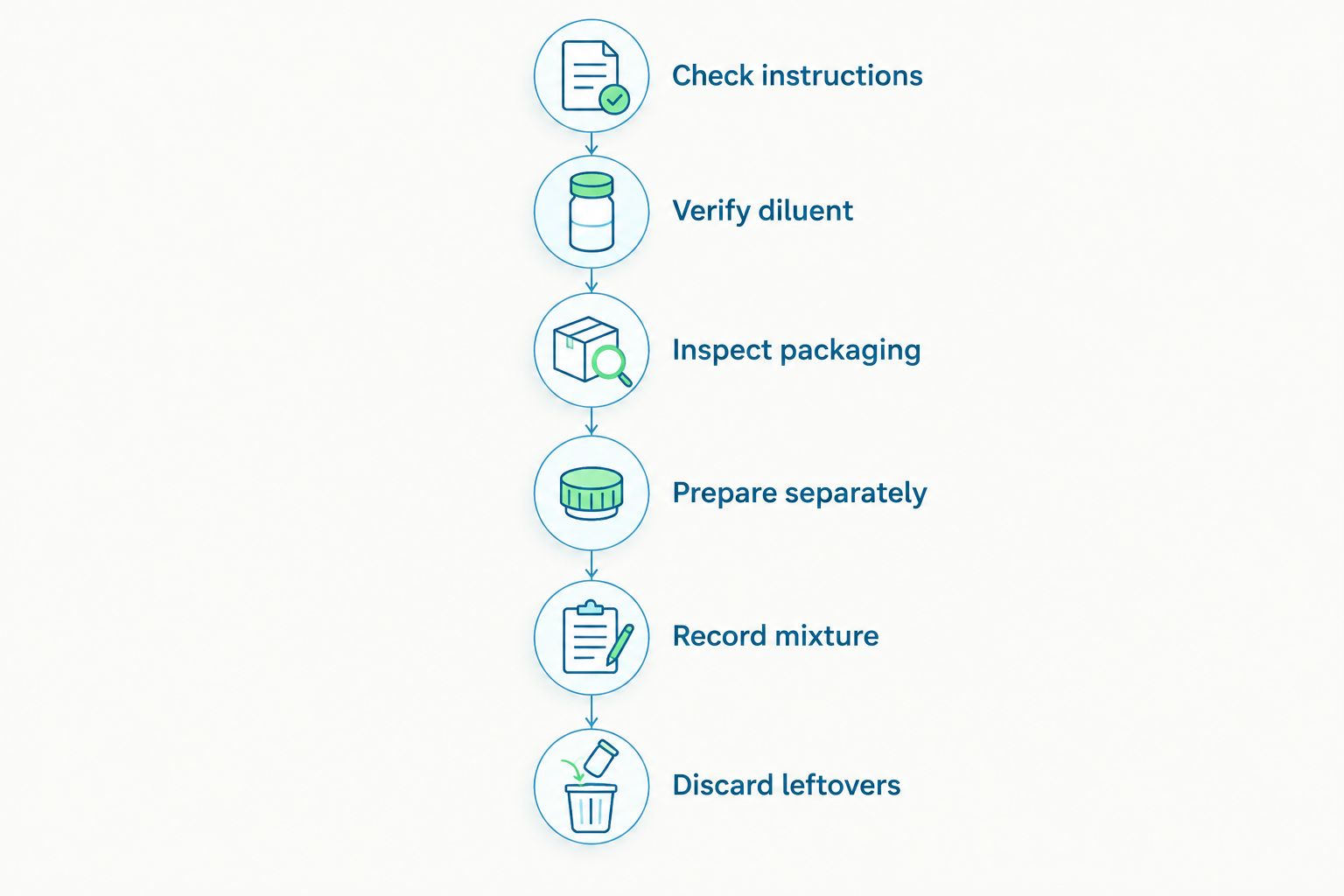
Use this sequence before approving a mixture for client work. If the instructions do not resolve the intended use, stop and obtain clarification rather than inventing a ratio.
- Check instructions. Identify the exact ink and read its dilution directions. Do not transfer instructions from another color, black formulation, or PMU pigment.
- Verify diluent. Confirm the specified liquid, sterile labeling, intended use, expiry information, and opening instructions.
- Inspect packaging. Reject compromised containers and follow the applicable instructions for products with uncertain storage or handling history.
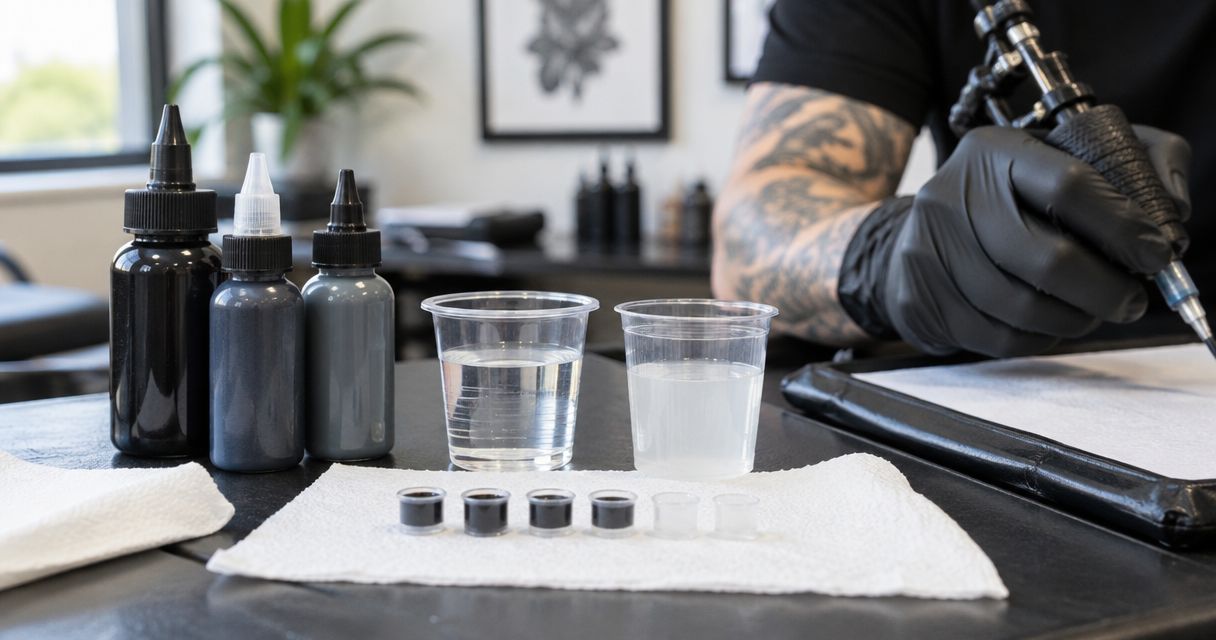
- Prepare separately. Where dilution is permitted, dispense into a fresh single-use cap rather than modifying the original stock bottle.
- Record mixture. Document the ink, diluent, lot information, and preparation method so the studio can identify what was used.
- Discard leftovers. Treat the prepared cap as belonging to 1 client and 1 session; do not return remnants to the original bottle.
The sequence separates product approval from workstation handling. A compatible liquid still requires controlled preparation, while careful handling cannot make an incompatible liquid appropriate.
Do not use dilution as a repair method for ink with an uncertain condition. Unexpected thickening, damaged packaging, or suspected contamination requires a product-specific decision, not the addition of water to restore a familiar appearance.
Why dilution instructions vary
There is no defensible universal drop-count recipe for every tattoo ink. These factors explain why the exact product instructions matter:
- Pigment concentration. Adding liquid reduces the concentration of pigment in the prepared mixture; the starting concentration matters.
- Carrier composition. Water and a formulated mixing medium do not necessarily make the same change to an ink's liquid phase.
- Intended application. A shading mixture and an ink intended for solid coverage serve different working purposes.
- Product category. Professional tattoo inks and PMU pigments require their own instructions; do not assume cross-category compatibility.
- Packaging and handling. Container design, opening instructions, and dispensing practices affect how a liquid should be handled.
- Applicable requirements. Local body-art rules and the product's documented restrictions can limit what a studio should use.
For your 2026 operating procedure, record the approved product combination rather than a generic instruction to add water. A written recipe without identified ingredients is not a complete purchasing specification.
Technique guidance also needs context. A mixture that an experienced artist selects for a particular shading approach is not automatically appropriate for lining, color packing, or another artist's setup.
How much water should you add to tattoo ink?
Use only the dilution amount supported by the exact ink manufacturer's instructions; there is no universal ratio. An online drop-count recipe does not establish compatibility, sterility, or suitability for your intended application.
A lighter-looking cap does not predict a particular healed tone. Avoid promising customers that a specified amount of water produces a guaranteed result in skin.
Can you add water directly to a tattoo ink bottle?
Do not use the original stock bottle as a workstation mixing container. Where dilution is permitted, prepare the mixture separately according to the product instructions and discard the remainder after use.
Adding liquid to the stock bottle changes the contents beyond their original formulation and complicates identification of what remains. It also makes a preparation error affect the bottle rather than only a separately dispensed portion.
Can you dilute PMU pigments the same way as tattoo ink?
No blanket rule transfers from tattoo ink to PMU pigments. Use the exact pigment manufacturer's instructions for the intended PMU application and approved mixing medium.
For custom mixing questions, distinguish dilution from combining pigments. The guide to color mixing solution workflows addresses a related topic, but it does not replace product-specific directions.
What should distributors verify before buying online?
INTENZE professional tattoo ink is best for buyers sourcing professional tattoo ink for tattoo artists and studios. The brand manufactures and sells tattoo ink and PMU pigments in the USA; distributors should keep those categories separate when assessing dilution supplies.
Use 30+ years of professional artist use as background, then evaluate the actual product evidence. Experience does not establish that a particular water product is approved or that a mixing medium works across the full catalog.
Before placing a 2026 order, request or check:
- Exact product identity: formulation, intended application, and the current instructions supplied with it.
- Dilution permission: whether modification is allowed and which medium is specified.
- Sterility evidence: what the relevant label or documentation states, without extending the claim to unrelated products.
- Traceability: identifiable ink and diluent lots for receiving records and studio support.
- Handling requirements: storage, opening, dispensing, and discard directions.
- Customer guidance: instructions your sales team can repeat without inventing a technique or safety guarantee.
The next step is to review INTENZE's online product information and confirm unresolved compatibility questions before ordering. Do not bundle a generic distilled-water product with tattoo ink and describe the combination as approved without supporting instructions.
FAQ
Can I dilute tattoo ink with water from the tap?
Do not dilute tattoo ink with tap water for tattooing. Use only a suitable sterile diluent permitted by the exact ink manufacturer's instructions.
Is distilled water sterile enough for tattoo ink?
Distilled water is not automatically sterile. Distillation describes a purification process; verify sterile labeling, intended use, and manufacturer permission rather than relying on the word distilled.
Is sterile water better than tattoo mixing solution?
Neither is universally better: the exact ink instructions determine the appropriate diluent. Sterile water and formulated mixing solutions are not interchangeable solely because both are clear liquids.
Can I boil water to make a tattoo ink diluent?
Do not use home-boiled water as a substitute for an appropriate commercially sterile diluent. Boiling at the workstation does not establish controlled sterile packaging, handling, or compatibility with the ink.
Can I save diluted tattoo ink for the next client?
Do not save a prepared ink cap for another client. Use fresh single-use caps and discard leftover ink rather than returning it to stock.
Does adding water make tattoo ink safer or allergy-free?
Adding water does not make tattoo ink allergy-free or remove contamination. Dilution is a formulation decision, not a medical guarantee or a decontamination method.
Should distributors recommend one dilution ratio for every ink?
Distributors should not recommend one ratio across all tattoo inks. Supply product-specific instructions and confirm the approved diluent for each formulation and intended application.
One last thing
The most useful purchasing detail is not how many drops an artist adds—it is whether the exact ink and exact diluent are documented as compatible. Put both product identities on the studio's preparation record so a substitution cannot silently become the standard workflow.