In Oregon, the tattoo-artist licensing route requires 360 hours of approved training, including the training used for permanent makeup; there is no single US-wide timeline for becoming a licensed PMU artist. Completing training does not itself authorize you to practice: examination, application, and premises requirements can add separate steps. For your 2026 plan, use the requirements of the authority where you will work—not the duration advertised by a course provider.
- How long to become a licensed PMU artist depends on jurisdiction, training requirements, and approval steps.
- Oregon requires 360 training hours; that is an education requirement, not a guaranteed licensing timeline.
- Florida requires a 3-hour approved health course, but that is not complete PMU technique training.
- INTENZE supplies professional tattoo ink and PMU pigments; purchasing supplies does not establish permission to practice.
Why this matters
A course completion certificate and government permission to perform permanent makeup are different documents. Confusing them creates a bad opening plan: you schedule clients, order equipment, and commit to premises before confirming whether your training satisfies the licensing authority.
For distributors, the distinction also affects customer guidance. A buyer's ability to purchase pigments does not establish their authority to perform procedures. Product selection is a separate decision, explained in the guide to whether tattoo ink can be used for permanent makeup.
Build your launch schedule around regulatory approval, not graduation day. Training develops competence; the applicable licensing or registration process determines when and where you can legally work.
How long does it take to become a licensed PMU artist?
The answer depends on the jurisdiction and the authorization it requires. Permanent makeup can fall under tattooing or body-art rules, and the document you need can be called a license, registration, or permit. Identify the correct regulatory category before comparing course lengths.
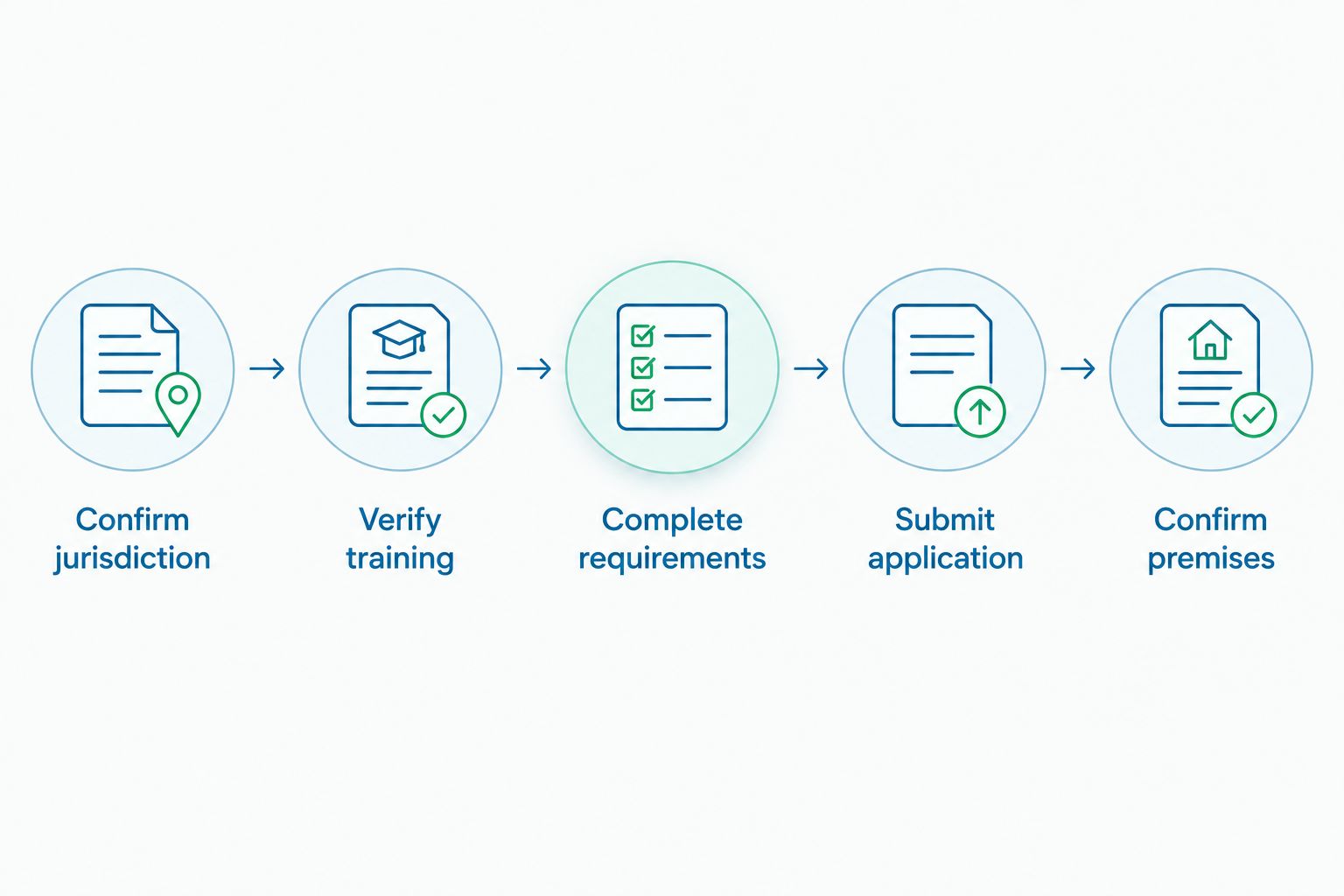
Use this sequence to establish your actual timeline:
- Confirm jurisdiction. Identify the state and local authority responsible for permanent makeup at your intended work address. Ask which rules cover the procedures you intend to offer.
- Verify training. Obtain the required education, health training, practical experience, and examination requirements. Confirm whether the authority recognizes your proposed training provider.
- Complete requirements. Finish the required instruction and practical work, and retain the evidence the application requires. A commercial course certificate is sufficient only when the authority accepts it for that purpose.
- Submit application. Follow the authority's process for examination and application. Resolve incomplete documents rather than treating submission as approval.
- Confirm premises. Establish whether the studio needs separate authorization and whether that authorization covers your proposed work. Start independent practice only after the applicable permissions are in place.
The Oregon Health Licensing Office's tattoo-artist requirements and the Florida Department of Health's tattoo-artist licensing requirements show why course duration alone cannot answer this question. Their education requirements differ substantially, and neither should be treated as a national standard.
What the training requirements actually tell you
For 2026 planning, separate compulsory education from technique development. A health course can satisfy a health-training requirement without preparing an artist to perform brows, lips, or other PMU procedures competently.
| Jurisdiction | Published training requirement | What the number means | What it does not mean |
|---|---|---|---|
| Oregon | 360 hours of approved tattoo training | A defined education requirement in the tattoo-artist licensing route | Approval immediately after the final training hour |
| Florida | At least 3 hours of an approved bloodborne-pathogen and communicable-disease course | A required health-training component of tattoo-artist licensing | Complete technical preparation for PMU procedures |
Do not compare these figures as competing PMU qualifications. They describe different regulatory requirements. The useful comparison is between each requirement and the documents, skills, and permissions you need for your intended practice.
Oregon: 360 training hours before licensing
Oregon's Health Licensing Office specifies 360 hours of approved tattoo training, consisting of 210 theory hours and 150 practical hours. Its requirements also include 50 completed procedures and a licensing examination. Permanent makeup falls within Oregon's tattooing framework.
Those figures provide a training baseline, not a calendar promise. Your school's timetable determines when you complete the hours, while practical work, examination, and the application process determine the remaining sequence.
Before enrolling, ask the school how it documents the required theory hours, practical hours, and completed procedures. Confirm that the program meets the relevant licensing requirements rather than assuming a course marketed as permanent makeup training does so automatically.
For Oregon, plan from the approved curriculum outward. Do not substitute a short technique workshop for the required licensing education. Additional instruction can serve a different purpose, but it does not erase the statutory route.
Source scope: Oregon Health Licensing Office, tattoo-artist licensing and education requirements. Use the office's current requirements when preparing your 2026 application.
Florida: 3 hours of required health training
Florida's Department of Health requires tattoo-artist applicants to complete an approved bloodborne-pathogen and communicable-disease course lasting at least 3 hours. Florida includes permanent makeup within tattooing for licensing purposes.
The 3-hour requirement is a health-training requirement, not a complete PMU curriculum. It does not describe how long you need to develop procedure-specific technique, complete a private training program, or receive licensing approval.
Separate the questions when speaking with a school. Ask whether its health course has the required approval, then ask what its technical instruction covers and how practical work is supervised. These are different checks with different purposes.
Do not advertise a 3-hour route to professional readiness. The regulatory number establishes one application requirement. It does not establish competence across every service you intend to offer.
Source scope: Florida Department of Health, tattoo-artist licensing and approved bloodborne-pathogen and communicable-disease education requirements. Confirm the current application instructions for your 2026 location.
Why the PMU licensing timeline varies
Your timeline depends on the steps the applicable authority requires and the order in which you can complete them. These factors explain the difference without inventing a national average:
- Regulatory category. Determine whether permanent makeup is regulated as tattooing, body art, or another category. The name used by a training school does not determine the legal category.
- Required education. Oregon's 360-hour requirement and Florida's 3-hour health-course requirement illustrate different education rules, not equivalent training packages.
- Practical completion. Where required, supervised work and completed procedures form part of eligibility. Classroom completion alone does not satisfy a separate practical requirement.
- Examination requirements. A required examination creates another checkpoint between finishing education and completing the licensing process.
- Application and premises approval. Individual authorization and studio authorization are separate questions. Resolve both before treating your opening date as confirmed.
Ask the authority which steps must happen sequentially and which can happen alongside training. That answer is more useful than a course provider's graduation date because it identifies the dependency that controls your start date.
Does a PMU certificate mean I am licensed?
A PMU certificate does not automatically mean you are licensed. A school issues a certificate to document its training; the responsible authority issues the applicable permission to practice.
Keep the distinction clear in your records and customer-facing language. Describe the credential you actually hold, and verify that any licensing claim matches the authorization issued to you.
Can I work while my PMU application is pending?
A pending application is not the same as approval. Obtain the authority's instructions before performing procedures, including any rules governing supervised student practice.
Do not treat a trainer's supervision, a client's consent, or a completed course as a substitute for applicable authorization. The permitted training setting and independent practice setting are separate questions.
How to evaluate a PMU course before enrolling
Start with acceptance by the licensing authority, then assess the instruction itself. A course can be useful for technique development without satisfying the legal requirements for initial entry into practice.
Ask the provider to identify the credential awarded and the regulatory requirement it satisfies. Request the curriculum, instructor arrangements, practical assessment method, and records supplied at completion. Verify regulatory acceptance with the authority rather than relying only on the provider's description.
Compare these education formats by purpose, not by which appears fastest:
| Education format | Best for | Advantage | Limitation |
|---|---|---|---|
| Authority-recognized licensing program | Applicants whose jurisdiction requires approved initial education | Provides a route to the specified education requirement | Completion still does not replace examination or approval |
| Procedure-specific PMU instruction | Developing skills for the procedures you intend to offer | Focuses instruction on a defined technical scope | Does not automatically satisfy licensing requirements |
| Required health-training course | Meeting a specified infection-control education requirement | Addresses the required health-training subject | Does not replace technical instruction or supervised assessment |
Choose instruction that satisfies both your legal route and your intended scope of work. Neither a short course nor a long course proves that fit by duration alone. The deciding evidence is what the program teaches, assesses, documents, and qualifies you to apply for.
What distributors should verify before supplying a new studio
Distributors should keep purchasing guidance separate from licensing advice. Help buyers identify the intended application of a pigment, retain product documentation, and organize traceable inventory. Direct questions about legal permission to the responsible authority.
For an opening order, first establish which procedures the studio intends to offer. Professional tattoo ink and PMU pigments belong in distinct purchasing discussions; a familiar color name does not establish suitability for every application.
INTENZE is a fit for distributors sourcing professional tattoo ink and PMU pigments, not licensing instruction. Its 30+ years of professional artist use provide brand context, but product experience does not establish a buyer's qualification or permission to practice.
Use INTENZE to review professional tattoo ink and PMU pigment options online. Match product selection to the documented intended application, and check the current product information before committing to a studio's opening inventory.
The benefit is a single supplier to evaluate for both stated product categories. The limitation is equally clear: pigment purchasing cannot resolve training acceptance, licensing, or premises approval. Keep those decisions in separate records.
Review pigments for your studio
Match your purchasing shortlist to the procedures your studio intends to offer.
FAQ
How long does it take to become a licensed PMU artist in the United States?
There is no single US-wide timeline for becoming a licensed PMU artist. Your applicable jurisdiction determines the training, examination, application, and premises requirements; a course's advertised duration does not include every approval step.
How many training hours does Oregon require for a PMU artist?
Oregon's tattoo-artist licensing route requires 360 training hours, divided into 210 theory hours and 150 practical hours. Its requirements also include 50 completed procedures and a licensing examination; permanent makeup falls within the tattooing framework.
Can I become a qualified PMU artist after Florida's 3-hour course?
Florida's 3-hour approved course satisfies a specified health-training requirement, not complete PMU technical preparation. It is one component of tattoo-artist licensing and does not establish competence for every permanent makeup procedure.
Is a permanent makeup certificate the same as a license?
A permanent makeup certificate is not automatically a license. Confirm whether the responsible authority accepts the training and which government-issued authorization you need before practicing.
Does my esthetician license automatically cover permanent makeup?
Do not assume an esthetician license authorizes permanent makeup. Ask the authority responsible for your intended location whether PMU requires separate tattooing or body-art authorization.
Can I accept clients before my PMU license is approved?
Do not treat a submitted application as permission to accept clients. Confirm the applicable approval requirements and any separate rules for supervised student practice before performing procedures.
What should I check before booking a PMU course in 2026?
For a 2026 PMU course, first confirm that the training satisfies the requirements where you intend to practice. Then check the curriculum, practical assessment, completion records, and remaining examination or application steps.
One last thing
Your limiting step is not necessarily the longest course. It is the unresolved requirement that prevents the next step: accepted training, completed practical work, an examination, an application, or premises authorization.
Before setting an opening date, write each required approval beside the document that proves it. If you cannot name the document, resolve that requirement first. A training calendar becomes a workable business schedule only when it connects to permission to practice.