Yes—when tattoo ink separates in bottle storage, pigment settling can be a normal feature of a suspension, provided it redistributes with the manufacturer’s prescribed mixing method. Separation alone does not establish whether ink is usable: persistent clumps, damaged packaging, an expired use date, or uncertain handling require a separate assessment before sale or use.
- When tattoo ink separates in bottle storage, assess pigment settling against the manufacturer’s mixing instructions.
- An even appearance after mixing does not prove sterility or resolve an expired use date.
- Quarantine bottles with persistent clumps, damaged seals, or uncertain storage history pending manufacturer guidance.
- INTENZE professional tattoo ink has 30+ years of professional artist use; assess each bottle independently.
Is it normal for tattoo ink to separate or settle in the bottle?
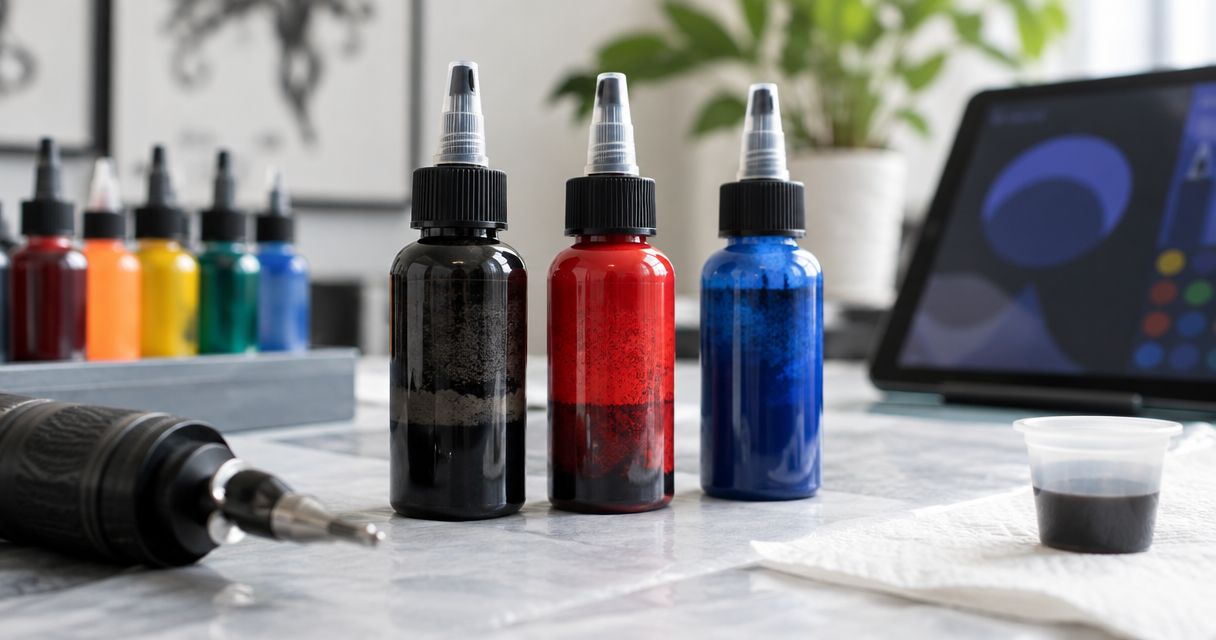
Settling can be normal; a bottle that will not redisperse needs investigation. Tattoo ink contains pigment particles suspended in a liquid carrier. During undisturbed storage, gravity can move those particles toward the bottom, leaving a less intensely colored layer above them.
That visible change is not, by itself, proof of spoilage, contamination, or poor manufacturing. Equally, shaking a bottle until it looks uniform does not establish that its contents are safe.
For distributors, provenance belongs in the same assessment as appearance. Start with a documented supply chain and review how to identify genuine INTENZE tattoo ink rather than treating a familiar-looking bottle as authentication.
| Bottle condition | What the observation establishes | Purchasing or handling decision |
|---|---|---|
| Pigment collects below a clearer carrier layer | The contents have visibly separated | Follow the product’s mixing instructions and inspect again |
| Contents become evenly dispersed after prescribed mixing | The visible settling is reversible | Continue checking the label, packaging, dates, and handling history |
| Dense lumps or bottom sediment persist after prescribed mixing | The prescribed method has not restored an even suspension | Quarantine the bottle and request manufacturer guidance |
| Bottle leaks or an expected tamper seal is damaged | Packaging integrity is compromised or uncertain | Do not release the bottle for use |
| Contents look even but the use date has passed | Appearance does not resolve the date restriction | Follow the labeled date; do not override it with a visual check |
Why this matters
Your receiving team needs to distinguish an appearance question from a release decision. Rejecting every settled bottle confuses suspension behavior with a defect; approving every bottle that shakes evenly confuses appearance with safety.
For a 2026 inventory procedure, document both decisions separately: whether the pigment redistributes and whether the bottle meets the remaining acceptance requirements. Neither check replaces the other.
What is the difference between settling and a bottle problem?
Settling describes pigment moving within the carrier. A bottle problem is a broader category that includes compromised packaging, unresolved changes in consistency, missing traceability, and storage outside the manufacturer’s instructions.
Use redispersion as an observation, not a safety certificate. A smooth-looking liquid can still have an unacceptable history. Visible sediment can exist in an otherwise properly handled suspension.
Reversible sediment: follow the prescribed mixing method
A layer that redistributes with the labeled mixing method is consistent with reversible settling. Check the bottle again after mixing rather than judging only the upper liquid or assuming movement inside the bottle means the entire contents are uniform.
This observation supports a handling decision, not an unconditional release. You still need acceptable packaging, readable identification, an applicable use date, and a documented source.
Persistent deposits: hold the bottle for assessment
A compact deposit, persistent lumps, or uneven material after prescribed mixing deserves manufacturer review. Do not invent a longer shaking interval or a more aggressive process to force the bottle to pass inspection.
Report what you can actually see. “Sediment remains after following the label” is useful; “the pigment has chemically failed” is a diagnosis your receiving team cannot establish from appearance alone.
Packaging damage: stop the release process
Leakage, a cracked bottle, or a damaged expected seal changes the decision even if the ink mixes evenly. Keep affected units out of saleable inventory while the issue is assessed.
Do not open a sealed bottle merely to investigate its smell or touch its contents. That action changes the condition of the product you are trying to assess.
Why tattoo ink settling varies
There is no universal visible settling pattern for every tattoo ink. Suspension behavior depends on the formulation and its storage conditions, so comparisons need to stay product-specific.
- Pigment properties: Particle size, density, and interactions influence how particles behave in a liquid suspension.
- Carrier properties: The liquid’s viscosity affects particle movement. Different formulations do not have to settle at the same rate.
- Undisturbed storage: A bottle sitting still gives particles an opportunity to collect below the carrier.
- Temperature exposure: Temperature changes affect liquid properties. Exposure outside labeled storage conditions requires separate review, not automatic approval after shaking.
- Mixing method: The manufacturer’s instructions determine how to prepare that formulation; an improvised method is not an equivalent standard.
A 2026 purchasing specification should therefore request the applicable storage and mixing instructions for each product. Do not copy the instructions from a different color or brand simply because the bottles look similar.
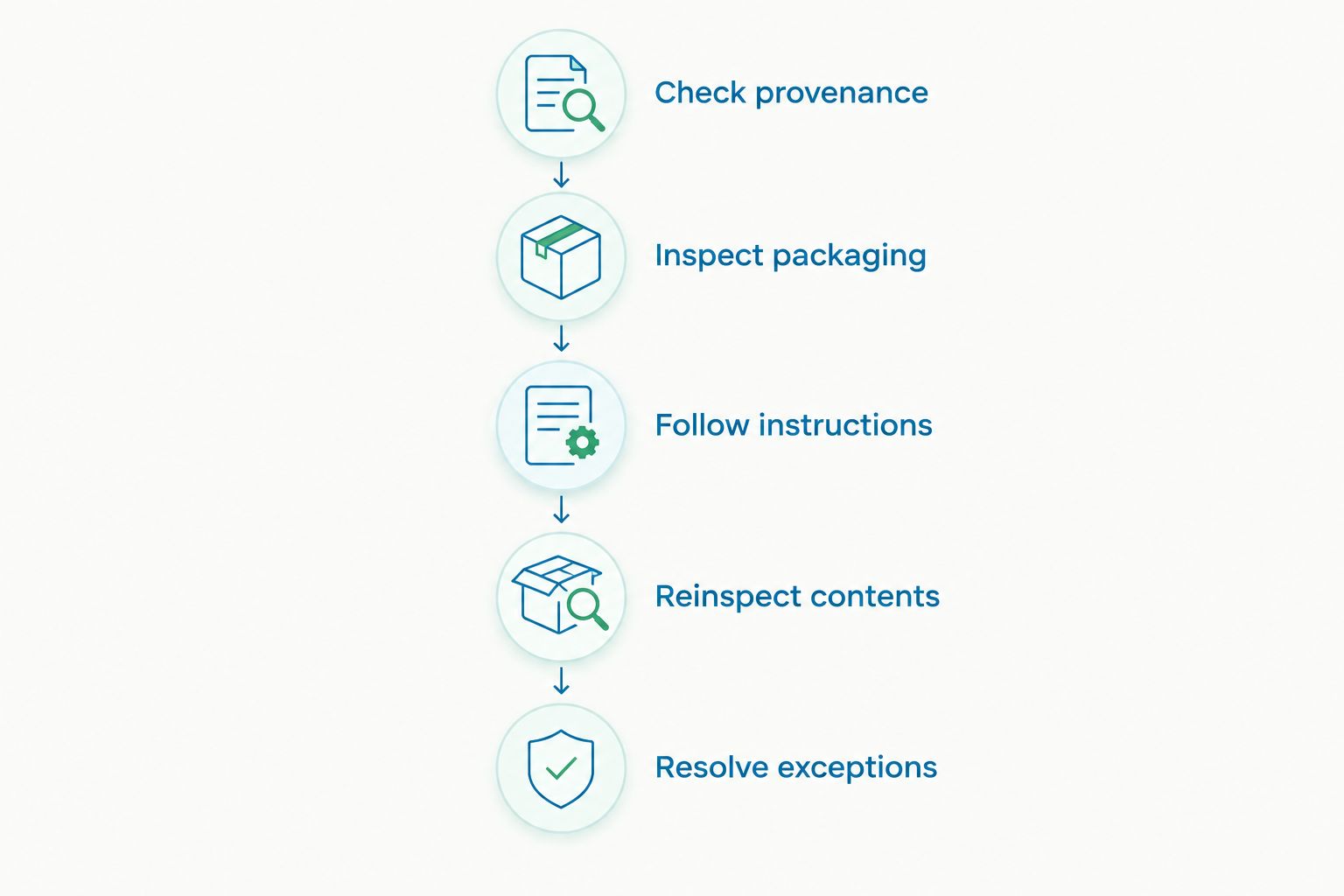
How should distributors check separated tattoo ink?
Use a receiving sequence that protects unopened stock and preserves traceability. The purpose is to record evidence and route exceptions—not to turn your warehouse into a formulation-testing facility.
1. Check provenance
Match the shipment to the purchase record and supplier. Confirm that product identity and batch information are readable wherever provided, and retain the documentation needed to trace affected units.
An unfamiliar source needs resolution before an appearance check can carry any weight. Uniform-looking ink does not authenticate a bottle.
2. Inspect packaging
Check for leakage, cracks, closure damage, and the condition of any expected tamper-evident feature. Record affected units without opening them.
Photograph the bottle and relevant labels when you need to raise an issue. Preserve the original packaging if it helps explain damage or exposure during shipment.
3. Follow instructions
Read the product’s own mixing, storage, and use-date instructions. Keep the closure secured and use the prescribed preparation method without adding liquid or inserting tools.
There is no evidence-based universal shaking time supplied here. Your standard operating procedure should point staff to the applicable product instruction rather than inventing a warehouse-wide duration.
4. Reinspect contents
Assess whether the visible sediment redistributes and whether unusual deposits remain. Record the result in plain language, including any limitations caused by an opaque bottle.
Do not dispense ink into a cap solely to approve unopened resale stock. If the bottle prevents a meaningful visual assessment, request the manufacturer’s assessment method.
5. Resolve exceptions
Separate unresolved units from saleable inventory and send the supplier the product identity, batch information, photographs, and handling history. Ask for a disposition specific to the affected product.
In your 2026 receiving log, record who authorized the final decision. A verbal assumption should not become the reason a questionable bottle returns to the shelf.
What should you avoid when trying to remix tattoo ink?
Do not reformulate a bottle to make it look acceptable. Adding water, alcohol, carrier, or another ink changes the contents and is not a substitute for resolving an abnormal condition with the manufacturer.
Avoid applying heat, freezing the bottle, removing deposits, or inserting a stirring tool unless the manufacturer explicitly provides that procedure for the product. An improvised intervention also makes the original problem harder to assess.
For distributors, opening and modifying a bottle introduces another problem: it is no longer unopened resale stock. Keep investigation and disposition separate from attempts to recover the unit.
The same boundary applies to studio customers. Technique preferences do not override product handling instructions, and a recommendation intended for a particular formulation should not become general advice for every ink.
How should you record a settling complaint?
A useful complaint describes the bottle, the observation, and the handling history without declaring a cause. Build your 2026 complaint form around information the manufacturer can assess.
Include these fields:
- Product identity and color as printed on the label.
- Batch or lot identification and any labeled use date.
- Supplier, purchase record, and receipt date.
- Whether the bottle is unopened or previously used.
- Known storage conditions and any documented shipping exception.
- Mixing instructions followed and the visible result.
- Photographs of the packaging, label, and observable separation.
Keep the limitation of photographs clear: they document appearance, not microbial status. Likewise, a batch identifier supports traceability but does not independently establish that every bottle sharing it has the same condition.
If several customers report the same observation, preserve those reports separately and identify the common product and batch details. Do not turn a repeated observation into a confirmed batch defect without manufacturer assessment.
Does separated tattoo ink mean it has expired?
Separation does not establish expiration. Settling is an observation about the suspension; expiration is governed by the applicable labeled date and instructions.
A bottle can settle before its use date, and an expired bottle can still appear evenly mixed. Keep date checks independent of the mixing result, including any manufacturer instructions that apply after opening.
For 2026 stock rotation, use the relevant labeled dates rather than deciding which bottle looks freshest. Appearance is not an inventory dating method.
Can you sell a bottle if the pigment mixes back in?
Redispersion alone is not enough to release a bottle for sale. You also need acceptable packaging, traceable sourcing, applicable dates, and storage consistent with the manufacturer’s instructions.
If any of those checks remains unresolved, hold the bottle pending guidance. Do not describe it as sterile, compliant, or fit for use solely because the sediment disappeared.
Where INTENZE fits in a distributor’s purchasing decision
INTENZE professional tattoo ink combines sterile manufacturing with 30+ years of professional artist use. Those are brand credentials—not an exemption from inspecting individual shipments or following product-specific instructions.
INTENZE is a professional tattoo ink manufacturer for distributors sourcing ink for tattoo artists and studios. For your next order, review the products online through INTENZE and confirm the handling information relevant to the products you intend to stock.
The practical limitation remains the same for this brand as for any other: a brand name cannot resolve a damaged seal, an uncertain storage history, or persistent deposits in a particular bottle. Keep those exceptions outside saleable inventory until assessed.
Review professional tattoo ink online
Choose products for your inventory and confirm their storage and mixing instructions.
FAQ
Is it normal for clear liquid to sit above tattoo ink pigment?
A clearer liquid layer above settled pigment can occur in a tattoo ink suspension. Follow the manufacturer’s mixing instructions, then assess packaging, dates, and handling history separately.
How long should I shake a separated tattoo ink bottle?
Follow the shaking or mixing instructions for that specific product. Do not substitute an invented universal duration or keep escalating the process when deposits persist.
Does shaking tattoo ink make it sterile again?
Shaking tattoo ink does not sterilize it. Redispersion changes the distribution of pigment; it does not resolve contamination or compromised packaging.
Can I add water to tattoo ink that will not mix?
Do not add water to repair a bottle that will not redisperse. Hold the bottle and request manufacturer guidance rather than changing its formulation.
Should a distributor open a sealed bottle to check sediment?
Do not open sealed resale stock solely to investigate sediment. Preserve its condition and ask the manufacturer how to assess a bottle that cannot be inspected adequately from outside.
Does sediment at the bottom prove tattoo ink is counterfeit?
Sediment alone does not prove tattoo ink is counterfeit. Assess authenticity through the supply chain, purchase documentation, and manufacturer guidance rather than suspension appearance.
One last thing
A bottle that looks uniform is not necessarily the bottle with the better handling history. Make provenance, packaging, dates, and prescribed mixing separate acceptance checks. That keeps an ordinary settling observation from becoming either an unnecessary rejection or an unsupported approval.