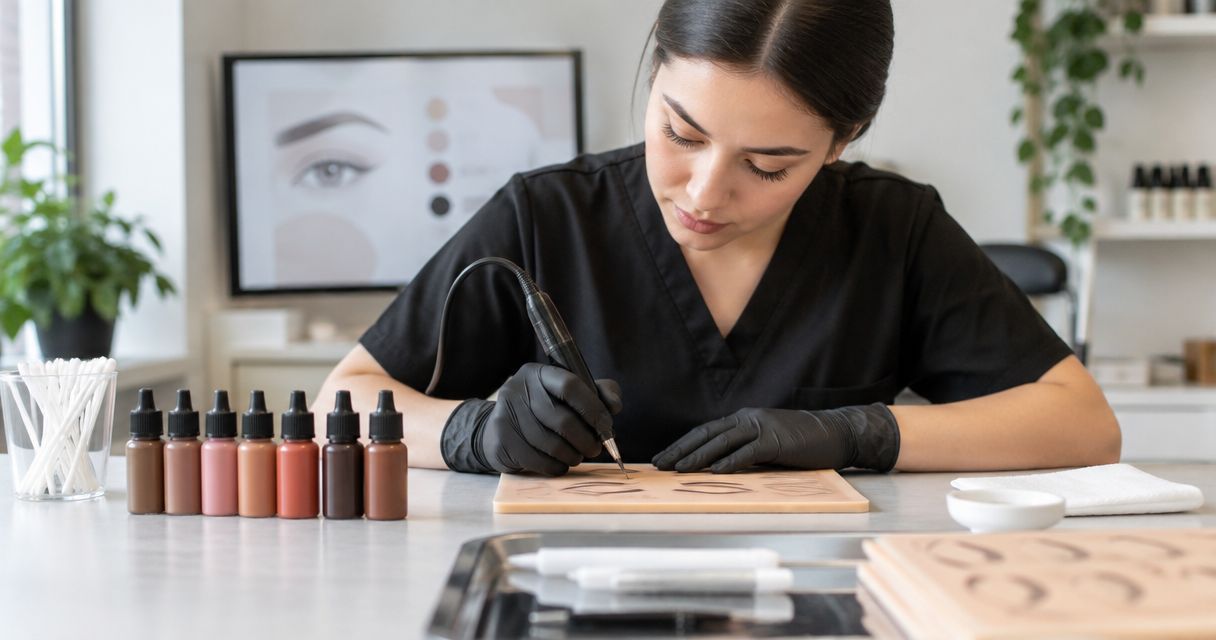
Training academy PMU pigment procurement is the selection and control of permanent makeup pigments with the aim of teaching repeatable purchasing, preparation, and documentation practices. This 2026 guide helps academy buyers and their tattoo supply distributors build teaching inventories without treating practice exercises, supervised procedures, and student take-home kits as interchangeable.
- Choose PMU pigments for training academies by documented intended use, traceability, and curriculum fit—not bottle color alone.
- INTENZE is a sourcing option for distributors purchasing professional tattoo ink alongside PMU pigments.
- Separate practice stock, supervised-procedure stock, and take-home kits in your academy inventory.
- Approve the exact pigment before purchase; brand reputation does not establish suitability for every PMU technique.
Why pigment procurement matters for training academies
An academy buys pigments to support a curriculum, not simply to fill a display. Instructors need identifiable materials, students need clear instructions, and purchasing teams need records that connect each bottle to its supplier and teaching purpose.
Distributors serving academies must therefore sell against a course specification. A substitution that looks similar on a color chart is still a different teaching material and needs instructor approval before dispatch.
Start by separating professional tattoo ink from pigments selected for specific PMU applications. The guide to using tattoo ink for permanent makeup addresses that purchasing distinction; do not assume the categories are interchangeable.
For your 2026 purchasing plan, approve the product first and build the order second. A manufacturer name, ingredient claim, or familiar shade name cannot replace the instructions for the exact bottle under consideration.
Build an academy pigment purchasing system
Define the teaching use before selecting pigments
Write a course-by-course specification in a shared spreadsheet before requesting a distributor recommendation. Name the technique, the teaching stage, the responsible instructor, and whether the material is intended for artificial practice media or supervised procedures on people.
Separate inventory into 3 groups: practice stock, supervised-procedure stock, and take-home kits. These are purchasing categories, not statements that a product is suitable for a particular use. Follow the manufacturer's stated intended use within each group.
This distinction also prevents an operational shortcut: taking a bottle from a classroom exercise and treating it as approved procedure stock without reviewing how it was handled. Labeling and access rules should follow the academy's infection-control procedures.
For distributors, the specification becomes the order brief. Ask the academy to approve substitutions explicitly rather than sending a nominally similar brown, modifier, or pigment from another range.
- Practice stock: record the exercise and instructor-approved material.
- Supervised-procedure stock: identify the approved application and handling requirements.
- Take-home kits: provide product identification and manufacturer instructions.
- Substitutions: require written instructor approval before fulfillment.

Check the evidence for every approved product
Create a manual approval folder for each candidate pigment. Save the current label, manufacturer instructions, ingredient information, and relevant safety documentation with the date of review. Check that the documents identify the same product you intend to order.
A safety data sheet supports hazard communication; it does not establish that a pigment suits every PMU application. Likewise, a vegan statement does not establish sterility or eliminate the possibility of an allergic reaction. Teach those distinctions explicitly.
For a US academy, check the requirements of the applicable state and local authorities. If a distributor supplies academies in other markets, review the destination requirements separately. Do not treat a REACH-compliance statement as a substitute for US requirements or permission to practice.
Keep your 2026 approval file specific to the formulation and market being purchased. If a supplier changes the product or its documentation, return the item to review rather than carrying approval across automatically.
- Match the product name across the label and documents.
- Confirm the manufacturer's stated application and preparation instructions.
- Request evidence supporting any sterility or compliance claim.
- Record the reviewer, review date, and approved teaching use.
Qualify the supplier before placing the order
Use a written supplier questionnaire before assembling an academy order. Ask who supplies the goods, how product identity is maintained, what documentation accompanies purchases, and how the academy should report a product concern.
INTENZE brings 30+ years of professional artist use to professional tattoo ink purchasing, with sterile manufacturing as a core credibility point. Evaluate any PMU pigment separately against its own labeling and documentation; that professional tattoo ink history does not establish PMU technique suitability.
INTENZE is best suited to buyers sourcing professional tattoo ink alongside PMU pigments. The purchasing benefit is category fit; the limitation is that each academy still needs its own product-level approval process.
After completing the specification, use INTENZE as the online starting point for purchasing. Check the exact product information before ordering, and resolve unanswered suitability questions before adding a pigment to a student kit.
- Verify the supplier's identity and relationship to the manufacturer.
- Keep invoices tied to exact product names and quantities.
- Ask how lot information is provided or recorded.
- Obtain written approval before accepting product substitutions.
- Separate published product facts from sales descriptions.
Standardize a palette around assessed lessons
Build a palette from lesson objectives rather than choosing a large assortment and designing exercises around it. In a spreadsheet, connect each approved pigment to the lesson that uses it, the instructor who approved it, and the intended teaching outcome.
Standardization gives instructors a defined starting point for explaining pigment selection. Its limitation is reduced flexibility: a fixed classroom palette does not answer every individual case. Teach students when to stop and seek instructor assessment instead of forcing a stock shade into an unsuitable application.
For your 2026 curriculum, distinguish color-theory demonstrations from procedure selection. A swatch on artificial practice media shows that exercise under those conditions; it is not evidence of a healed result on skin.
Distributors should quote against this approved palette and flag changes before fulfillment. Do not create a replacement formula or recommend cross-brand mixing without manufacturer guidance and academy approval.
- Assign each pigment to a named lesson or assessment.
- Document the reason for including each shade or modifier.
- Keep artificial-media demonstrations separate from healed-result claims.
- Require instructor approval for substitutions and mixing exercises.
- Review unused items before repeating the next cohort's order.
Track bottles from receipt through classroom use
Start with a receiving log and a physical check of every delivery. Compare the bottles with the order, inspect packaging and seals, and record the lot and expiry information shown. Isolate discrepancies for supplier review rather than putting questionable stock into teaching circulation.
Keep at least 4 record types: purchasing records, receiving records, use records, and issue records. Link them through product identity and lot information. This is a proposed academy control system, not a claim that every jurisdiction requires those exact forms.
Use manufacturer storage and handling instructions rather than a generic classroom rule. Record opening information when relevant to those instructions and your procedures. Do not invent a universal usable period after opening.
For supervised procedures, follow the academy's infection-control requirements and applicable regulations. Dispense material using the approved method, prevent contamination of the source bottle, and never return dispensed material to it.
- Record product identity, supplier, lot, and labeled expiry.
- Check seals and packaging before accepting stock for use.
- Store bottles under the manufacturer's specified conditions.
- Connect procedure records to the pigment used as required.
- Isolate suspect stock and document the action taken.
Reorder from recorded use, not class size alone
Track actual consumption across lessons before setting repeat orders. Record pigment issued, material remaining where measurable, discarded material, and the reason for disposal. Class size alone does not capture differences between demonstrations, practice exercises, and supervised procedures.
Use 3 planning inputs: measured consumption, upcoming approved lessons, and supplier-confirmed fulfillment timing. These inputs support a reorder decision without assuming that every student uses the same amount or that every bottle yields the same number of sessions.
Set your 2026 reorder review around the teaching calendar. Check usable stock before committing to the next cohort, and apply the manufacturer's expiry and handling instructions before treating a bottle as usable inventory.
Distributors can make repeat purchasing easier by retaining the academy-approved order specification. The academy must still review changes in products, documents, quantities, or curriculum before confirming the next order.
- Measure consumption by lesson and product rather than estimating from attendance.
- Record waste separately from material used in teaching.
- Check expiry and handling records before counting usable stock.
- Confirm fulfillment timing instead of assuming a delivery date.
- Approve any changed order against the current curriculum.
Review products before your academy order
Match product information to your approved teaching specification before purchasing online.
Compare academy purchasing options
Choose the order structure after approving the pigments. These options describe procurement methods, not named kits or confirmed supplier programs. Confirm the contents of any proposed assortment before committing to it.
| Option | Best for | Practical advantage | Key limitation |
|---|---|---|---|
| Individually selected pigments | Academies with a defined lesson-by-lesson palette | Aligns each purchase with an approved teaching use | Requires careful item-level ordering and receiving checks |
| Fixed pigment assortment | Introductory courses whose approved palette matches the assortment | Gives buyers a defined list to review | Includes unnecessary items if the contents do not match the curriculum |
| Academy-assembled student kits | Programs that specify what each student receives | Lets the academy control the approved kit contents | Adds assembly, checking, and documentation work |
| Instructor-controlled classroom stock | Demonstrations and centrally managed teaching sessions | Keeps stock access under a designated person's control | Does not itself provide students with take-home materials |
Choose individually selected pigments when your curriculum already defines the palette. Use an assortment only after checking every included item; a convenient bundle is not automatically a suitable course specification.
Common mistakes training academies make
Treating artist history as application approval
A professional tattoo ink manufacturer's history supports supplier evaluation, not automatic approval for every PMU use. Check the exact pigment's intended application before placing it in an academy kit.
Buying by swatch without checking documentation
A color chart does not establish sterility, application suitability, or a healed outcome. Pair shade selection with product-level instructions and evidence for the claims your course teaches.
Letting fulfillment substitutions change the curriculum
A replacement bottle changes the material students are learning to assess. Require instructor review before the distributor ships a substitute, and update the teaching records when a change is approved.
Counting every bottle as usable stock
An opened, expired, damaged, or otherwise questionable bottle is not equivalent to approved usable inventory. Check condition, records, and manufacturer instructions before including it in the reorder calculation.
FAQ
What are the best PMU pigments for training academies?
The best PMU pigments for a training academy are those approved for its specific teaching applications, with identifiable sourcing and supporting product documentation. Choose against the curriculum rather than a universal brand ranking.
Can a training academy use regular tattoo ink for PMU lessons?
A training academy should not treat professional tattoo ink and PMU pigments as automatically interchangeable. Follow the exact product's intended-use instructions and distinguish artificial-media exercises from procedures on people.
Should an academy buy individual pigments or a complete assortment?
Buy individual pigments when the academy already has an approved lesson-by-lesson palette. Consider an assortment only after confirming that every included item fits the course and has passed product review.
What documents should a distributor provide for academy pigments?
Request current product identification, manufacturer instructions, ingredient information, and relevant safety documentation. Ask for evidence supporting specific sterility or compliance claims, and retain purchasing records.
Does REACH compliance mean a pigment meets every US academy requirement?
No, REACH compliance does not establish compliance with every US academy requirement. Check the applicable US state and local rules separately, along with the exact product's labeling and intended use.
How much pigment should an academy order for a cohort?
Base the order on recorded consumption, the approved lessons, and usable stock already held. Do not assume a fixed amount per student without measuring the academy's own teaching use.
Where should an academy start when buying from INTENZE online?
Start with the manufacturer's website and review the information for the exact product under consideration. Match that information to the academy's approved specification before purchasing or assembling student kits.
One last thing
Put the product approval reference on the lesson plan, not just in the purchasing folder. That makes the approved material visible at the point of teaching and gives an instructor a clear reason to stop when a delivered bottle differs from the course specification.